Last editorial review: September 8, 2026
Cashless Exercise of Stock Options: Costs, Taxes, Risks, and Alternatives
A cashless exercise uses an immediate share sale to fund an option exercise. Compare plan mechanics, withholding, option type, tax reporting, fees, and concentration risk before acting.
9 min read
Practice investing with Finelo
Build practical investing skills with guided lessons, simulator practice, and structured challenges.
Want to learn more?
Build practical investing skills with guided lessons, simulator practice, and structured challenges.
Explore FineloExplore Finelo's 28-day challenges
Turn learning into a daily habit with guided challenge paths.
U.S. scope: This article discusses U.S. institutions, financial products, tax rules, and dollar examples unless stated otherwise. Rules and product terms may change; verify current official guidance for your situation.
Quick answer
A cashless exercise uses an immediate sale of some or all acquired shares to fund an option exercise. Depending on the plan and transaction type, proceeds may pay the strike price, fees, and an estimated withholding amount, with any balance paid to the participant (Charles Schwab). Withholding is not a final tax calculation, and tax treatment depends on the option type and disposition. This page is educational, not financial or tax advice.
Educational scope and verification
Finelo publishes educational articles about equity compensation and personal finance. Treat this content as general guidance and verify plan rules and tax consequences with your plan administrator or advisor.
What is Cashless Exercise of Stock Options?
Definition and core mechanics
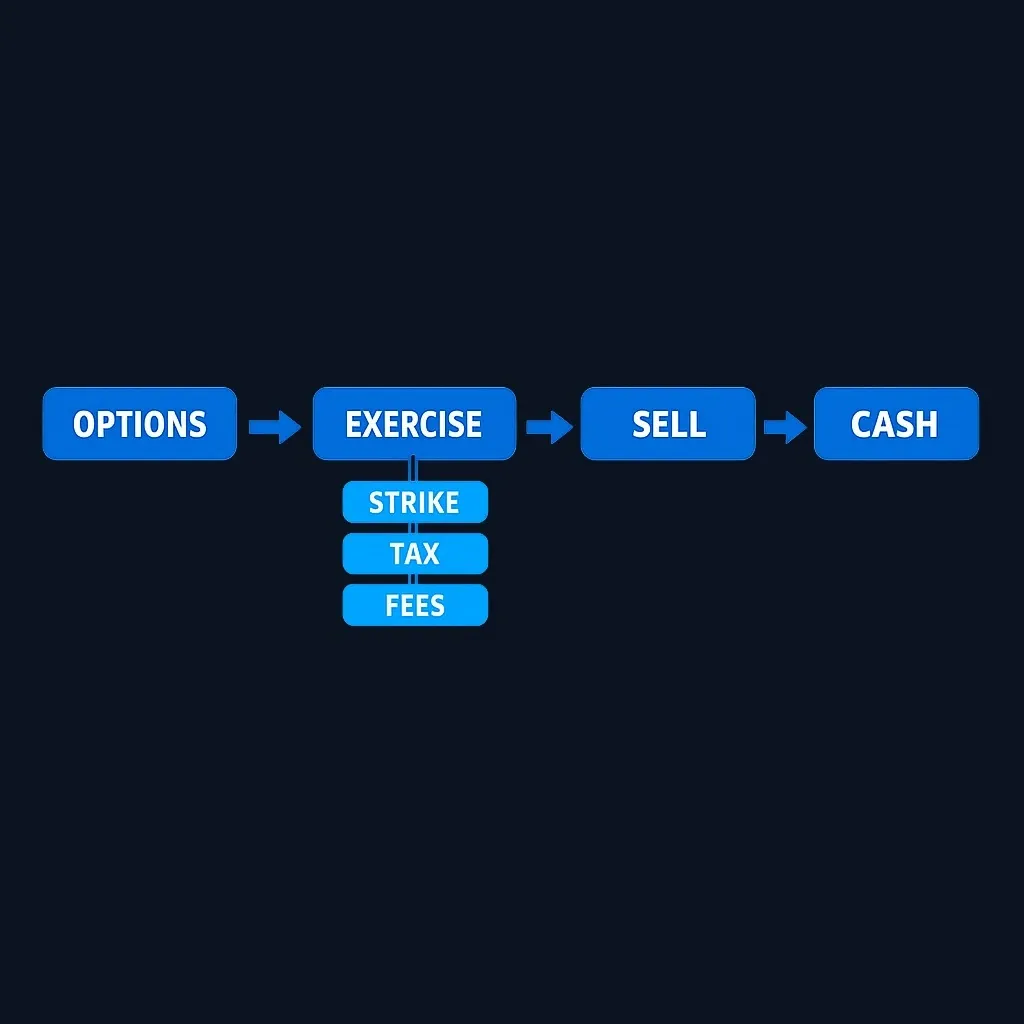
A cashless exercise converts option rights into cash without you supplying the strike price up front. In practice, you exercise the option into shares, and a broker or plan administrator immediately sells some or all of those shares. Proceeds from the sale pay the strike price and commonly cover withholding for taxes and transaction costs; any remaining proceeds are paid to you Charles Schwab.
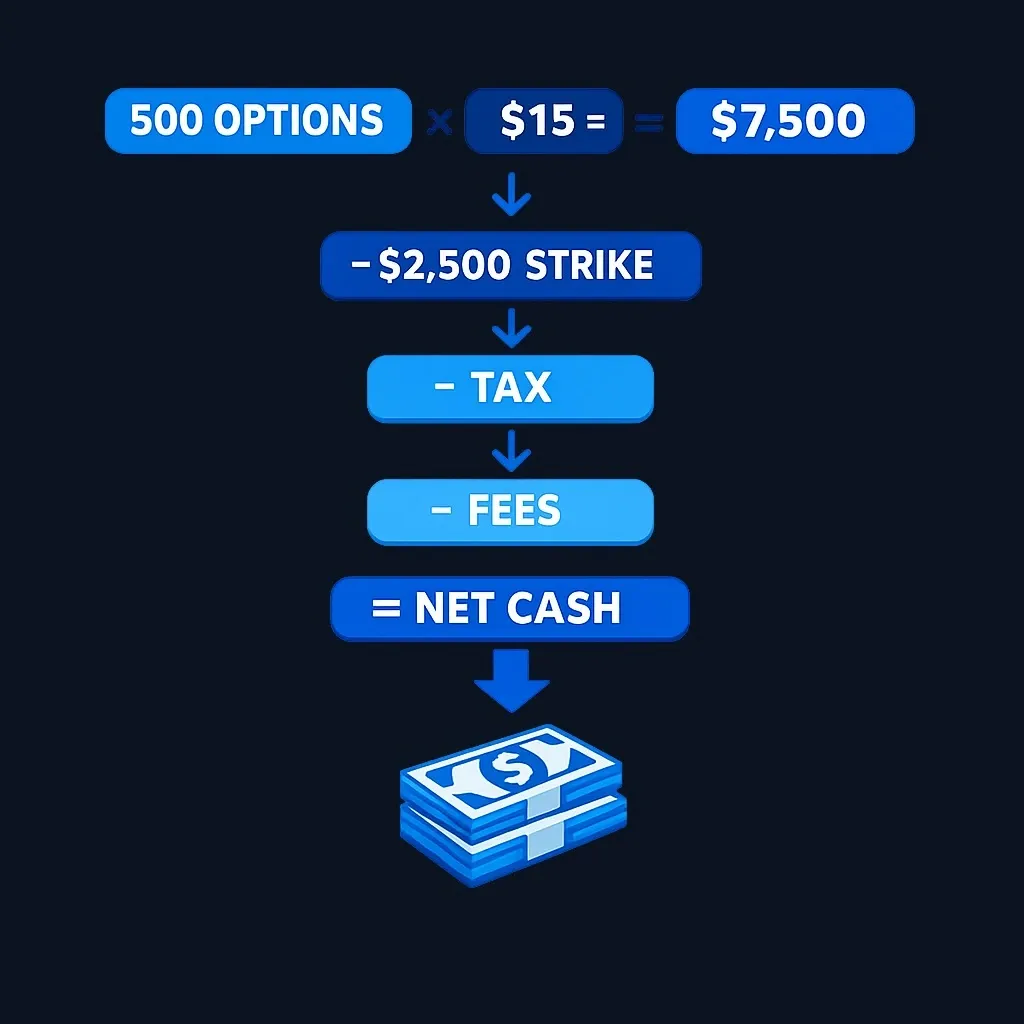
Example (illustrative): you hold 500 options with a $5 strike and the market price is $15. If you exercise and sell immediately, the sale proceeds fund the $2,500 strike cost and can cover taxes and fees, leaving you the net difference. Exact net proceeds depend on sale price, withholding, and fees.
How the broker/plan typically handles it
- You submit an instruction to “exercise & sell” or “sell to cover.”
- The broker executes the exercise, sells shares, and applies proceeds to costs and withholding.
- You receive any remaining cash after settlement and fees Charles Schwab.
Benefits of Cashless Exercise
Cashless exercises are popular because they remove the need for up-front cash and simplify converting option value to spendable money.
- No out-of-pocket funding required: the sale proceeds pay the strike price and often tax withholding Charles Schwab.
- Immediate liquidity: you realize the option spread as cash at once, which is useful if you need funds for major expenses or taxes.
- Simpler execution: a single bundled transaction reduces coordination between paying for exercise and later selling shares.
Worked example (illustrative): you have 1,000 options, strike $8, market $20. A cashless exercise sells shares at $20 to cover the $8,000 strike, taxes, and fees, giving you immediate net proceeds without borrowing or using savings.
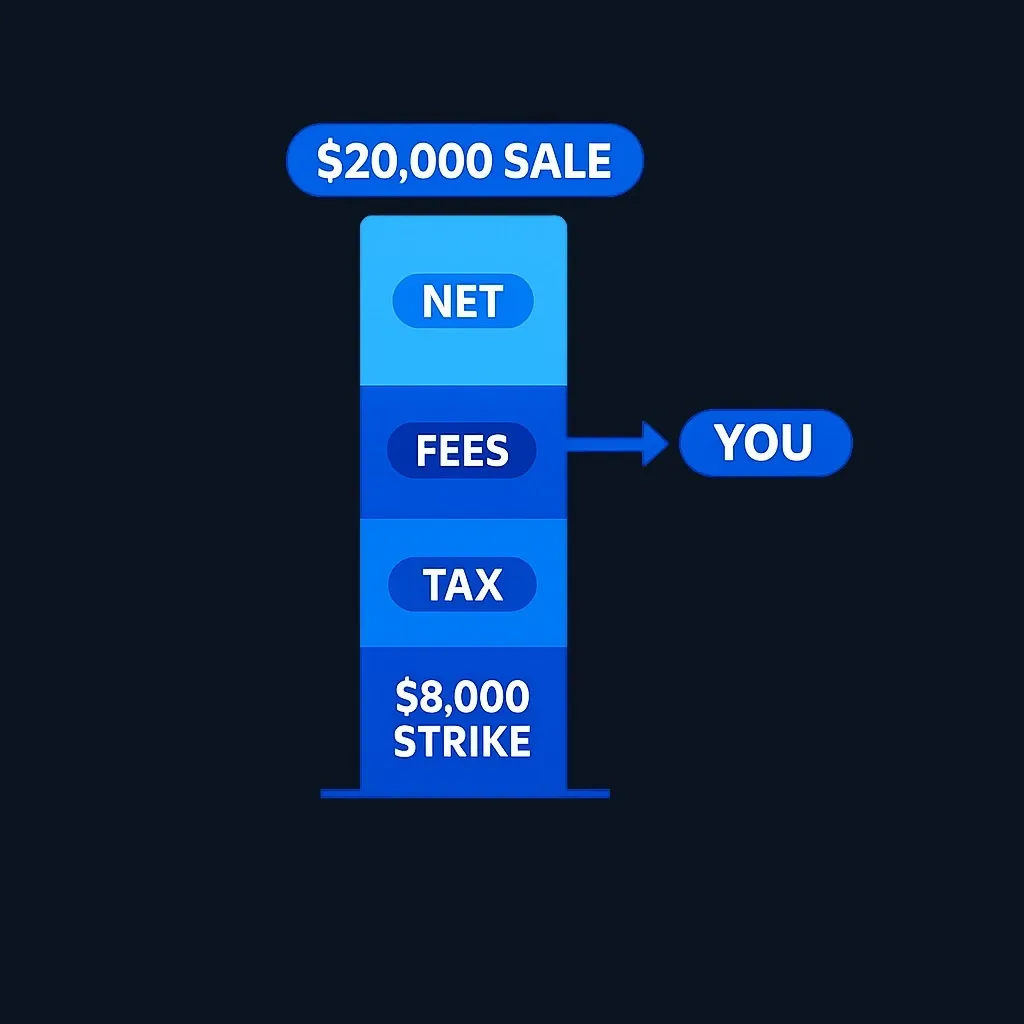
A cashless exercise can reduce the outside cash needed to exercise, but it also creates an immediate sale and may reduce future exposure. Confirm available methods, execution price, fees, withholding assumptions, and tax reporting before comparing net proceeds.
Risks and Tax Implications
This combined section summarizes the main downsides and immediate tax consequences to consider; it includes this educational note: this is educational content, not tax or investment advice.
- Loss of future upside: selling immediately surrenders any later gains. If the stock rises after your sale, you won’t participate.
- Tax and reporting consequences: the timing, character, and amount of income depend on whether the option is nonstatutory or statutory, when it is exercised, and when the shares are sold (IRS Topic 427, IRS Publication 525).
- Reduced after-tax proceeds: estimated withholding and broker fees reduce net cash received. A sell-to-cover instruction can fund withholding required by the employer or plan, but the amount withheld may be more or less than the participant's eventual federal, state, and local tax liability.
- Timing and market risk at execution: you may receive less or more depending on the sale price at the moment of execution.
For a typical nonstatutory option without a readily determinable value at grant, the spread at exercise is generally compensation income; a later sale can create a separate capital gain or loss. A statutory ISO generally does not create regular gross income at exercise, but the spread can be an alternative-minimum-tax adjustment when shares are retained. Disposing of ISO shares in the exercise year can change that result, and the sale's timing affects whether the disposition receives statutory treatment (IRS Publication 525). Confirm the grant type, basis, reporting forms, and transaction dates rather than applying one rule to every option.
Practical tax-risk checklist
- Identify your option type (NQSO vs ISO) and confirm special holding-period rules.
- Estimate withholding and net proceeds before executing.
- Ask the plan administrator whether the broker will withhold or require you to certify estimated taxes.
Cite plan documents and a tax professional for jurisdictional specifics before acting.
Comparing Cashless and Traditional Exercises
This table highlights key trade-offs in compressed form. Where a claim refers to the mechanics of “exercise & sell” or “sell to cover,” it is grounded in broker-handled exercises Charles Schwab.
| Consideration | Cashless exercise (exercise & sell / sell to cover) | Traditional exercise (exercise & hold) |
|---|---|---|
| Up‑front cash required | No — sale proceeds generally fund the strike and often taxes/fees Charles Schwab | Yes — you must pay strike price to acquire shares |
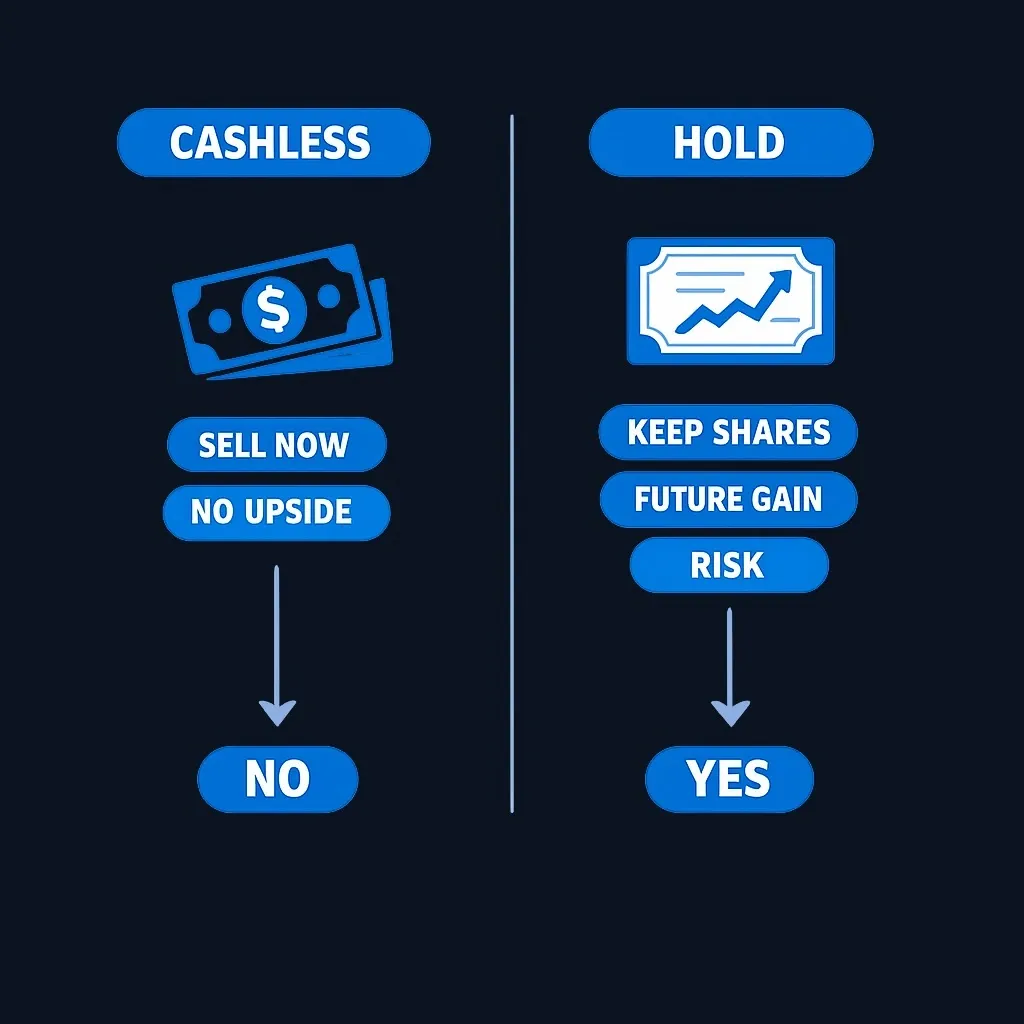
| Liquidity at execution | Immediate — you receive cash after sale | No — you hold shares and must sell later |
| Future upside | You give up post‑sale upside | You retain upside if price rises after exercise |
| Tax timing | Exercise and sale can create compensation income, AMT adjustments, capital gain or loss, and withholding depending on option type and timing (IRS Topic 427) | Exercise and later sale can create different regular-tax and AMT outcomes; holding shares does not guarantee favorable treatment |
| Complexity | Often one bundled transaction with broker handling | Requires funding and separate decisions about selling |
| Use case | May fit a participant who prioritizes liquidity or cannot fund the strike from other cash | May fit a participant willing to fund the exercise and accept concentration, price, and tax risk |
Decision highlight: compare the available plan methods rather than treating either as a default. A cashless method reduces the external cash needed but sells shares immediately; an exercise-and-hold method preserves exposure while adding funding, concentration, price, and potentially AMT risk.
Practice investing with Finelo
Build practical investing skills with guided lessons, simulator practice, and structured challenges.
What to know before deciding
This section gives the concrete items to confirm before executing any exercise method.
- Confirm plan rules and broker options. Some plans offer “sell to cover” (sell just enough) and “exercise & sell all” (sell all exercised shares). Ask your plan administrator which choices the platform supports.
- Estimate net proceeds with a worksheet: number of options × assumed sale price − strike cost − estimated taxes − fees = net cash. (A simple spreadsheet is sufficient.)
- Check withholding behavior and whether the broker or employer remits an estimated amount. Do not treat withholding as proof that the final liability is fully paid.
- Be aware of blackout windows, market‑sell restrictions, or transfer limits that may affect timing. Ask your administrator about settlement times and any blackout periods around company events.
- Consider your exposure and goals. If preserving company upside or achieving long‑term capital gains treatment matters, evaluate whether you can fund exercise without selling.
Example checklist item to send to your administrator: “Please confirm whether my account supports ‘exercise & sell’ and ‘sell to cover,’ the estimated per‑share fees, and the broker’s tax‑withholding policy.”
Decision framework
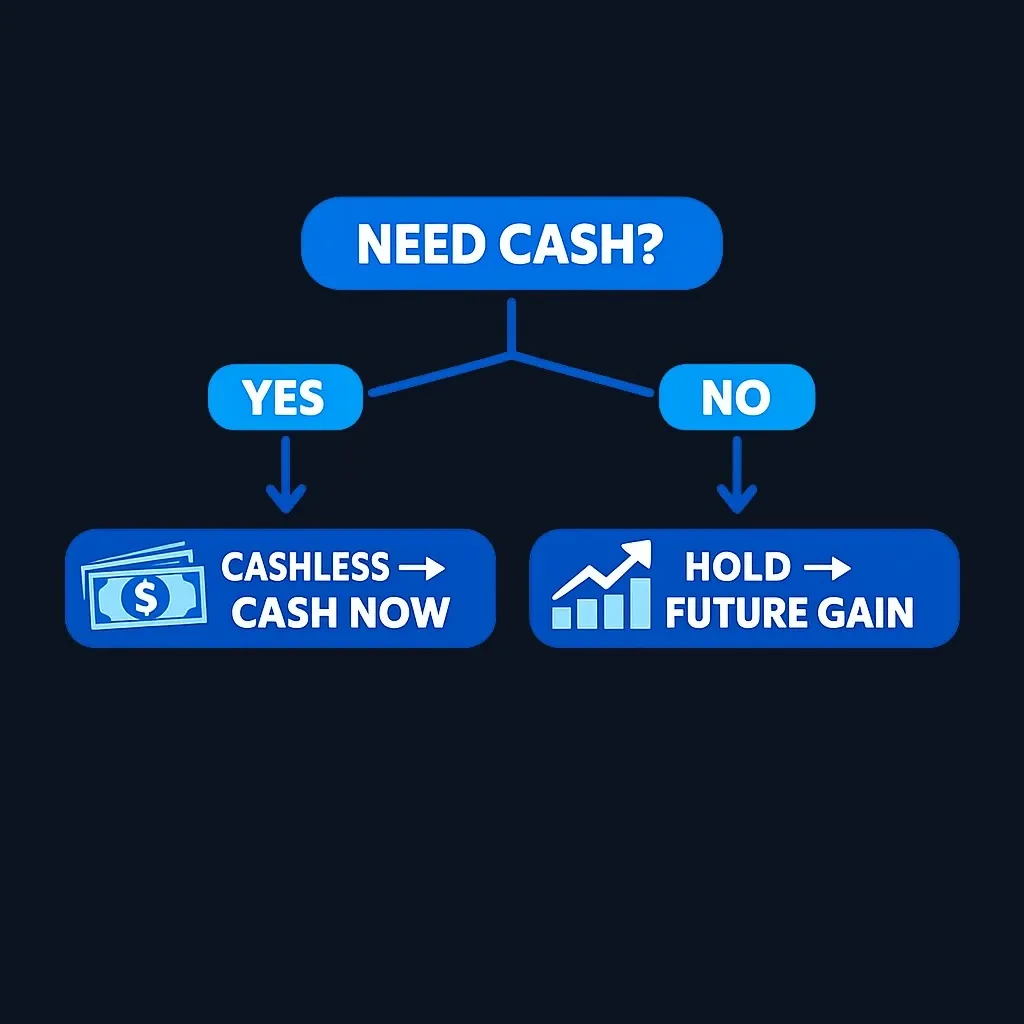
A concise flow and checklist to choose which method fits your objectives.
Quick checklist
- Do you need cash now?
- If yes, compare cashless exercise with other permitted liquidity choices.
- If no, compare immediate sale with the risks and funding needs of holding shares.
- Can you afford to fund the strike out of pocket without undue leverage?
- Yes → consider exercising and holding to pursue long‑term gains.
- No → cashless avoids borrowing.
- Are you optimizing for tax treatment (long‑term capital gains)?
- If yes, compare holding timelines with a tax advisor before selling.
- Does your plan support the method you prefer?
- If no, you may need to use the available option or request an exception.
Step-by-step flow
- Confirm option type (NQSO vs ISO) and vesting status.
- Check plan/broker choices, fees, withholding, blackout rules.
- Run two scenarios in a spreadsheet: cashless net proceeds vs. exercise-and-hold projected after-tax value given assumed future prices.
- Weigh liquidity needs, tax timing, and belief about future share performance.
- If uncertain on tax consequences, consult a tax advisor before executing.
Example scenario: you need down‑payment funds and cannot or do not want to borrow. A cashless exercise converts part of your option spread into cash immediately. If instead you can cover the strike and want to wait for potential long‑term gains, exercising and holding may align better with that goal.
FAQ
What is a cashless exercise?
A cashless exercise is when you exercise stock options and immediately sell shares so you don’t pay the strike price from your own cash; brokers often offer “exercise & sell” or “sell to cover” to handle this in one step Charles Schwab.
How does a cashless exercise work?
You exercise the option into shares and the broker sells enough shares to cover the strike price and commonly taxes and fees; any remaining proceeds are delivered to you. The broker handles settlement and remittance Charles Schwab.
How do taxes work with a cashless exercise?
The result depends on whether the option is nonstatutory or statutory, the spread at exercise, the sale timing, basis reporting, and the participant's jurisdiction. Nonstatutory-option exercise income is generally compensation under the applicable rules; an ISO can instead create an AMT adjustment, subject to disposition timing and other conditions (IRS Topic 427, IRS Publication 525). Withholding is only a prepayment, not a final determination of liability.
Can I choose how many shares to sell?
That depends on your plan and broker. Some platforms provide “sell to cover” (sell just enough) and “sell all” options. Confirm available execution types with your plan administrator.
If you want a ready spreadsheet to compare cashless vs hold outcomes, list: number of options, strike price, assumed sale price, fees, estimated withholding, and compute net proceeds. That simple model helps reveal the trade‑offs before you act.
Sources and Further Verification
More from Finelo
- Early Exercise of Stock Options: Taxes, Costs, Risks, and When It May Fit
- Stock Options vs. RSUs: Key Differences
- Best Stock Market Movies for Beginners in 2026
Disclaimer
This article is provided by Finelo for educational and informational purposes only. Finelo does not provide financial, investment, tax, legal, or insurance advice. Consider your circumstances and consult an appropriately qualified professional before making financial decisions.
InvestingBeginner GuideFinancial Education
Practice investing with Finelo
Build practical investing skills with guided lessons, simulator practice, and structured challenges.
About the author
Finelo Team
The Finelo Team creates practical investing and trading education designed to help beginners learn faster with structured challenges, simulator practice, and bite-sized lessons.
Keep reading — Related articles

Investing
Yield to Call vs Yield to Maturity: Assumptions and Bond Risks
Yield to call (YTC) estimates a bond's yield if the issuer redeems it on an eligible call date; yield to maturity (YTM) estimates yield if it remains outstanding to final maturity.
Finelo Team
Investing
Will My Employer Know If I Take a 401(k) Loan?
Who this page is for: readers new to 401(k) loans who want a practical, privacy‑focused explanation — what your employer can see, how to limit visibility, and the financial tradeoffs to weigh.
Finelo Team
Investing
What Medical Expenses Qualify for a 401(k) Hardship Withdrawal?
Before you decide, confirm three things with your plan administrator:
Finelo Team