Last editorial review: September 8, 2026
Coast FIRE vs. Barista FIRE: Savings Targets, Work, and Trade-Offs
In a coast fire vs barista fire comparison, Coast FIRE focuses on front-loading retirement savings and continuing to work, while Barista FIRE relies on ongoing part-time income to reduce…
18 min read
Practice investing with Finelo
Build practical investing skills with guided lessons, simulator practice, and structured challenges.
Want to learn more?
Build practical investing skills with guided lessons, simulator practice, and structured challenges.
Explore FineloExplore Finelo's 28-day challenges
Turn learning into a daily habit with guided challenge paths.
U.S. scope: This article discusses U.S. institutions, financial products, tax rules, and dollar examples unless stated otherwise. Rules and product terms may change; verify current official guidance for your situation.
In a coast fire vs barista fire comparison, Coast FIRE focuses on front-loading retirement savings and continuing to work, while Barista FIRE relies on ongoing part-time income to reduce portfolio withdrawals.
Coast FIRE means saving enough early that your investments may grow toward a future retirement goal with limited added contributions. Barista FIRE means partial retirement supported by part-time work, consulting, or a side hustle that may cover expenses, provide benefits, or reduce withdrawals from savings, according to Charles Schwab’s FIRE overview (Charles Schwab). Choose Coast FIRE if you can front-load savings and keep working. Consider Barista FIRE if you want to leave full-time work sooner and can support the gap with reliable earned income.
This comparison is educational, not financial or investment advice. Investing can involve loss, and each path depends on assumptions about work, spending, markets, taxes, and health coverage.
Quick comparison answer
Coast FIRE and Barista FIRE both sit inside the broader Financial Independence, Retire Early movement, which focuses on building resources to reduce dependence on full-time work (Charles Schwab). The difference is the main lever.
With Coast FIRE, the lever is early capital. You build a large enough portfolio now, then let it compound toward your later retirement target with limited additional contributions (Charles Schwab). You may still work for many years, but retirement saving becomes less urgent.
With Barista FIRE, the lever is ongoing income. You leave full-time work earlier, then use part-time work, consulting, or side income to help cover expenses and reduce withdrawals from savings (Charles Schwab). You gain lifestyle flexibility sooner, but you depend more on continued work availability.
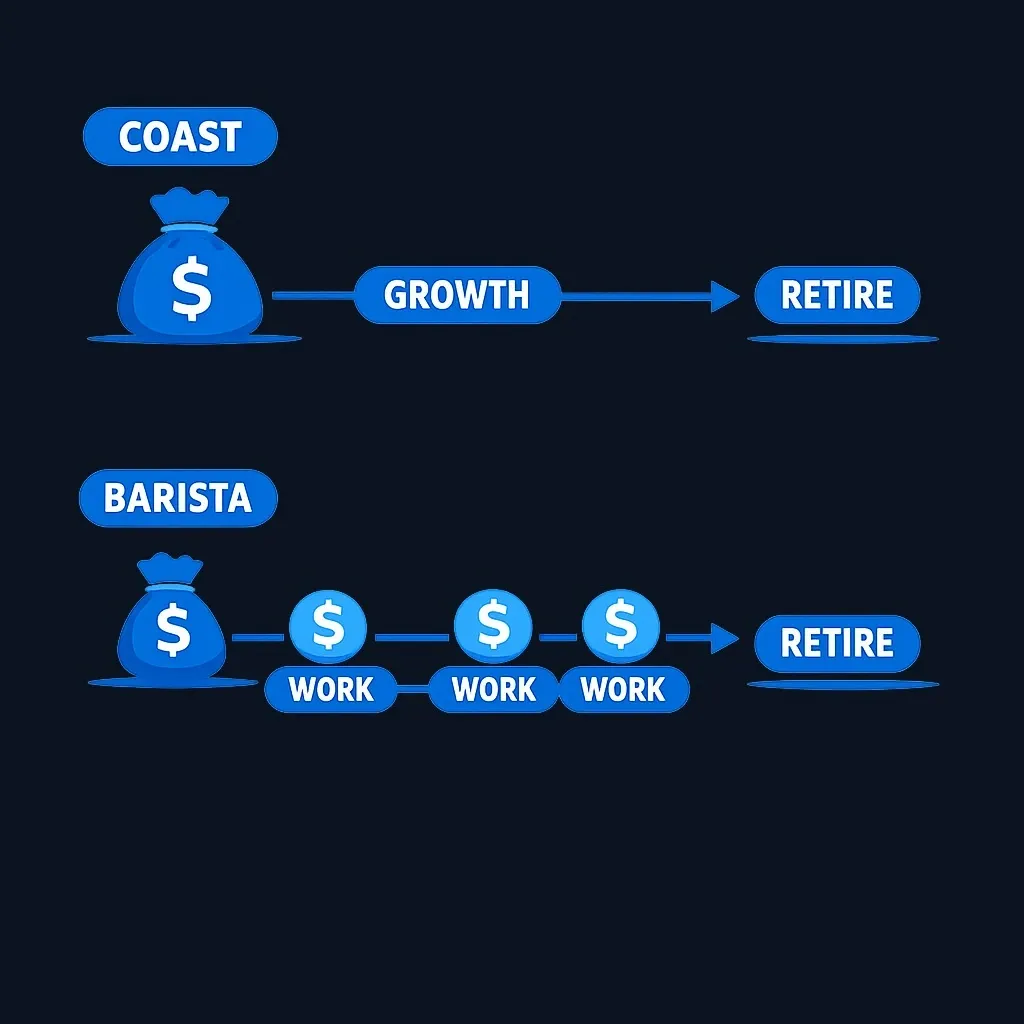
The best answer to “Coast FIRE vs. Barista FIRE” is not that one is universally better. Coast FIRE fits people who want lower saving pressure later. Barista FIRE fits people who want lower work intensity sooner.
How Coast FIRE and Barista FIRE work
FIRE stands for Financial Independence, Retire Early. The core idea is to build enough financial resources to gain more control over work, spending, and retirement timing. Schwab describes FIRE as a movement with different approaches, including Barista FIRE and Coast FIRE (Charles Schwab).
Coast FIRE and Barista FIRE are useful because they avoid the all-or-nothing framing of traditional early retirement. You do not have to choose between full-time work forever and never working again. Instead, each strategy changes one side of the equation.
Coast FIRE changes the savings timeline. Barista FIRE changes the work timeline. That single distinction affects your portfolio target, job choices, stress level, health coverage planning, and margin for error.
What is Coast FIRE?
Coast FIRE means you have saved enough early that your invested assets may continue growing toward a future retirement goal with limited added contributions (Charles Schwab). You are not necessarily retired when you reach Coast FIRE. You are saying, “If my assumptions hold, this portfolio can do much of the remaining retirement work.”
That makes Coast FIRE attractive to people who can save aggressively early. It can also suit people who like their career but want freedom from constant retirement contributions. After reaching the coast number, they may redirect cash flow toward family, travel, debt repayment, caregiving, education, or lower-paying work.
The main trade-off is patience. Coast FIRE usually keeps paid work in the picture for longer. You may feel financially relieved, but you still need income for current expenses until full retirement.
How to calculate a Coast FIRE target
A simple Coast FIRE calculation asks one question: what amount do you need today to grow into your future retirement target?
Use this formula:
Coast FIRE number = future retirement target ÷ (1 + assumed annual return) ^ years until retirement
Here is an illustrative example, not a recommendation:
- Future retirement target:
$1,000,000 - Years until planned retirement:
25 - Assumed annual return:
5% - Calculation:
$1,000,000 ÷ (1.05 ^ 25) - Approximate Coast FIRE number:
$295,000
Under those assumptions, a person with about $295,000 invested could be “coasting” toward a $1,000,000 target. If the assumed return falls, the required starting amount rises. If the time horizon shortens, the required starting amount also rises.
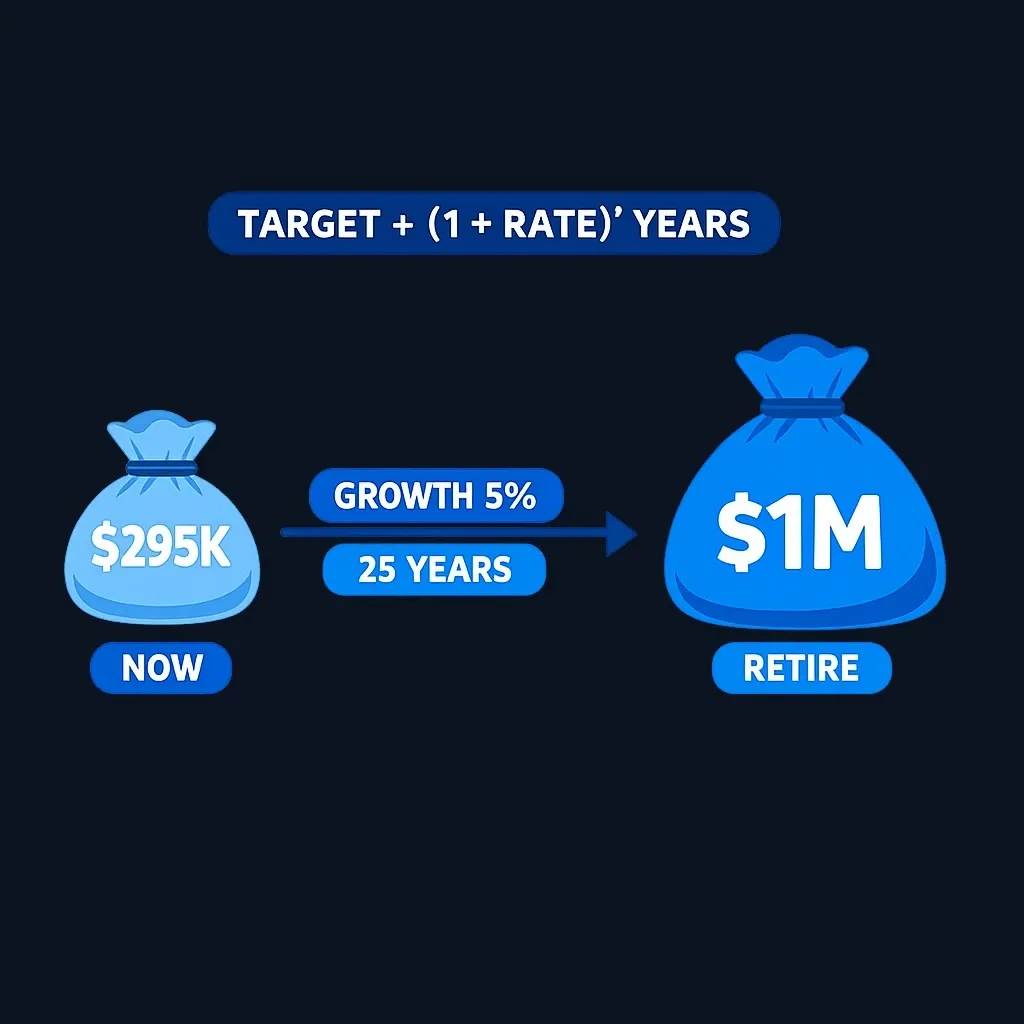
The calculation is clean, but the assumptions are not guaranteed. Revisit the number when markets move, expenses change, or your retirement date shifts.
Coast FIRE example: Maya keeps her career but changes the pressure
Maya is a composite example. She has a strong savings period in her early career and reaches her Coast FIRE number before she wants to stop working. Instead of increasing lifestyle spending immediately, she keeps enough income to cover living costs and stops treating retirement contributions as the top priority.
Her daily life does not look retired. She still works and still manages job stress. The benefit is that every future career decision no longer depends only on maximizing retirement savings.
If Maya’s industry weakens or investment returns disappoint, she may need to contribute again. Coast FIRE is flexible, but it is not a permanent permission slip to ignore the plan.
What is Barista FIRE?
Barista FIRE combines partial retirement with part-time work, consulting, or a side hustle. Schwab notes that the additional income may help cover expenses, provide benefits, or reduce the amount withdrawn from savings (Charles Schwab).
This path appeals to people who want to leave a demanding full-time career earlier. They may still want work, income, structure, or social connection. They just do not want the same hours, pressure, commute, or corporate track.
Barista FIRE usually requires more active cash-flow planning than Coast FIRE. You need to estimate living expenses, expected earned income, benefit changes, taxes, and portfolio withdrawals. The plan can work well when part-time income is realistic, but it becomes fragile when income is irregular.
How to estimate a Barista FIRE gap
A basic Barista FIRE calculation starts with annual spending and subtracts expected earned income.
Use this formula:
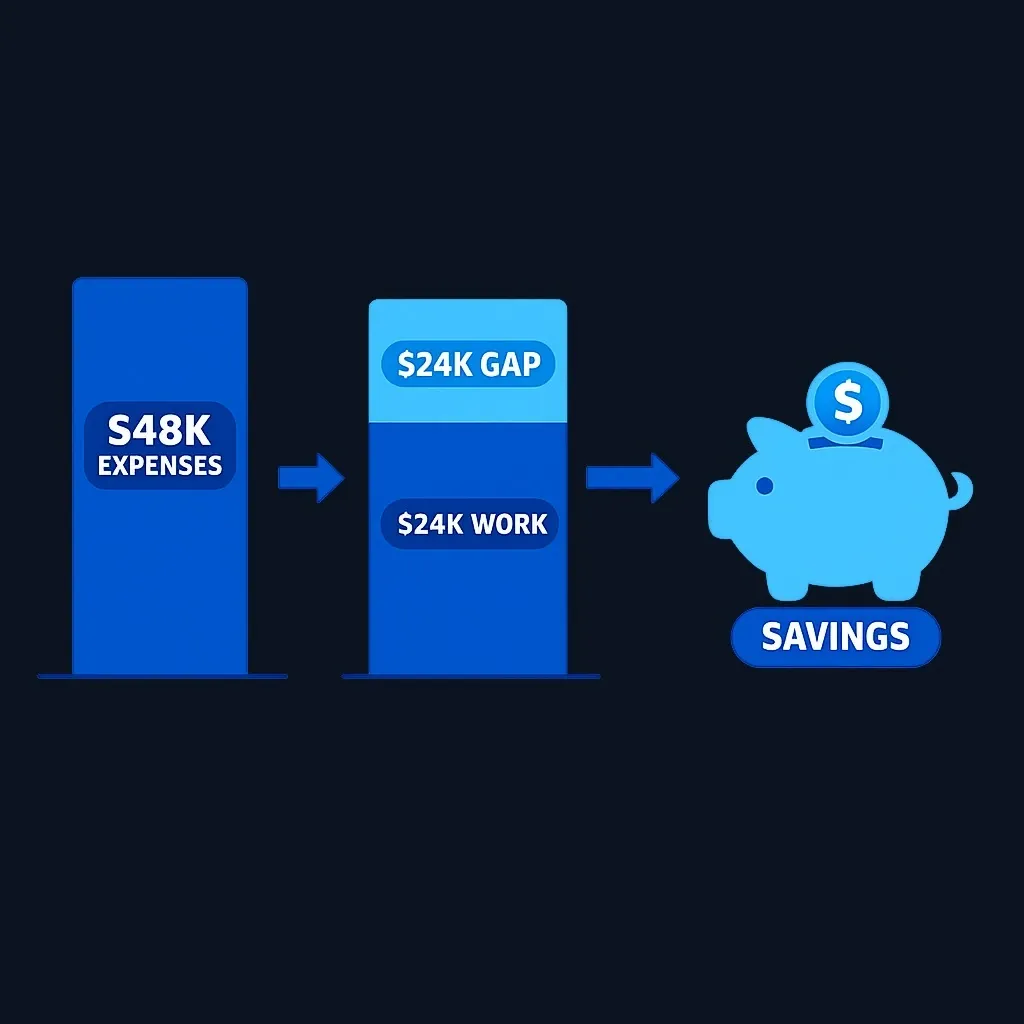
Annual portfolio gap = annual expenses − annual part-time income
Here is an illustrative example:
- Annual living expenses:
$48,000 - Expected part-time income:
$24,000 - Annual portfolio gap:
$24,000
In this example, part-time work covers half of annual spending. The remaining $24,000 must come from savings, investments, cash reserves, a partner’s income, or another source.
You can then stress-test the plan:
- What if part-time income drops by one-third?
- What if health coverage costs rise?
- What if the work becomes unavailable?
- What if you want to stop part-time work earlier than planned?
That stress test matters because Barista FIRE depends on both markets and labor income.
Barista FIRE example: Jordan leaves full-time work but keeps income
Jordan is a composite example. He leaves a high-stress full-time role and replaces part of his income with freelance work. His spending drops because he no longer commutes as much, but his income also becomes less predictable.
The upside is immediate lifestyle relief. Jordan controls more of his time and can test semi-retirement before committing to full retirement.
The downside is operational. He must track cash flow closely, keep a larger buffer, and plan around benefit gaps. If freelance work slows, he may need to work more, spend less, or draw more from savings.
Side-by-side comparison table
| Decision point | Coast FIRE | Barista FIRE |
|---|---|---|
| Core idea | Save enough early so investments may grow toward a future retirement goal with limited added contributions (Charles Schwab) | Use part-time work, consulting, or a side hustle during partial retirement (Charles Schwab) |
| Main lever | Early savings and time in the market | Ongoing earned income after leaving full-time work |
| Work pattern | Often keeps full-time or steady work while reducing saving pressure | Reduces or leaves full-time work sooner |
| Portfolio pressure | Higher early savings target | Lower initial pressure, but withdrawals may start earlier |
| Lifestyle change | Usually gradual | Usually immediate |
| Key dependency | Long-term investment growth assumptions | Part-time income, benefits, and cash-flow stability |
| Main benefit | Less need for future retirement contributions | More control over time sooner |
| Main risk | False confidence from optimistic assumptions | Income instability and benefit gaps |
| Better fit when | You can front-load savings and tolerate more years of work | You want semi-retirement sooner and can earn reliably part time |
The table shows the central trade-off. Coast FIRE gives your portfolio more time to work before withdrawals. Barista FIRE gives you more time freedom earlier, but your plan depends on continued earned income.
Key differences between Coast FIRE and Barista FIRE
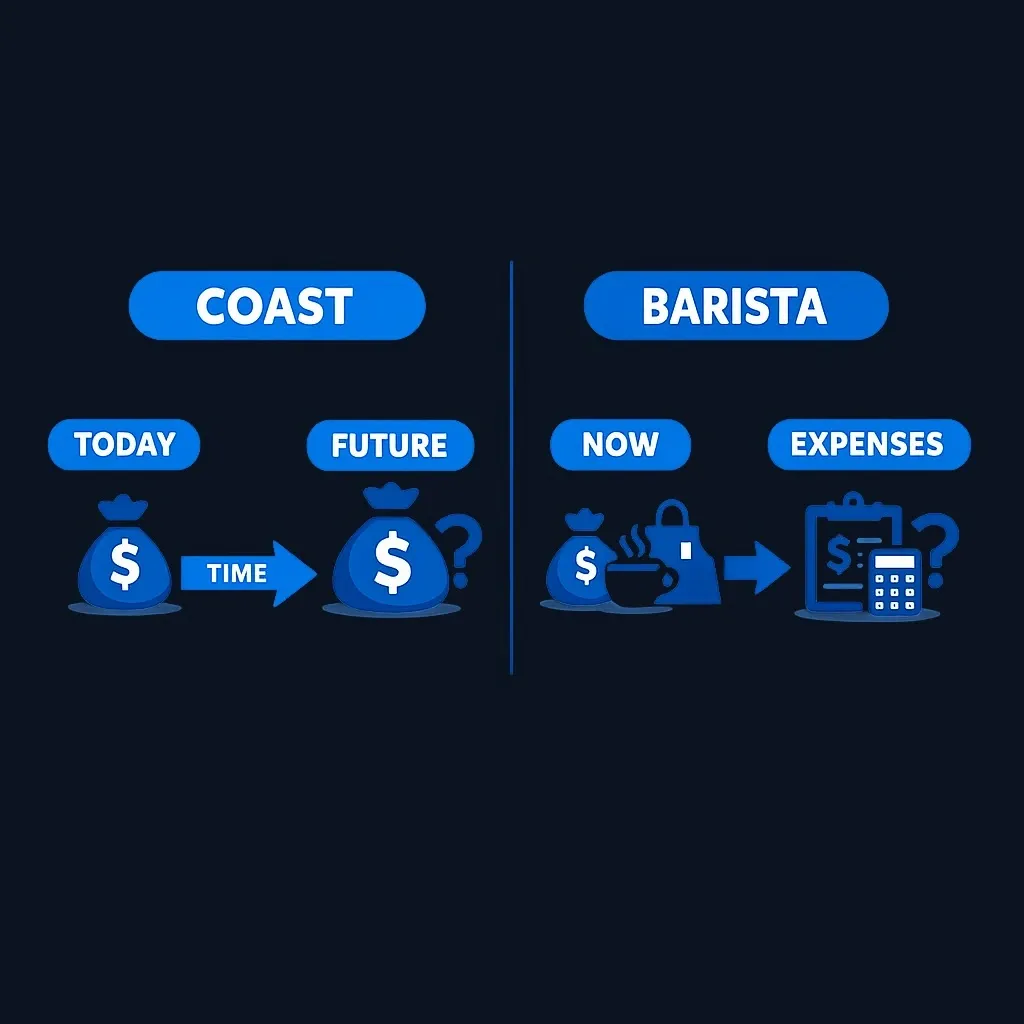
The biggest difference is what changes first. With Coast FIRE, your financial behavior changes first because you reduce or stop retirement contributions. With Barista FIRE, your work life changes first because you move away from full-time employment.
Coast FIRE generally keeps current income more stable for longer. That can make it easier to handle rent, mortgage payments, family expenses, and insurance premiums. The emotional benefit is knowing your future retirement goal may already be funded under your assumptions.
Barista FIRE changes the present more dramatically. You may get back time, reduce stress, or relocate to a cheaper area. In exchange, you must replace part of your paycheck and manage a more complex income mix.
The investment math also differs. Coast FIRE asks, “Can my current balance grow into my future target?” Barista FIRE asks, “Can my reduced income and current assets support my spending now?”
Geography can change the answer. A lower-cost area may make Barista FIRE easier because part-time income covers more expenses. A higher-cost area may favor Coast FIRE if leaving full-time work creates too large a monthly gap.
Benefits also matter. Schwab notes that Barista FIRE income may help provide benefits or reduce withdrawals (Charles Schwab). In practice, you need to verify what any specific job actually offers before counting on it.
Pros and cons of Coast FIRE
Coast FIRE’s biggest benefit is reduced future savings pressure. Once you reach the coast number, you may have more room in your budget. That can make your working years feel less constrained.
It also gives you a clear planning checkpoint. Instead of asking whether you are fully financially independent, you ask whether your current portfolio can plausibly grow into your future target. That makes Coast FIRE easier to model than many lifestyle-based FIRE variations.
Another benefit is career optionality. You might stay in the same role, move to a lower-paying job, take a sabbatical, or fund other goals. The strategy does not require you to stop working immediately.
The first drawback is that Coast FIRE requires a meaningful early balance. If you start later, have volatile income, or face high living costs, the coast number may feel hard to reach. The shorter your time horizon, the more demanding the target becomes.
The second drawback is assumption risk. A Coast FIRE calculation can look precise while relying on uncertain returns, inflation, spending, and retirement timing. A small change in inputs can create a large change in the required balance.
The third drawback is lifestyle mismatch. If you dislike your work, Coast FIRE may not solve the real problem. You may have a stronger balance sheet while still spending years in a role that drains you.
A useful fix is to treat Coast FIRE as a dashboard, not a finish line. Recalculate annually, test lower-return scenarios, and define what would make you restart contributions.
Pros and cons of Barista FIRE
Barista FIRE’s biggest benefit is earlier lifestyle change. You can reduce hours, change environments, or leave a high-pressure career before reaching full financial independence. For some people, that time freedom is the point.
It can also make retirement less binary. You keep earning, stay active, and test a lower-work life before fully exiting the workforce. Schwab describes Barista FIRE as partial retirement supported by part-time work, consulting, or a side hustle (Charles Schwab).
Another benefit is reduced portfolio strain compared with funding all expenses from savings. If earned income covers part of your spending, you may withdraw less from investments. That can create a smoother bridge between full-time work and full retirement.
The first drawback is income risk. Part-time work can change, disappear, or pay less than expected. Consulting income can also arrive unevenly, which makes budgeting harder.
The second drawback is benefits risk. If your full-time job provided important benefits, leaving it can change your total cost picture. Count the full value of lost benefits, not only the lost salary.
The third drawback is tax and administrative complexity. Multiple income sources can require more tracking, withholding, estimated payments, or recordkeeping. Rules vary by location and account type, so verify details before relying on after-tax estimates.
A practical fix is to run a “bad year” budget. Model lower part-time income, higher expenses, and no bonus income. If the plan only works in a perfect year, it needs a wider margin.
Practice investing with Finelo
Build practical investing skills with guided lessons, simulator practice, and structured challenges.
Decision criteria
Choosing between Coast FIRE and Barista FIRE starts with five questions. These criteria keep the decision tied to your life, not someone else’s spreadsheet.
1. Do you need relief now or later?
If your main problem is saving pressure, Coast FIRE may fit. It lets you keep income while easing future contribution demands. You still work, but the financial load may feel lighter.
If your main problem is work intensity, Barista FIRE may fit better. It targets time, stress, and schedule control sooner. The cost is more income uncertainty.
2. How reliable is your part-time income?
Barista FIRE needs believable income, not hopeful income. Ask whether your skills translate into steady freelance, consulting, seasonal, or part-time work. Also ask whether you would still want that work after the novelty fades.
Coast FIRE depends less on future side income. It depends more on your current balance, time horizon, and market assumptions.
3. How much margin do you have?
Both strategies need margin, but for different reasons. Coast FIRE needs margin because returns and inflation may disappoint. Barista FIRE needs margin because income and benefits may change.
A simple test is to create three versions of each plan: base case, conservative case, and stress case. If one strategy survives the stress case with fewer painful changes, it may better match your risk tolerance.
4. What does your location do to the math?
Cost of living can make one path far more realistic. A part-time income that works in one city may not cover basic expenses in another. Housing, transportation, healthcare access, and local job options all matter.
Remote work can help, but do not assume it will always be available. Build the plan around income sources you can reasonably maintain.
5. What will you do if the plan changes?
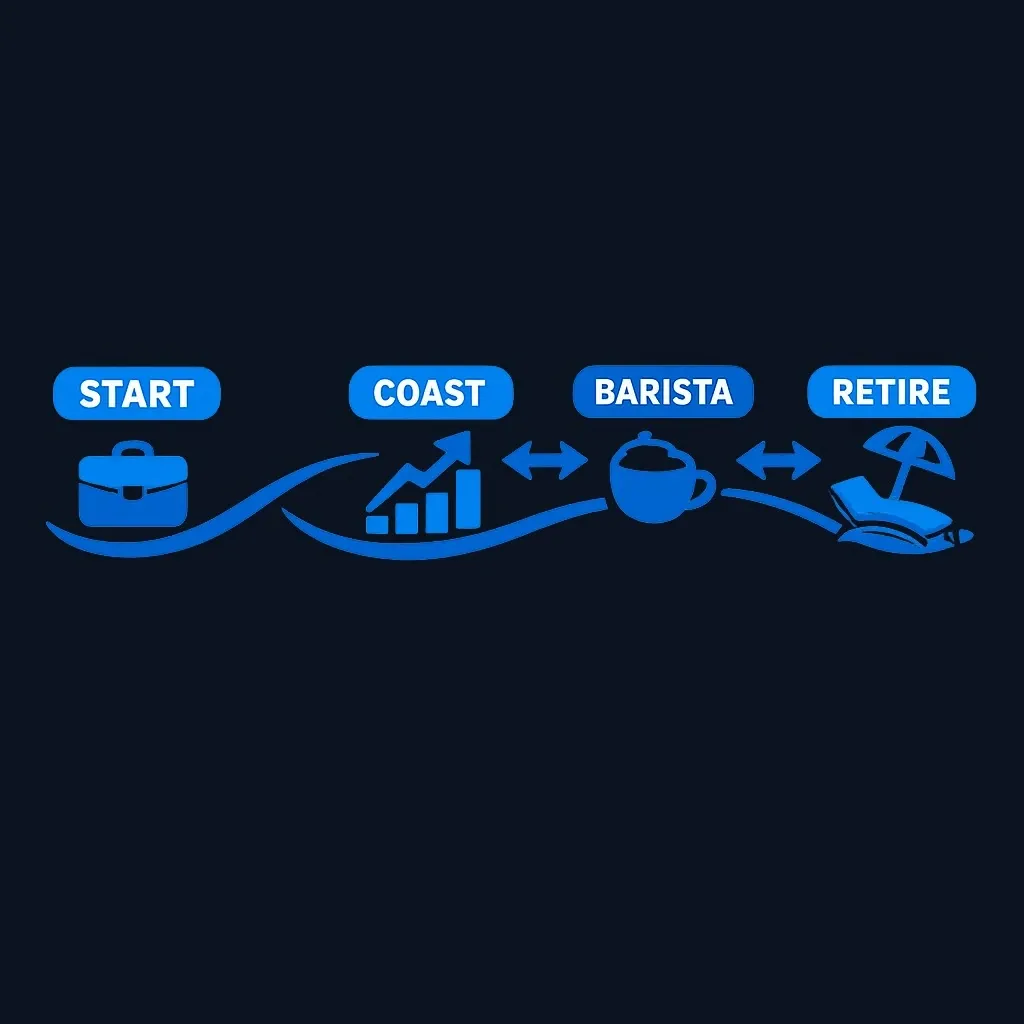
The ability to switch matters. Coast FIRE can become Barista FIRE if you later leave full-time work and use part-time income. Barista FIRE can become Coast FIRE if you return to higher income and let investments grow untouched.
Before choosing, define your reset triggers. Examples include a portfolio drop, job loss, health change, family change, or several months below target income.
When to choose each option
Choose Coast FIRE when you have a strong early savings base, a long enough horizon, and a tolerable work situation. It is especially useful if you want to reduce money pressure without leaving a career immediately. You may still pursue promotions or flexible work, but retirement contributions no longer drive every choice.
Coast FIRE can also fit people who value structure. Keeping a job can preserve routine, benefits, social connection, and predictable income. The strategy works best when staying employed feels acceptable, not like a sacrifice you resent.
Choose Barista FIRE when time freedom matters more than maximizing income. It may fit if you can reliably earn part-time income and keep spending flexible. It also suits people who want to test semi-retirement before committing fully.
Barista FIRE can be useful after burnout, caregiving changes, relocation, or a desire to build a small business. Still, it needs a real operating plan. A vague wish to “pick up work if needed” is not enough.
If both options appeal, compare the weakest part of each plan. For Coast FIRE, the weak point may be market assumptions or staying employed. For Barista FIRE, the weak point may be income stability or benefits.
Worked examples and composite case studies
Example 1: Coast FIRE calculation
Assume Priya wants a future retirement target of $1,200,000 in 20 years. She uses an assumed annual return of 5% for her planning scenario.
Her calculation is:
$1,200,000 ÷ (1.05 ^ 20) = about $452,000
If Priya has $452,000 invested, her plan suggests she may be at Coast FIRE under those assumptions. If she has $350,000, she has not reached that version of the target. She could keep contributing, extend the timeline, lower the target, or use a more conservative plan.
The real lesson is not the exact number. The lesson is sensitivity. Changing the return, target, or timeline changes the answer.
Example 2: Barista FIRE cash-flow gap
Assume Luis spends $54,000 per year. He expects part-time consulting income of $30,000 per year. His annual gap is:
$54,000 − $30,000 = $24,000
That $24,000 must come from savings, investments, or another source. If his consulting income falls to $20,000, the gap rises to $34,000. That is why Barista FIRE planning needs a downside scenario.
Luis can improve the plan by lowering fixed expenses, building a cash buffer, or delaying the transition. He can also test the consulting income before leaving full-time work.
Example 3: Switching paths
Sam starts with Coast FIRE because their job is manageable and income is high. After several years, their portfolio grows and their priorities change. They move into Barista FIRE by reducing hours and using consulting income to cover part of spending.
This sequence can work because the strategies are not locked boxes. They are planning modes. Your path can change when your health, family, work, or market environment changes.
Tradeoffs and caveats
The biggest caveat is that both strategies rely on projections. Coast FIRE projections rely heavily on investment growth over time. Barista FIRE projections rely heavily on earned income and manageable spending.
Neither path removes risk. Coast FIRE can fail if the portfolio underperforms, expenses rise, or the retirement date moves earlier. Barista FIRE can fail if part-time income disappears, benefits cost more, or withdrawals become too large.
A second caveat is that lifestyle labels can hide real costs. A lower-stress job may pay less, but it can still consume energy. A coast plan may look relaxed, but it can keep you tied to a job longer than expected.
A third caveat is that taxes and account access matter. Retirement accounts, taxable accounts, employment income, and local rules can interact in complex ways. Keep the tax side separate from the lifestyle story, and verify details before acting.
A final caveat is emotional. Coast FIRE can create impatience because you are “on track” but not free yet. Barista FIRE can create anxiety because your freedom depends on continued income.
The safest planning habit is not choosing the most exciting label. It is building a plan that still works when one assumption disappoints.
FAQ
What are the key differences between Coast FIRE and Barista FIRE?
Coast FIRE relies on saving enough early that investments may grow toward a future retirement goal with limited added contributions (Charles Schwab). Barista FIRE relies on part-time work, consulting, or side income during partial retirement (Charles Schwab).
How much money do I need for Coast FIRE?
You need the present amount that could grow into your future retirement target. A simple formula is: future target divided by (1 + assumed annual return) ^ years until retirement. Because the result depends on assumptions, calculate conservative and stress-case versions.
Can I switch from Coast FIRE to Barista FIRE later?
Yes, these are flexible planning approaches. Someone might reach Coast FIRE first, then later reduce work and use part-time income. Someone using Barista FIRE might also return to higher income and let investments coast.
What are the main risks of Coast FIRE and Barista FIRE?
Coast FIRE is most sensitive to investment returns, inflation, and time horizon. Barista FIRE is most sensitive to part-time income, benefits, expenses, and job availability. Both require regular review because life and markets can change.
Sources and Further Verification
More from Finelo
- 1031 Exchange vs. Opportunity Zone: Key Differences
- 83(b) Election: Deadlines, Tax Risks, and When Early Filing May Fit
- After-Tax 401(k) vs. Roth 401(k): Key Differences
Disclaimer
This article is provided by Finelo for educational and informational purposes only. Finelo does not provide financial, investment, tax, legal, or insurance advice. Consider your circumstances and consult an appropriately qualified professional before making financial decisions.
InvestingBeginner GuideFinancial Education
Practice investing with Finelo
Build practical investing skills with guided lessons, simulator practice, and structured challenges.
About the author
Finelo Team
The Finelo Team creates practical investing and trading education designed to help beginners learn faster with structured challenges, simulator practice, and bite-sized lessons.
Keep reading — Related articles
Investing
Yield to Call vs Yield to Maturity: Assumptions and Bond Risks
Yield to call (YTC) estimates a bond's yield if the issuer redeems it on an eligible call date; yield to maturity (YTM) estimates yield if it remains outstanding to final maturity.
Finelo Team
Investing
Will My Employer Know If I Take a 401(k) Loan?
Who this page is for: readers new to 401(k) loans who want a practical, privacy‑focused explanation — what your employer can see, how to limit visibility, and the financial tradeoffs to weigh.
Finelo Team
Investing
What Medical Expenses Qualify for a 401(k) Hardship Withdrawal?
Before you decide, confirm three things with your plan administrator:
Finelo Team