T+1 settlement means a securities trade becomes final one business day after the day you place it. The "T" is the trade date, the day your order executes, and the "+1" is the single business day the market needs to move the money and the shares to their new owners. Buy a stock on Tuesday and it settles Wednesday: your payment is due and the shares are legally yours. Sell on Tuesday and your cash is fully settled on Wednesday.
T+1 Settlement: Next-Day Settlement Explained for Investors
T+1 settlement means most US securities trades settle one business day after execution. Learn the timing, exceptions, and cash-account restrictions that affect when sale proceeds become settled funds.
9 min read
Practice trading with Finelo
Practice in a simulator, learn with bite-sized lessons, and build confidence before risking real money.
Want to learn more?
Practice in a simulator, learn with bite-sized lessons, and build confidence before risking real money.
Explore FineloExplore Finelo's 28-day challenges
Turn learning into a daily habit with guided challenge paths.
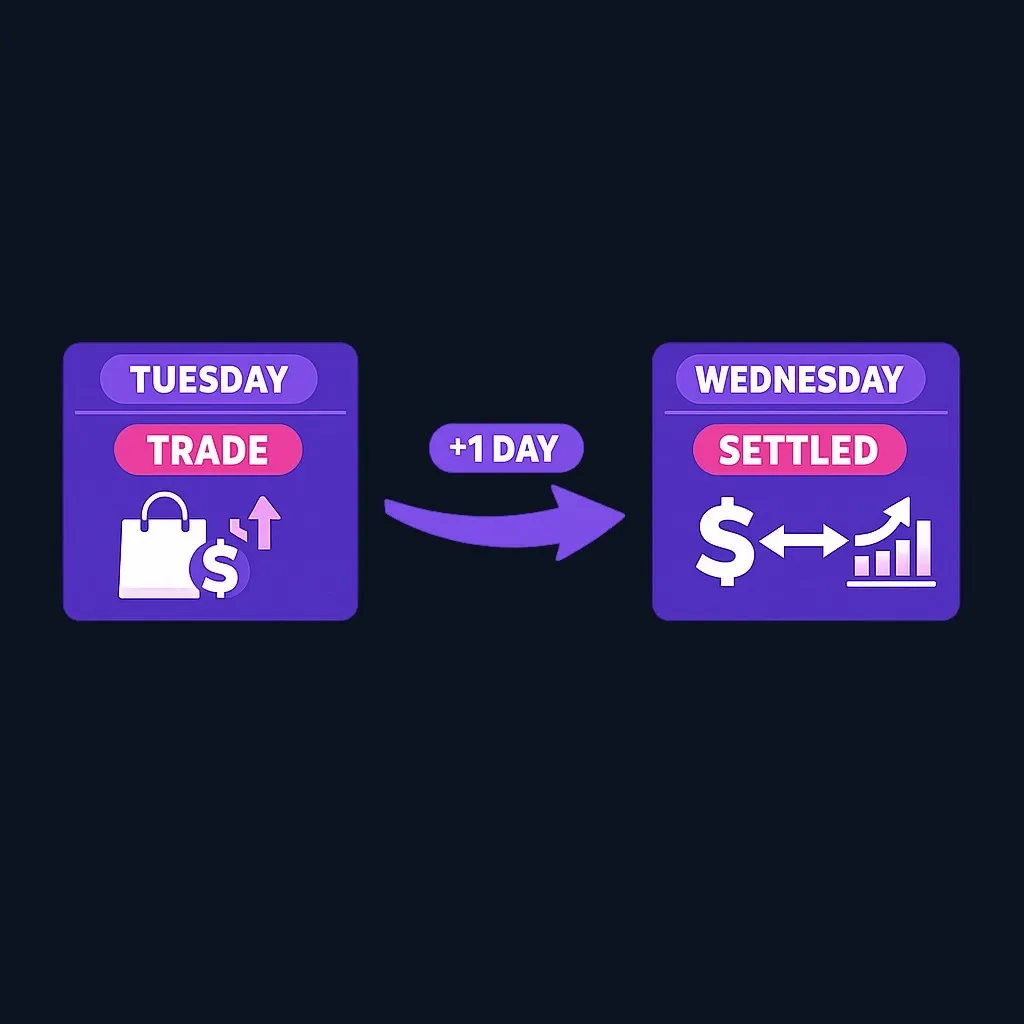
T+1 has been the US standard since May 28, 2024, when it replaced T+2, cutting a full business day out of nearly every stock, bond, and ETF trade.
For an everyday investor, settlement timing decides one very practical thing: the moment your money is truly yours to use again.
This guide covers what settlement is, what changed in 2024 and why, which securities are affected, and the part most explainers skip: what T+1 means for the cash in your own account. If the mechanics of orders and exchanges are still new, start with Finelo's guide to how the stock market works.
A trade sets your price; settlement is when the money and the shares actually change hands.
What settlement actually is
When you buy a share, three things have to happen. The trade executes, so price and quantity are locked. The money moves from buyer to seller. And ownership of the security transfers. The execution is effectively instant. The exchange of money and ownership is settlement, and it runs through market infrastructure, in the US the Depository Trust and Clearing Corporation (DTCC) and its subsidiaries, which net and finalize the flows between brokers behind the scenes.
That leaves two dates worth keeping straight:
- Trade date (T): the day your order fills. Your price is fixed here, and for many purposes, such as identifying the purchase or sale date for tax, this is the reference date; a stock holding period generally begins the next day.
- Settlement date: the day payment and delivery are final. Cash from a sale becomes settled, subject to any separate broker holds or withdrawal requirements, on this date.
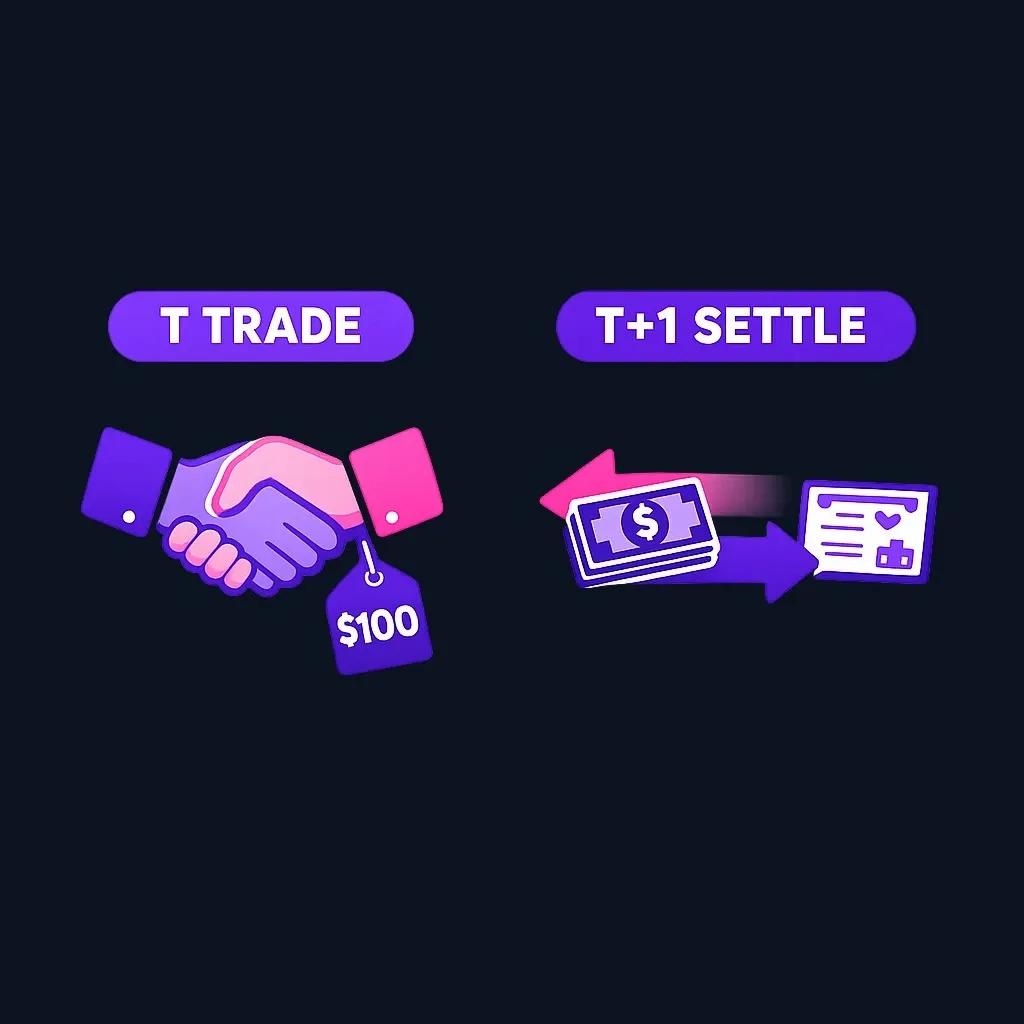
Under T+1 those two dates are one business day apart. Business day is the operative phrase, because weekends and market holidays do not count. A Tuesday trade settles Wednesday, but a Friday trade settles the following Monday, and a trade just before a long weekend settles on the next trading day after it.
The move from T+2 to T+1
Until May 2024, US trades settled in two business days. On February 15, 2023, the SEC adopted amendments to its settlement rule, Rule 15c6-1, shortening the standard cycle to one business day. The shortened cycle applied to transactions on or after May 28, 2024, which is the date most people mean when they say the US "switched to T+1." DTCC coordinated the industry conversion over the final week of May 2024, and the market has run on T+1 since.
Why shorten it at all? Mostly risk. Every day between trade and settlement is a day one side could fail to pay or deliver, and a day the clearinghouse must hold margin from brokers to cover that gap. Modern systems no longer need the buffer that paper certificates once required, and the SEC has said the shorter cycle addresses one of the areas its staff flagged after the extreme volatility of early 2021, when clearinghouse margin demands led some brokers to restrict trading.
Shortening the window reduces the time available for a counterparty failure; the size of the risk reduction depends on positions, volatility, and netting. Several other markets have since moved to T+1 or announced their own timelines, though this guide covers the US market, and settlement cycles still vary from country to country.
What settles T+1
Most of what a retail investor trades now settles the next business day. A few instruments run on their own timing, which is worth knowing mainly so an unfamiliar settlement date on a statement does not alarm you.
| Settles T+1 (standard cycle) | Different or nuanced timing |
|---|---|
| US-listed stocks | Options: the premium settles the next business day, and an exercise or assignment then settles the underlying on its own schedule |
| ETFs | Some mutual funds, which vary by fund |
| Corporate bonds | US Treasuries, which follow their own conventions, often T+1 or same day |
| Municipal bonds | Bank deposits and directly issued bank CDs; brokered CDs may have security-specific settlement terms |
| REITs and exchange-traded limited partnerships | International markets, which run on their own cycles |
The left column covers the vast majority of everyday trades. The right column is the fine print, not something most investors need to track day to day.
What T+1 means for buyers and sellers
For buying, your payment has to be in place by settlement, one business day after the trade. In practice most brokers already require the cash or margin availability before they accept the order, so day to day nothing feels different. The one real trap is funding by bank transfer: an ACH deposit can take longer to arrive than the trade takes to settle, so begin transfers early rather than buying against money still in transit.
For selling, your proceeds settle one business day after the sale, a full day sooner than under T+2. Sell Tuesday and your cash is settled Wednesday; sell Friday and it settles Monday. Keep in mind that settled is not the same as withdrawn, since moving cash to your bank adds its own transfer time on top.
If your securities are held electronically, which is nearly all of them, there is nothing for you to do, because your broker handles delivery. The rare investor holding paper certificates simply has one less day to deliver them.
Practice trading with Finelo
Practice in a simulator, learn with bite-sized lessons, and build confidence before risking real money.
Cash accounts, unsettled funds, and good faith violations
In a cash account you are expected to pay for purchases with settled funds. The moment you sell, your broker will usually let you reuse the proceeds right away to buy something else, even though the sale has not settled yet. That is allowed. The trap is only in what some investors do next.
The danger is not reusing your sale proceeds, it is selling what you bought with them before the original sale has settled. That pattern is a good faith violation.
Consider one illustrative example. On Monday you sell Stock A for $2,000, which will settle Tuesday. Monday afternoon you use that unsettled $2,000 to buy Stock B, which brokers allow. But if you sell Stock B before Tuesday, when the Stock A sale settles, you have sold a position you never paid for with settled cash. Occasional slips usually draw a warning; brokers commonly restrict a cash account to settled-funds-only trading for 90 calendar days after three good faith violations in a rolling twelve-month period.
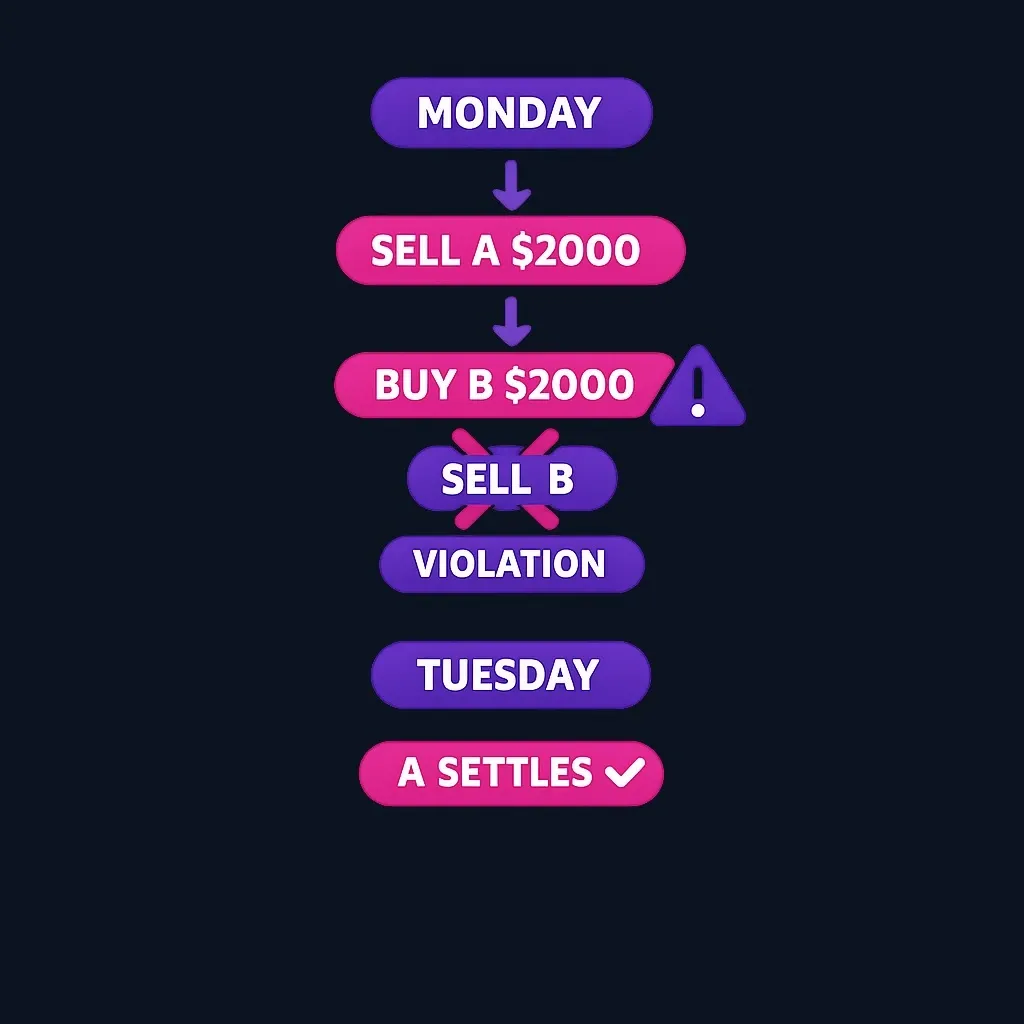
A more serious cousin is freeriding: buying a security without the settled cash to cover it and then selling to pay for the purchase, so the money never really arrives. That one violates Federal Reserve rules and can trigger a 90-day restriction on a single occurrence. Enforcement details vary between brokers, so treat the specifics as your broker's to confirm.
The practical takeaway is narrow. Selling and immediately rebuying is fine; the risk is reselling quickly after you bought with unsettled money. T+1 softened this because funds now settle a day sooner than they used to, but it did not remove it. For the account-side detail, see Finelo's guide to settled cash vs cash available to trade. These constraints are specific to cash accounts: a margin account vs cash account works differently by lending against your positions, which sidesteps the settled-funds problem while adding its own, larger risks. Anyone trading frequently in a cash account, including anyone exploring day trading, needs these rules cold.
A short history of settlement, and what comes next
Settlement has been shrinking for decades as technology replaced paper. The US ran on five business days (T+5) in the certificate era, moved to three business days (T+3) in 1995, to two business days (T+2) in September 2017, and to one business day (T+1) in May 2024. Each step removed risk and freed up capital that used to sit locked between trade and settlement.
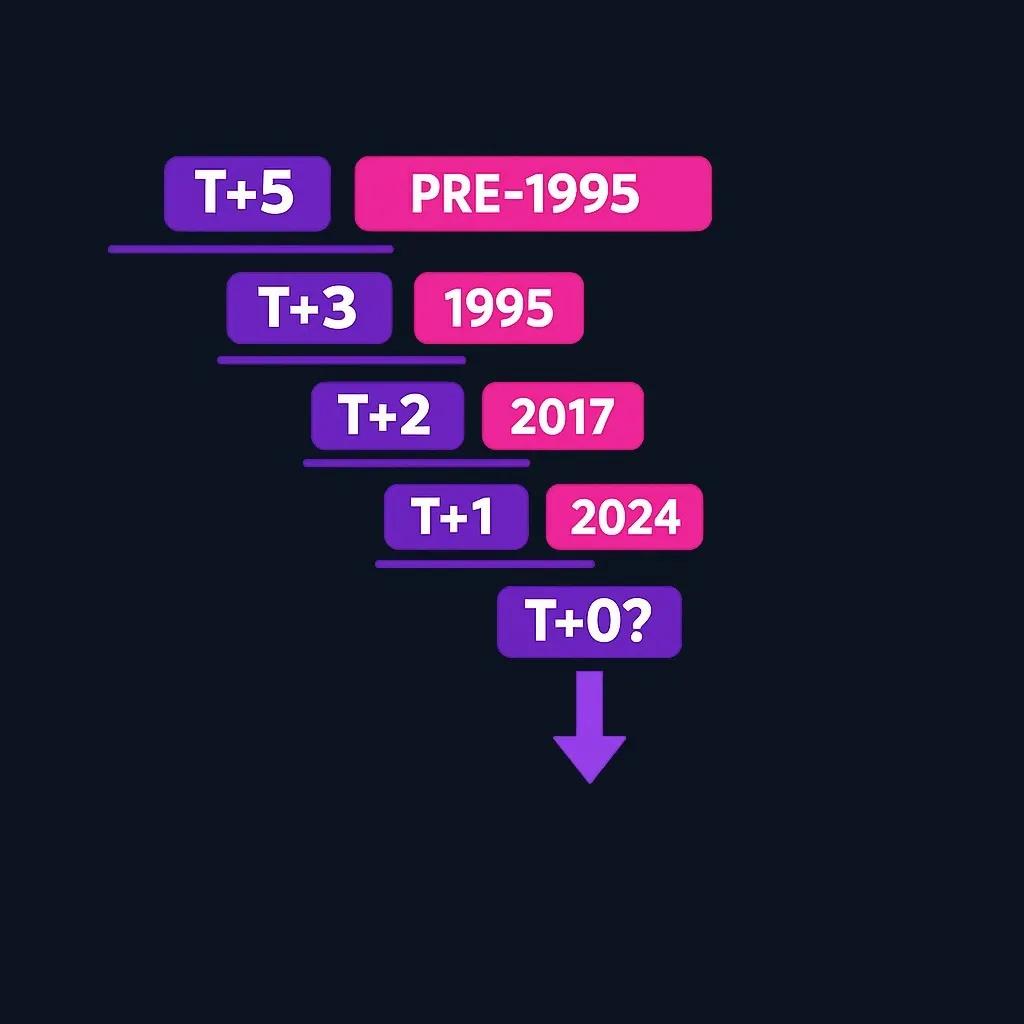
The natural question is whether T+0, meaning same-day or even instant settlement, comes next. It is genuinely debated. Supporters point to even less risk; skeptics note that netting, funding, currency conversion, and international time zones all get much harder when there is no overnight window to sort them out. Faster settlement removes risk on one side of the trade and adds operational pressure on the other, which is why T+0 is a debate and not a date.
No US transition has been decided, so treat same-day settlement as an industry discussion rather than a schedule.
Practice the mechanics before they cost you
The test of whether you understand settlement is simple: for any trade you make, can you say when the cash or the shares are truly yours? If you can, you already know more than most retail investors do.
Settlement rules are cheap to learn on paper and expensive to learn by getting your account restricted. Inside Finelo, you can study how markets work and practice buy, sell, and hold decisions on real market data with virtual funds. There are no deposits, no withdrawals, and no broker connection, it is a closed practice loop, so you can build the habit of thinking in trade dates and settlement dates before any of it touches real money.
Where to learn more
Settlement rules are regulatory facts, not opinions, so it pays to learn them from sources that cite the regulators and date their claims. For the account side, Finelo's settled cash vs cash available to trade explainer and the margin account vs cash account comparison are the natural next reads. You can also learn more about Finelo, read Finelo reviews, see the About Finelo page, or visit the Finelo support center.
Educational note: This article is for educational purposes only and does not constitute financial, investment, legal, or tax advice. Finelo is an educational product, not a brokerage or adviser. Simulator practice uses virtual funds. Investing and trading involve risk, including possible loss of principal; verify account-specific requirements with your broker.
Sources and Further Verification
Frequently asked questions
What does T+1 settlement mean?
It means a trade settles, so money and securities officially change hands, one business day after the trade date. Buy or sell on a Tuesday and the trade is final on Wednesday. T+1 has been the US standard for most securities transactions since May 28, 2024.
What did T+2 settlement mean?
T+2 was the previous US standard, in place from September 2017 until May 2024: trades settled two business days after the trade date, so a Tuesday trade settled Thursday. The SEC's 2023 rule change replaced it with T+1, taking one full day of risk and waiting out of the cycle.
What is T+0 settlement?
T+0 means settling on the trade date itself, either the same day or, in the extreme version, instantly. Some instruments already work this way, and the industry debates moving stocks there eventually, but no US transition has been decided. For now, treat T+0 as a discussion rather than a plan.
When can I use the money from selling a stock?
Most brokers let you reuse sale proceeds to buy other securities before settlement. But in a cash account the proceeds are not fully settled until one business day after the sale, and reselling something you bought with them too quickly can trigger timing rules. When unsure, wait for settlement or check your broker's display.
What is a good faith violation?
It is a cash-account issue that happens when you buy a security with unsettled funds and then sell it before those funds settle, effectively trading with money that was not fully yours yet. Three within a rolling twelve months typically restrict the account to settled cash for 90 days. Details vary by broker.
Do options settle T+1?
An option premium settles the next business day, and if the option is exercised or assigned, the underlying shares then settle on their own timeline. The mechanics differ from a plain stock trade, so check your broker or current OCC and FINRA guidance for the specifics that apply to your account.
T+1 SettlementFinancial LiteracyBeginner
Practice trading with Finelo
Practice in a simulator, learn with bite-sized lessons, and build confidence before risking real money.
About the author
Finelo Team
The Finelo Team creates practical investing and trading education designed to help beginners learn faster with structured challenges, simulator practice, and bite-sized lessons.
Keep reading — Related articles

Financial Literacy
Mercury Books Review 2026: Is It Worth It for Startups?
Mercury Books brings double-entry accounting into Mercury. Review its $35 pricing, reports, AI features, integrations, and migration limits.
Finelo Team

Financial Literacy
Why is My FICO Score Lower Than My Credit Score?
Example takeaway: seeing a higher score in a bank app doesn’t guarantee lenders will see the same FICO number at application time; lenders often pull a specific FICO version from a specific bureau.
Finelo Team

Financial Literacy
Why Is My FICO Score Higher Than My Credit Score?
Brief educational note: this article is educational, not financial or investment advice; investing and credit decisions involve risk and possible loss.
Finelo Team