Last editorial review: September 8, 2026
Backdoor Roth vs. Mega Backdoor Roth: Rules, Limits, and Key Differences
Backdoor and mega-backdoor Roth strategies use different accounts and plan features. Eligibility, aggregation, basis, conversion tax, limits, and reporting require case-specific review.
12 min read
Practice investing with Finelo
Build practical investing skills with guided lessons, simulator practice, and structured challenges.
Want to learn more?
Build practical investing skills with guided lessons, simulator practice, and structured challenges.
Explore FineloExplore Finelo's 28-day challenges
Turn learning into a daily habit with guided challenge paths.
U.S. scope: This article discusses U.S. institutions, financial products, tax rules, and dollar examples unless stated otherwise. Rules and product terms may change; verify current official guidance for your situation.
Quick comparison answer
“Backdoor Roth” and “Mega Backdoor Roth” are informal planning labels, not separate account types. The first usually combines a nondeductible traditional IRA contribution with a Roth conversion; the second may combine employee after-tax plan contributions with an in-plan Roth rollover or permitted distribution. Neither creates an exemption from contribution limits, plan terms, conversion tax, or reporting rules. IRA conversions can include untaxed amounts in income, and Form 8606 is used to report nondeductible IRA contributions and conversions (IRS IRA FAQs, Form 8606 instructions).
Educational note: This content is educational and not tax or investment advice. Conversions can change taxable income; consult a tax professional before executing material moves.
What is a Backdoor Roth IRA?
Backdoor Roth: concept and purpose
A backdoor Roth strategy is commonly considered by taxpayers whose modified adjusted gross income limits direct Roth IRA contributions. The usual path is a nondeductible traditional IRA contribution followed by a Roth conversion. It still requires taxable compensation for the contribution, compliance with the annual IRA contribution limit, and reporting on Form 8606. The IRS states that a conversion can be made regardless of adjusted gross income, but any untaxed amount converted is included in income (IRS Topic No. 309, IRS IRA FAQs).
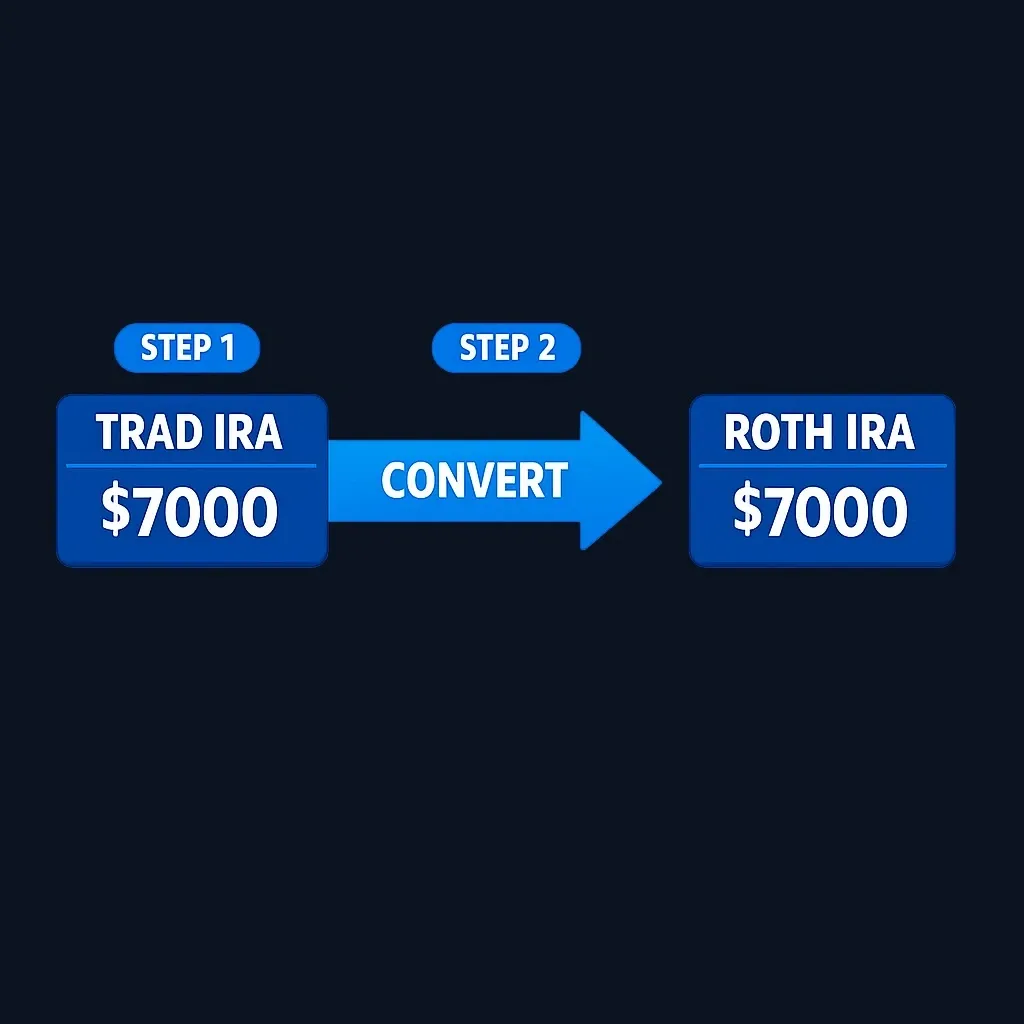
Practical takeaway: The Backdoor Roth is executed at an IRA custodian and does not require employer cooperation, making it widely available to individuals regardless of their 401(k) plan design (Charles Schwab).
How it works (stepwise)
- Contribute to a traditional IRA (often a nondeductible contribution if income is high).
- Convert the contributed amount to a Roth IRA. The conversion is the step that creates Roth treatment for future growth (Charles Schwab).
Key operational note: Any earnings that accrue on the contribution before conversion can be taxable at conversion; timing and tracking basis matter for tax reporting.
What is a Mega Backdoor Roth IRA?
Mega Backdoor Roth: concept and purpose
A Mega Backdoor Roth leverages employer retirement plans to move significantly larger sums into Roth treatment than an IRA‑based Backdoor typically allows. It uses after‑tax contributions inside a 401(k) (or similar plan) and then converts those after‑tax amounts to Roth via an in‑plan Roth conversion or an in‑service distribution to a Roth account (Fidelity, Charles Schwab).
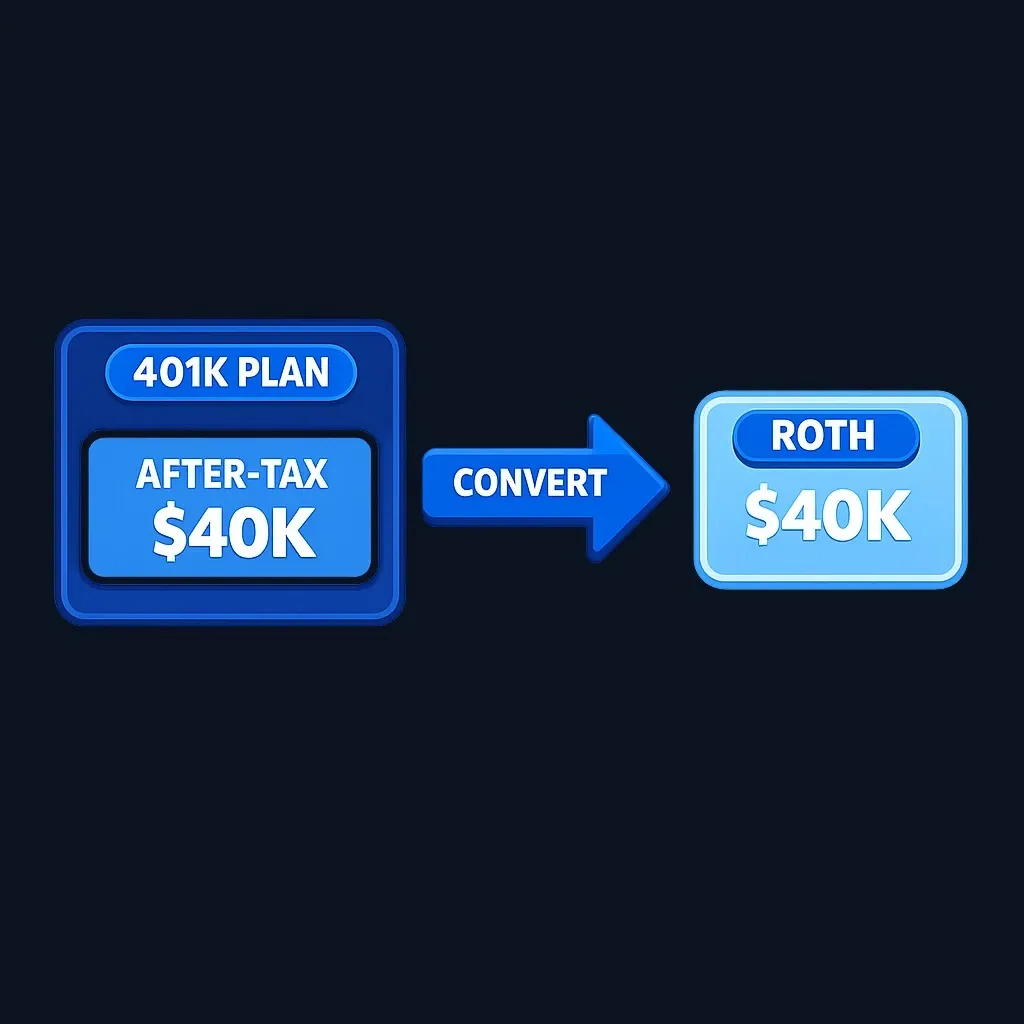
Practical takeaway: The Mega Backdoor can materially increase how much you shift into Roth each year — but it requires specific plan features and administrator cooperation (Charles Schwab).
Typical mechanics (high level)
- Verify your 401(k) plan accepts after‑tax (non‑Roth) contributions distinct from regular pre‑tax or Roth deferrals.
- Make after‑tax contributions in the plan.
- Move those after‑tax balances into Roth treatment by performing an in‑plan Roth conversion or taking an in‑service distribution to a Roth account — doing the conversion promptly limits taxable earnings on the after‑tax principal (Fidelity).
Operational note: Availability and process vary by employer plan; some plans automate conversions while others require manual in‑service distributions.
Side-by-side comparison table
| Feature / question | Backdoor Roth IRA | Mega Backdoor Roth |
|---|---|---|
| Where it runs | IRA custodian; no employer action required (Charles Schwab) | Inside employer 401(k) (or similar); requires plan features and admin cooperation (Charles Schwab) |
| Core steps | Contribute to traditional IRA → convert to Roth (Charles Schwab) | Make after‑tax 401(k) contributions → convert in‑plan or take in‑service distribution to Roth (Fidelity) |
| Scale / contribution capacity | Limited by IRA contribution capacity and IRS IRA rules — check current limits on the IRS site | Potentially much larger; constrained by your plan’s allowance for after‑tax contributions and total plan/IRS limits — check plan documents and IRS guidance (Charles Schwab) |
| Eligibility | Requires contribution eligibility and compensation for the IRA contribution; conversion tax and reporting still apply | Only participants in plans that permit after-tax contributions and the needed conversion or distribution step (Fidelity) |
| Administrative complexity | Low–moderate (IRA custodian paperwork and Form 8606 reporting) | Moderate–high (plan coordination, conversion timing, possible plan windows) |
| Best fit | Savers without qualifying employer plan or who want a simple Roth access route | Employees with qualifying plans who can save beyond IRA limits and want to accelerate Roth accumulation (Charles Schwab) |
Table note: This table compares structure and workflow. For numeric contribution ceilings and year‑specific limits, check current official IRS guidance and your plan’s Summary Plan Description before acting.
Decision criteria
Use this checklist and the short decision framework to decide which strategy to pursue.
Checklist (yes/no)
- Does your 401(k) plan accept after‑tax contributions distinct from regular salary deferrals?
- Does your plan allow in‑plan Roth conversions or timely in‑service distributions to an external Roth IRA?
- Do you have capacity to save meaningfully above IRA contribution capacity?
- Are you comfortable coordinating with your plan administrator and tracking conversion timing?
- Do you have pre‑tax traditional IRA balances that could complicate conversions (i.e., trigger pro‑rata tax treatment)?
How to interpret the checklist
- If you answered Yes to plan capability and to capacity to save beyond IRA limits, the Mega Backdoor is worth exploring; it can move substantially more into Roth when the plan supports it (Charles Schwab, Fidelity).
- If your plan lacks after‑tax or conversion features, the Backdoor Roth remains a widely available, lower‑complexity option (Charles Schwab).
- If you can, consider using both: the Backdoor Roth for IRA‑sized contributions and the Mega Backdoor to capture extra Roth space if your plan permits (Charles Schwab).
Quick decision framework
- Priority = simplicity and independence from employer: Backdoor Roth.
- Priority = maximize Roth conversion capacity and you have a cooperative plan: Mega Backdoor Roth.
- Priority = both goals: explore whether your plan supports Mega Backdoor, then layer a Backdoor Roth for any remaining IRA capacity.
When to choose each option
When to favor the Backdoor Roth
- You don’t have a 401(k) that supports after‑tax contributions or in‑service conversions. The Backdoor Roth works solely through IRAs and does not require plan features (Charles Schwab).
- You prefer a simpler process with minimal plan coordination and you’re primarily filling IRA contribution space.
When to favor the Mega Backdoor Roth
- Your employer plan accepts after‑tax contributions and permits either in‑plan Roth conversions or in‑service distributions to a Roth. Converting those after‑tax dollars is the conversion step needed to create Roth treatment (Fidelity).
- You can save well beyond IRA contribution capacity and want to accelerate Roth accumulation at larger scale.
When to use both
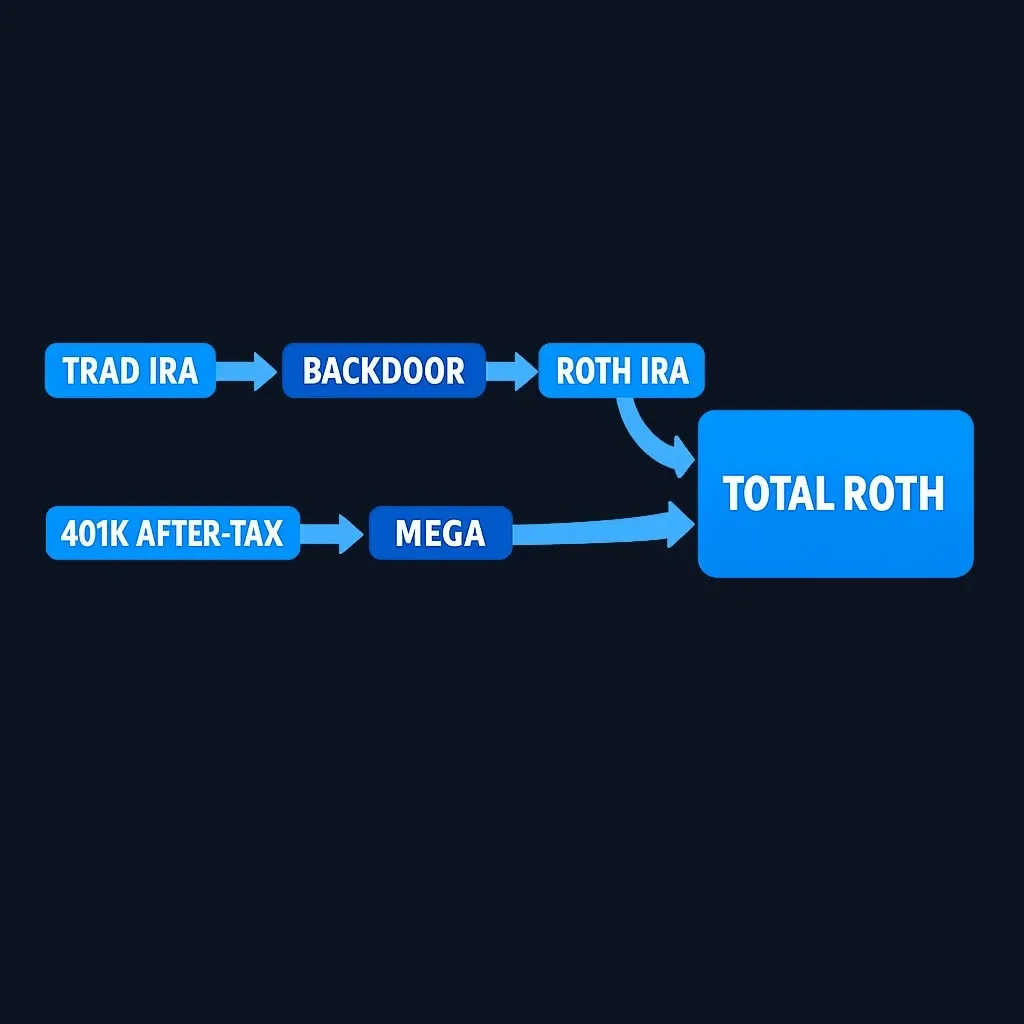
If your plan supports the Mega Backdoor and you still want to maximize Roth accumulation, many savers combine both strategies: use the Mega Backdoor for the extra employer‑plan capacity and keep making IRA‑level Backdoor Roth contributions to fully use available Roth avenues (Charles Schwab).
Tradeoffs and caveats
- Availability versus scale: The Backdoor Roth is broadly available; the Mega Backdoor offers larger capacity but depends on employer plan features (Charles Schwab).
- Administrative burden: Mega Backdoor typically requires active coordination with plan administrators and careful timing to minimize taxable earnings on after‑tax contributions; Fidelity emphasizes conversion of after‑tax contributions as the central step (Fidelity).
- Tax reporting complexity: Conversions require careful tracking and tax reporting. If you have pre‑tax IRA balances, conversions can trigger pro‑rata tax calculations (discuss with a tax advisor).
- Plan variability: Employer plans differ widely in whether they permit after‑tax contributions, allow in‑plan Roth conversions, or offer in‑service distributions. Confirm via your plan’s documentation and administrator before assuming availability.
- Not a replacement for tax planning: Large conversions can push taxable income for the year; coordinate material conversions with your tax professional.
Practical mitigation tips
- Confirm plan features by requesting the plan’s Summary Plan Description and asking the administrator about after‑tax contribution rules and conversion/distribution mechanics.
- If your plan supports conversions, convert after‑tax balances promptly to limit taxable earnings on principal (Fidelity).
- Keep clear records of basis (Form 8606 for IRA nondeductible contributions) and any conversion steps to simplify tax reporting.
Practice investing with Finelo
Build practical investing skills with guided lessons, simulator practice, and structured challenges.
Tax Implications of Each Strategy
This section explains the general tax mechanics; it does not list year‑specific limits.
Backdoor Roth tax logic
- A conversion moves assets from a traditional IRA to a Roth IRA. Untaxed amounts converted are included in gross income; the after-tax basis calculation is reported on Form 8606 (IRS IRA FAQs).
- Form 8606 calculates the taxable and nontaxable portions using the taxpayer's traditional, SEP, and SIMPLE IRA values and basis; opening a separate new IRA does not by itself isolate the nondeductible contribution from other IRA balances (Form 8606 instructions).
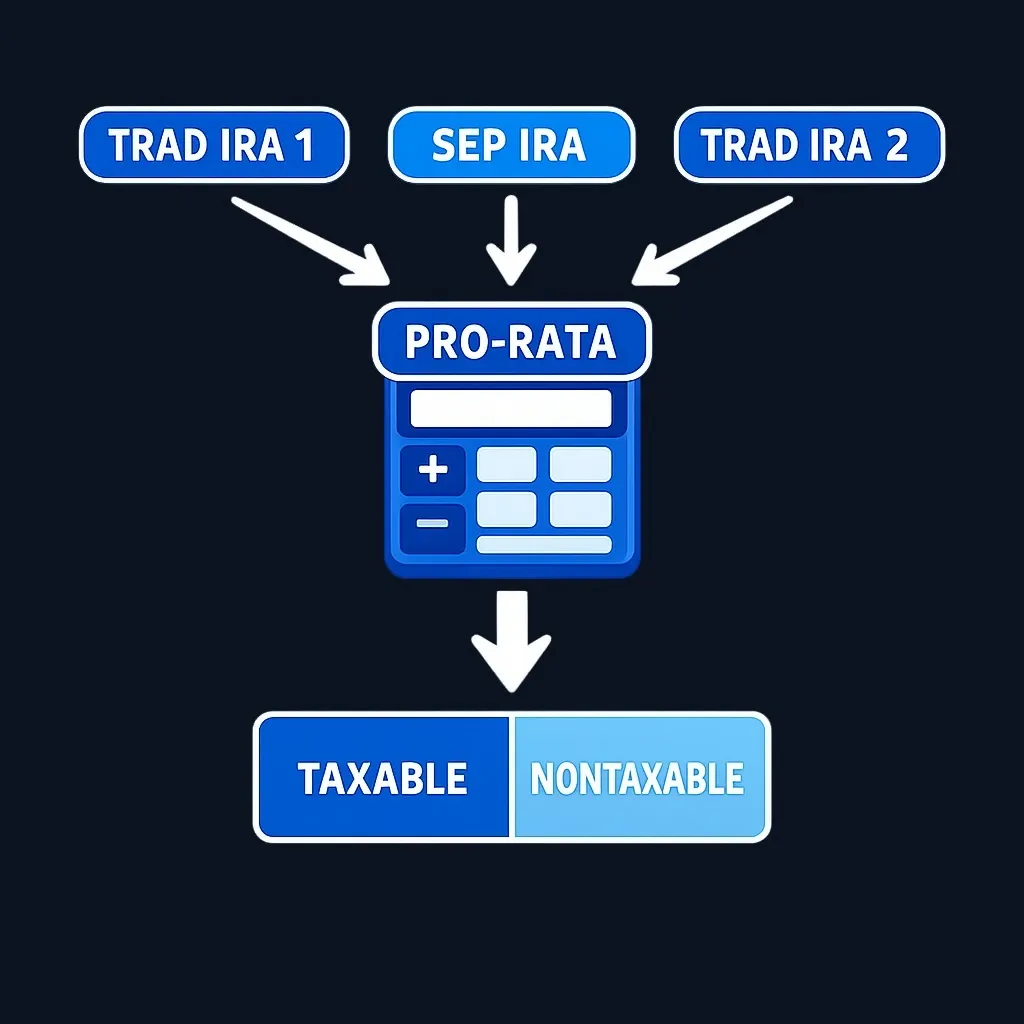
Mega Backdoor Roth tax logic
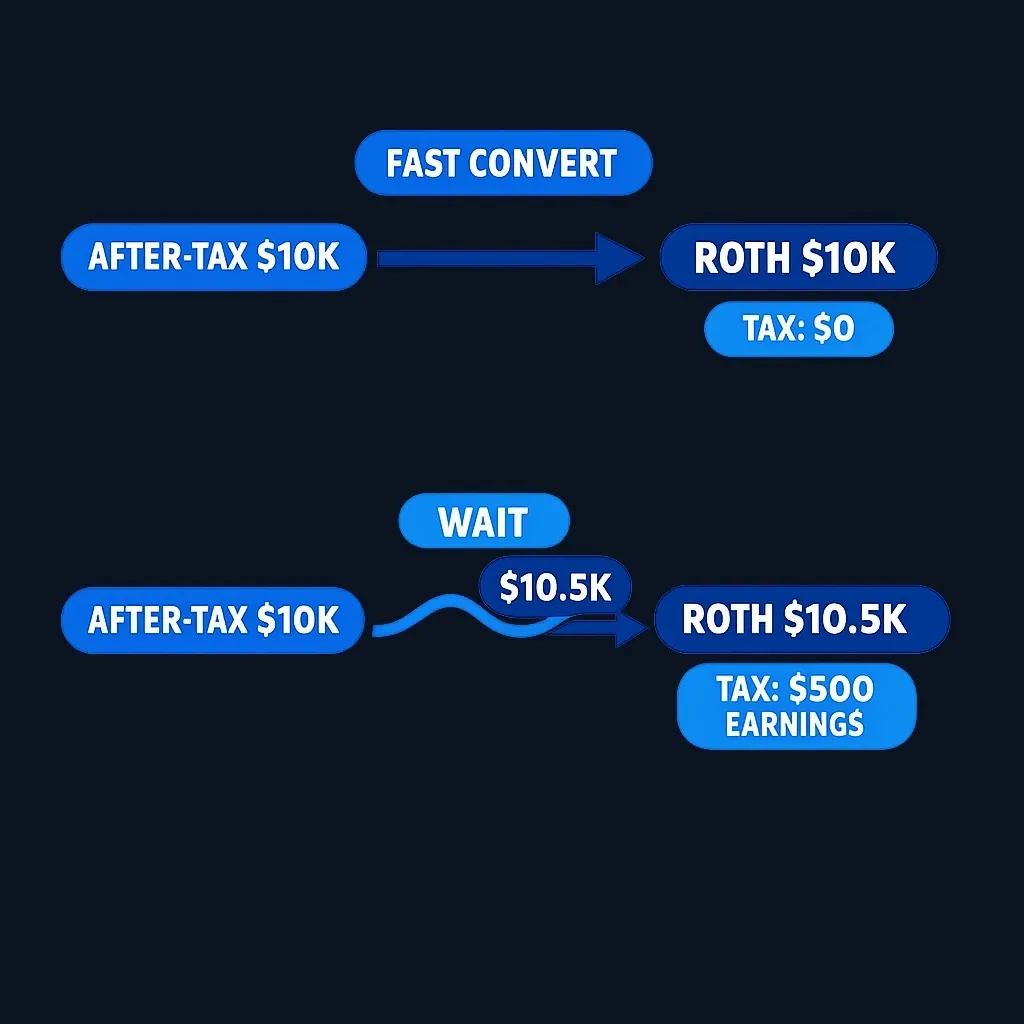
- After‑tax 401(k) contributions are converted to Roth treatment so future growth is tax‑free; converting promptly reduces the chance that earnings on after‑tax principal will be taxable (Fidelity).
- The taxable outcome depends on whether the conversion touches only after‑tax basis or includes earnings. Plan rules on conversion timing and distribution frequency directly affect this.
Educational note: This material is educational only. Conversions can materially affect taxable income and interact with state tax rules. Discuss large or complex moves with a qualified tax professional.
Action steps for tax clarity
- Before converting, ask whether in‑plan conversions or distributions will be treated as converting only after‑tax basis or if earnings will be rolled together.
- Track basis and conversion dates carefully and retain plan statements showing after‑tax contributions and any conversions.
Common Mistakes to Avoid
- Assuming your 401(k) supports a Mega Backdoor without checking. The Mega Backdoor requires plan features — confirm with the plan administrator (Fidelity).
- Delaying conversion of after‑tax contributions. Delays allow earnings to accumulate and can create taxable income on conversion; prompt conversion limits that risk (Fidelity).
- Overlooking plan operational limits. Some plans have limited windows or require forms for in‑service distributions or conversions; do not assume instant or automated processing.
- Forgetting IRA pre‑tax balances. Pre‑tax IRAs can complicate conversions via pro‑rata calculations; failing to account for this raises unexpected tax bills.
- Treating these strategies as tax‑free “loopholes.” Conversions change the tax profile of a year and should be coordinated with broader tax planning.
Quick prevention checklist
- Request plan documentation (Summary Plan Description).
- Ask plan admin whether after‑tax contributions are accepted and how conversions/distributions are processed.
- If using a Backdoor Roth, file Form 8606 as required for nondeductible IRA contributions.
- Talk to a tax advisor before large conversions.
Real-Life Case Studies (illustrative, non‑numeric)
These short, qualitative scenarios show how the two strategies fit different saver profiles. They are hypothetical illustrations, not financial advice.
Case A — The contractor without plan access
A high‑earning contractor has no employer 401(k). They use the Backdoor Roth route via an IRA custodian to secure Roth treatment for annual IRA contributions. The approach is simple, independent of employer plans, and avoids plan coordination.
Case B — The employee at a large firm with a flexible plan
An employee whose 401(k) accepts after‑tax contributions and allows in‑plan Roth conversions uses the Mega Backdoor to shift a sizable amount into Roth during the year. Because the plan supports quick conversions, the employee minimizes taxable earnings on after‑tax principal and accelerates Roth accumulation beyond IRA limits (Fidelity, Charles Schwab).
Case C — The hybrid approach
A saver whose employer plan allows after‑tax contributions still uses a Backdoor Roth for the IRA contribution window. They layer both approaches: IRA Backdoor for simplicity and Mega Backdoor for extra Roth capacity. This combination maximizes Roth growth while balancing paperwork and plan complexity.
Practical lesson: Which case applies to you depends on employer plan features, how much you want to save beyond IRA limits, and your willingness to manage plan operations and tax reporting.
FAQ
What is the difference between a Backdoor Roth and a Mega Backdoor Roth?
A Backdoor Roth converts IRA contributions to Roth and works through an IRA custodian, making it plan‑independent; a Mega Backdoor Roth uses after‑tax 401(k) contributions plus an in‑plan conversion or in‑service distribution to move larger sums into Roth — but requires a qualifying employer plan (Charles Schwab, Fidelity).
How do I know if my 401(k) plan supports a Mega Backdoor Roth?
Ask your plan administrator and request the plan’s Summary Plan Description. You need the plan to accept after‑tax contributions and to permit either in‑plan Roth conversions or timely in‑service distributions to a Roth account; converting after‑tax contributions into Roth is the key procedural step (Fidelity).
Can I convert my after‑tax contributions to a Roth account?
Yes — converting after‑tax contributions to Roth treatment is the central step of the Mega Backdoor Roth strategy. Fidelity describes converting after‑tax contributions to a Roth account as the necessary step to create Roth assets (Fidelity).
Who should read this page and what will they understand after reading?
This page is for savers who understand Roth vs. traditional tax differences and are comparing tactical routes to build Roth assets. After reading, you’ll be able to evaluate feasibility based on your employer’s plan features, decide whether to pursue a Mega Backdoor (if supported) or a Backdoor Roth, and understand the core tax and operational tradeoffs through a neutral educational lens.
Verify current numeric limits and any year-specific IRS rules before acting; plan design and tax rules change, and conversions can affect your taxable income. For material moves, consult a qualified tax or financial advisor.
Sources and Further Verification
- Charles Schwab
- Fidelity
- IRS: Retirement plans FAQs regarding IRAs
- IRS Topic No. 309: Roth IRA contributions and conversions
- IRS Instructions for Form 8606
- IRS 2026 contribution limits
More from Finelo
- After-Tax 401(k) vs. Roth 401(k): Key Differences
- 1031 Exchange vs. Opportunity Zone: Key Differences
- 83(b) Election: Deadlines, Tax Risks, and When Early Filing May Fit
Disclaimer
This article is provided by Finelo for educational and informational purposes only. Finelo does not provide financial, investment, tax, legal, or insurance advice. Consider your circumstances and consult an appropriately qualified professional before making financial decisions.
InvestingBeginner GuideFinancial Education
Practice investing with Finelo
Build practical investing skills with guided lessons, simulator practice, and structured challenges.
About the author
Finelo Team
The Finelo Team creates practical investing and trading education designed to help beginners learn faster with structured challenges, simulator practice, and bite-sized lessons.
Keep reading — Related articles
Investing
Yield to Call vs Yield to Maturity: Assumptions and Bond Risks
Yield to call (YTC) estimates a bond's yield if the issuer redeems it on an eligible call date; yield to maturity (YTM) estimates yield if it remains outstanding to final maturity.
Finelo Team
Investing
Will My Employer Know If I Take a 401(k) Loan?
Who this page is for: readers new to 401(k) loans who want a practical, privacy‑focused explanation — what your employer can see, how to limit visibility, and the financial tradeoffs to weigh.
Finelo Team
Investing
What Medical Expenses Qualify for a 401(k) Hardship Withdrawal?
Before you decide, confirm three things with your plan administrator:
Finelo Team