Last editorial review: September 8, 2026
Bank CDs vs. Brokered CDs: Key Differences
The shortest bank cd vs brokered cd answer: a bank CD is bought directly from a bank, while a brokered CD is accessed through a brokerage account. Bank CDs usually fit people who want a…
12 min read
Practice investing with Finelo
Build practical investing skills with guided lessons, simulator practice, and structured challenges.
Want to learn more?
Build practical investing skills with guided lessons, simulator practice, and structured challenges.
Explore FineloExplore Finelo's 28-day challenges
Turn learning into a daily habit with guided challenge paths.
U.S. scope: This article discusses U.S. institutions, financial products, tax rules, and dollar examples unless stated otherwise. Rules and product terms may change; verify current official guidance for your situation.
Quick comparison answer
The shortest bank cd vs brokered cd answer: a bank CD is bought directly from a bank, while a brokered CD is accessed through a brokerage account. Bank CDs usually fit people who want a simpler deposit relationship. Brokered CDs may fit investors who already use a brokerage and want to compare CD choices there. Bank CDs involve keeping money on deposit for a set term, often three months to five years or more, in exchange for interest (FDIC). The purchase channel is the clearest split: direct bank versus brokerage (Schwab).
What each CD type means
What is a bank CD?
A bank certificate of deposit is a deposit product where you keep money with a bank for a specified term in exchange for interest (FDIC). The FDIC describes bank CD terms as usually ranging from three months to five years or more (FDIC).
In everyday terms, a bank CD is a direct relationship with one financial institution. You compare that bank’s available terms, decide whether the maturity date fits your cash needs, and hold the CD through that bank.
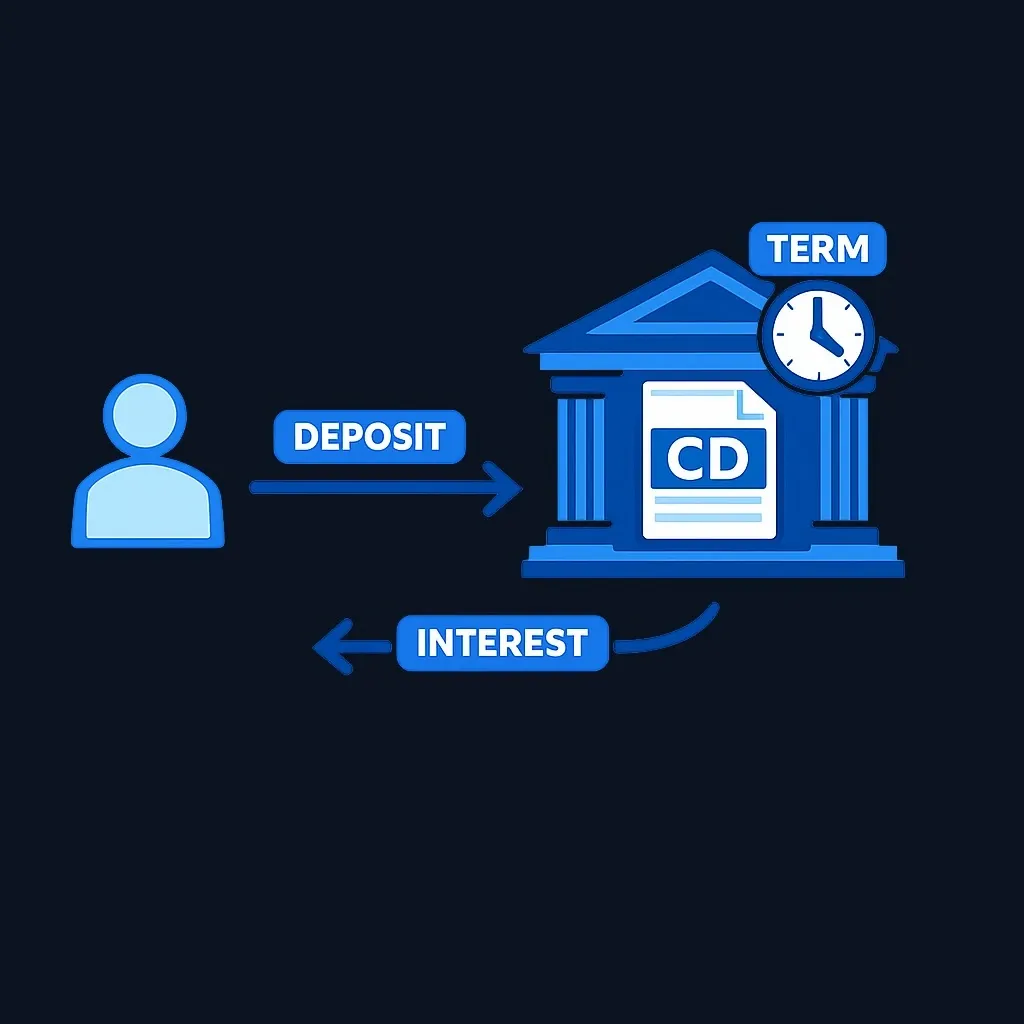
The main appeal is simplicity. You do not need to learn a brokerage order screen or manage a CD inside an investment account. The tradeoff is that easy access to one bank does not automatically mean you have compared the broader market.
What is a brokered CD?
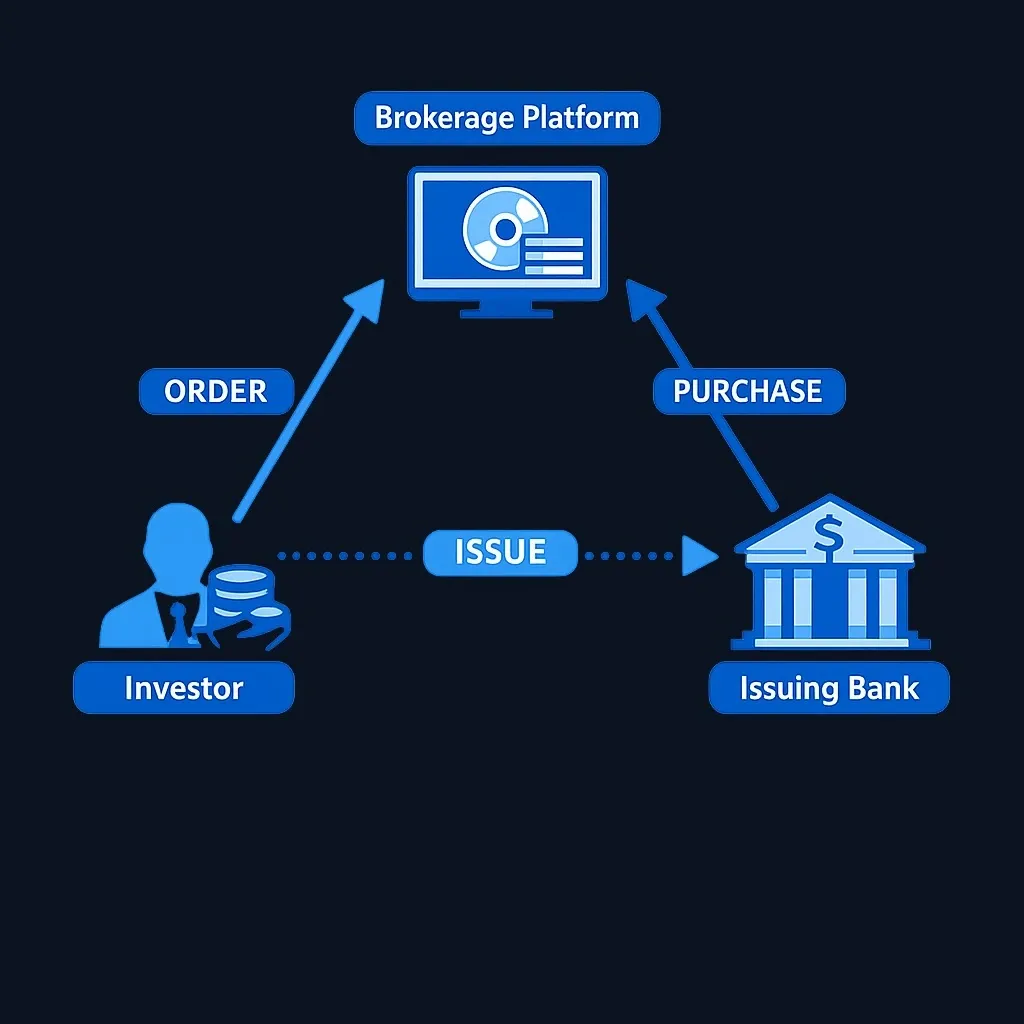
A brokered CD is a CD purchased through a brokerage rather than directly from a bank. Schwab summarizes the transaction difference clearly: bank CDs are purchased directly from a bank, while brokered CDs are purchased through a brokerage (Schwab).
That change affects the whole ownership experience. You evaluate the CD inside a brokerage workflow, track it in that account, and need to understand the brokerage’s order details before investing.
Brokered CDs can be useful for people already comfortable with brokerage accounts. They can also add complexity, because the broker and the issuing bank are not the same party. The SEC’s Investor.gov maintains an investor bulletin on brokered CDs, which is worth reading before using this structure (Investor.gov).
Side-by-side comparison table
| Decision point | Bank CD | Brokered CD |
|---|---|---|
| Where you buy it | Directly from a bank (Schwab) | Through a brokerage (Schwab) |
| Basic structure | Money stays on deposit for a specified term in exchange for interest (FDIC) | A CD accessed through a brokerage workflow (Schwab) |
| Typical term framing | FDIC describes bank CD terms as usually three months to five years or more (FDIC) | Review the term shown in the brokerage listing before placing an order |
| Best operational fit | People who prefer a direct bank relationship | People already comfortable using a brokerage account |
| Main convenience | Fewer moving parts | Centralized comparison inside a brokerage workflow |
| Main due diligence need | Compare more than one bank and read the term details | Confirm issuer, maturity, yield, fees, and exit mechanics |
| Liquidity question | What happens if you need the money before maturity? | How would you exit, and what would that process cost? |
| Common mistake | Choosing the familiar bank without shopping | Treating the brokerage listing like a simple savings account |
The practical difference is not “safe versus risky” or “good versus bad.” It is direct simplicity versus brokerage-based comparison. The better fit depends on the job the money must do, the account setup you already use, and how much complexity you are willing to manage.
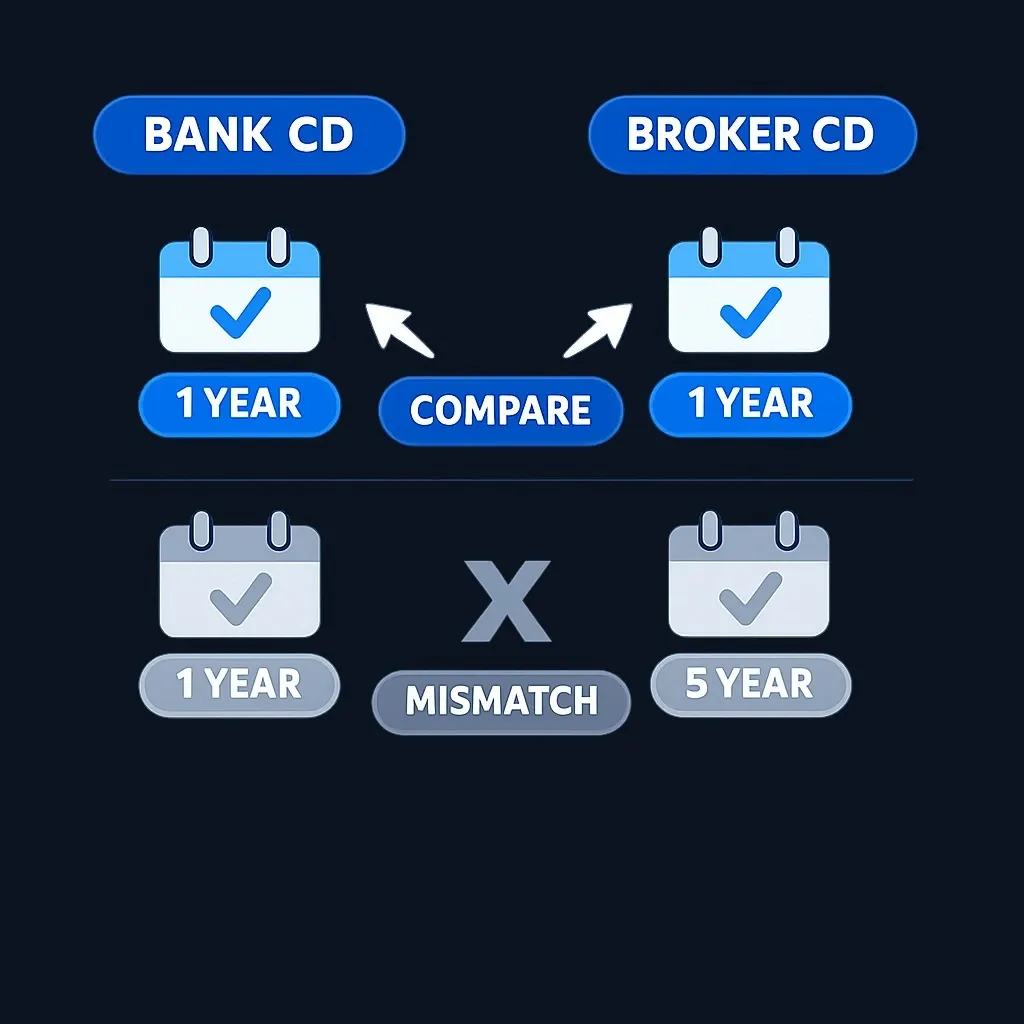
A useful rule: compare CDs with the same maturity first. A one-year CD and a five-year CD solve different cash-flow problems, even if one shows a more attractive quote. Then compare the exit path, not only the entry yield.
Key differences that matter most
Purchase process
The purchase channel is the cleanest distinction. A bank CD is bought from a bank, while a brokered CD is bought through a brokerage (Schwab). That affects research, account setup, statements, service questions, and recordkeeping.
If you want one bank login and a direct service channel, the bank CD workflow may feel more natural. If you already manage investments through a brokerage, the brokered workflow may fit your existing routine.
Rate comparison
The biggest comparison mistake is looking only at the quoted rate. A rate is useful only when the maturity date, funding amount, access rules, and issuer details also fit your situation.
For example, suppose you need money for a home repair fund next spring. A longer maturity may look attractive, but it may not match the date when cash is needed. In that case, the better comparison is “which CD fits the deadline?” rather than “which screen shows the highest number?”
Term and cash-flow fit
A CD term is a planning commitment. The FDIC describes a bank CD as money kept on deposit for a specified term (FDIC). That structure can work well for planned cash, but it can be awkward for money needed at uncertain times.
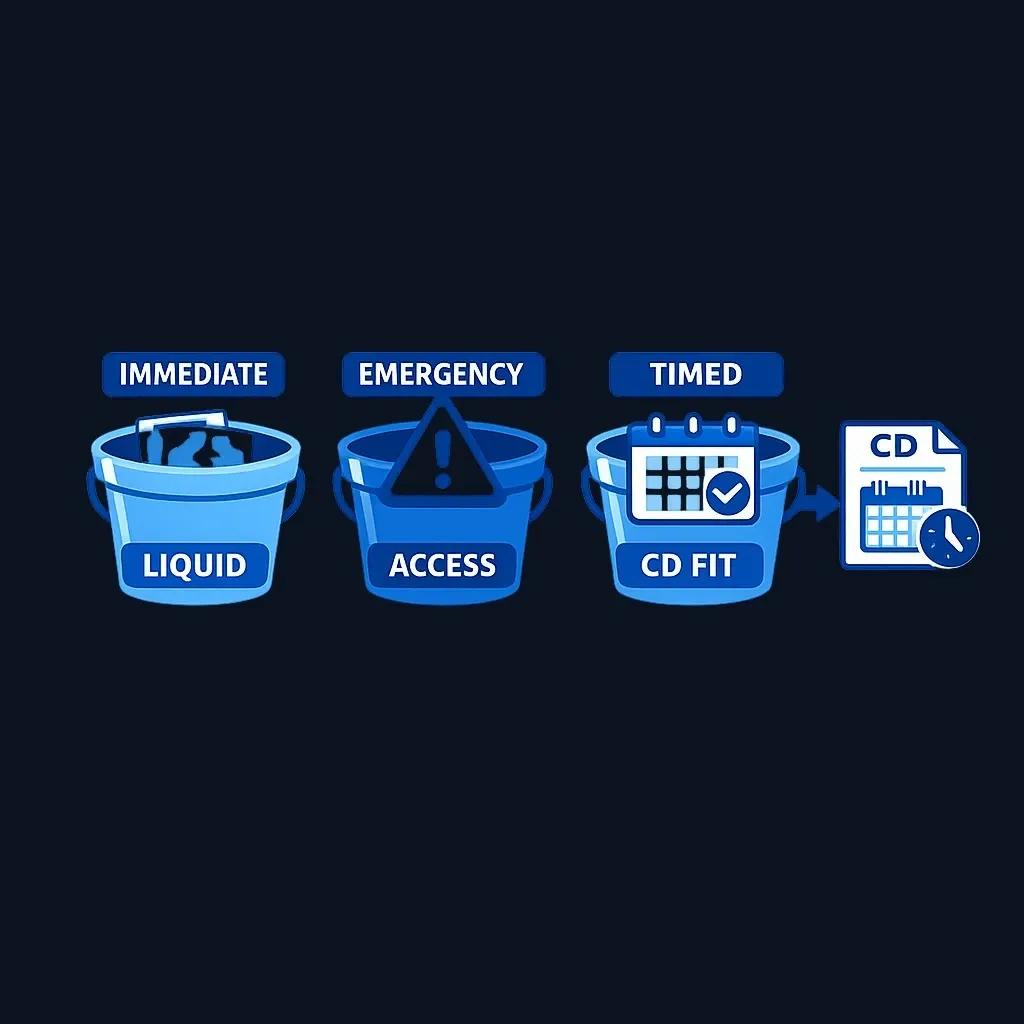
Before comparing products, sort the money into three buckets:
- Immediate cash: money for bills and near-term needs.
- Emergency cash: money that may be needed without warning.
- Timed savings: money set aside for a known future date.
CDs generally make the most sense to evaluate for the third bucket. If the money belongs in the first two buckets, the CD type may be less important than liquidity.
Decision criteria
Start with the job the money must do
The best bank cd vs brokered cd decision starts with purpose. Are you saving for a fixed date, building a simple CD ladder, or managing idle cash inside a brokerage account?
If the purpose is narrow, such as “available around next summer,” choose the structure that makes that maturity easiest to track. If the money already sits in a brokerage account, comparing brokered listings may be efficient. If the goal is simplicity, a direct bank CD may remove extra process risk.
Compare the full path, not only the entry rate
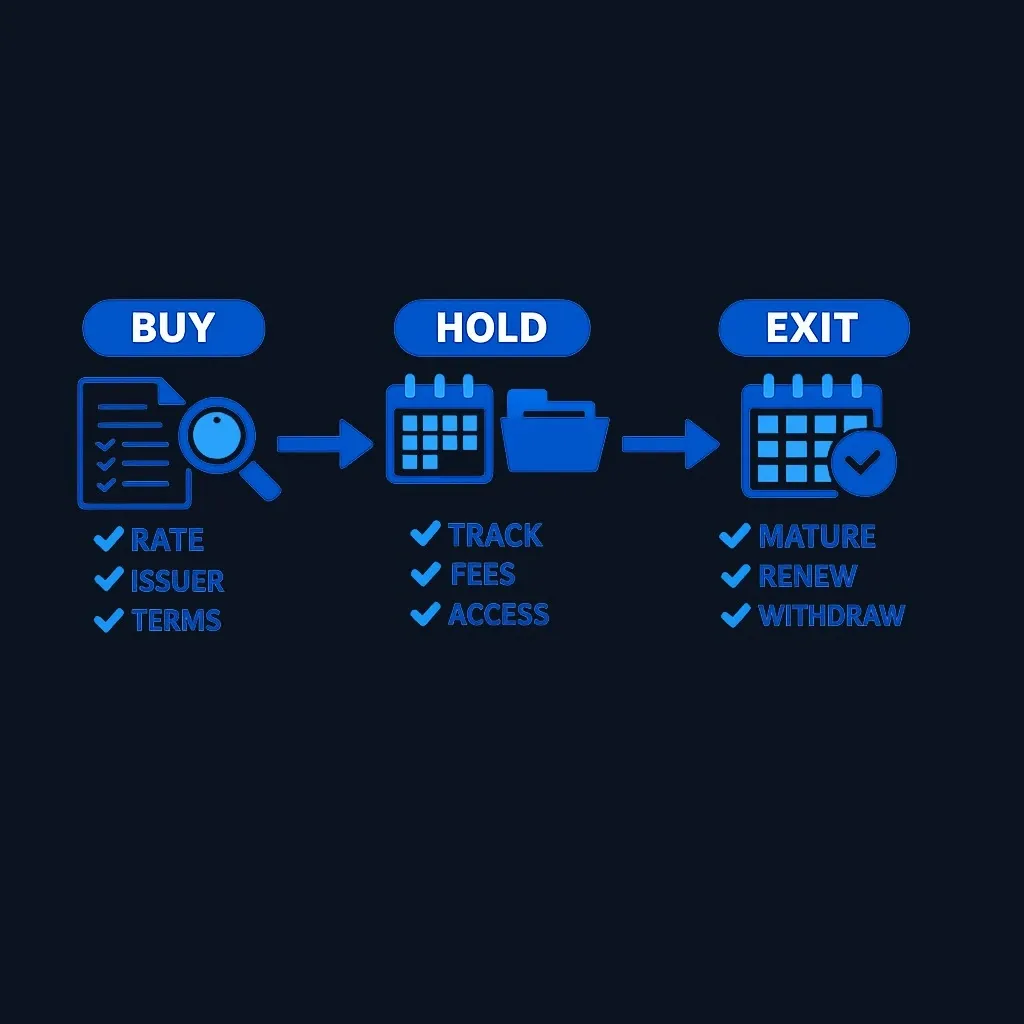
A CD decision has three phases: buying, holding, and exiting. Many buyers focus on the first phase and ignore the other two.
Use this checklist before committing money:
- What is the maturity date?
- Where will you track the CD?
- What happens when it matures?
- What happens if you need cash before maturity?
- Is the issuer clear?
- Are there account-level fees or transaction costs to understand?
- Can you document the terms before placing the order?
- Does the CD fit money that can stay committed for the full term?
This checklist works for both structures. It forces you to compare the ownership experience, not just the headline rate.
Use a simple decision flow
Use this quick flow before choosing:
- Need uncertain access to the cash? Consider whether a CD fits at all.
- Need the simplest setup? Compare direct bank CDs first.
- Already use a brokerage account? Compare brokered listings against bank offers.
- Unsure how early exit works? Pause until the terms are clear.
- Chasing the highest quote only? Recheck maturity, issuer, liquidity, and fees.
This flow helps prevent the most common mismatch: using a term product for money that still needs flexibility.
Advantages of bank CDs
Simplicity and direct access
The main bank CD advantage is operational simplicity. You buy directly from a bank, rather than through a brokerage (Schwab). That can make the product easier to manage for people who do not use investment platforms.
A bank CD can also be easier to coordinate within a household. One person may handle the bank relationship, see the maturity date, and track the CD alongside other savings accounts.
Clearer behavior for cautious savers
A direct CD can encourage disciplined cash planning. Because the money is tied to a specified term, the decision naturally begins with a useful question: “Can this money stay put until maturity?” The FDIC describes CDs as requiring money to remain on deposit for a specified term (FDIC).
The limitation is that convenience can reduce shopping discipline. If you only compare one bank, you may miss a better maturity or more suitable account terms elsewhere. A simple comparison sheet can fix this.
Practical bank CD worksheet
Before opening a bank CD, write down:
| Item to compare | Why it matters |
|---|---|
| Maturity date | It must match the date you may need cash |
| Current APY | Compare only against CDs with similar terms |
| Minimum deposit | It affects whether the offer fits your funding amount |
| Early-access rules | Liquidity terms matter if plans change |
| Renewal handling | You need to know what happens at maturity |
| Insurance status | Confirm the relevant protections before depositing |
This worksheet is intentionally plain. A simple table often prevents better mistakes than a complex model.
Practice investing with Finelo
Build practical investing skills with guided lessons, simulator practice, and structured challenges.
Advantages of brokered CDs
Brokerage-based comparison
The main brokered CD advantage is the brokerage workflow. Because brokered CDs are purchased through a brokerage, they may fit investors who already manage cash and investments in that environment (Schwab).
For those investors, the appeal is not only the CD itself. It is the ability to compare choices inside a familiar account. That can reduce the need to open separate relationships at several banks.
Fit for organized cash management
Brokered CDs may also fit people who want a more structured cash plan. For example, a retiree might line up several maturities with expected spending needs. A brokerage account can make that kind of planning feel more centralized.
Still, centralized does not always mean simple. If you do not understand the order process, issuer details, or exit mechanics, the extra access may not be worth the added work.
Brokered CD due diligence checklist
Before buying a brokered CD, confirm:
- The issuing bank.
- The maturity date.
- The yield calculation shown in the brokerage.
- Any fee or spread that could affect your outcome.
- How the CD is displayed in your account.
- What happens at maturity.
- How an early sale or exit would work, if available.
- Whether the CD’s insurance treatment fits your situation.
This checklist matters because a brokerage screen can make different products look deceptively similar. Slow down before treating every listing as interchangeable.
Tradeoffs and caveats
Bank CD caveats
The main caveat with a bank CD is opportunity cost. A CD requires money to stay on deposit for a specified term (FDIC). If your plans change, that term can become inconvenient.
Another caveat is limited comparison. A bank may be familiar, but familiarity is not the same as best fit. Compare several banks at the same maturity before deciding whether convenience is worth any tradeoff.
Bank CDs can also create renewal risk. If you forget the maturity date, the money may not be handled the way you intended. Put the maturity date on your calendar before funding the CD.
Brokered CD caveats
The main brokered CD caveat is complexity. You are not only evaluating the CD. You are also using a brokerage process, because brokered CDs are bought through a brokerage (Schwab).
That means more details can matter. Issuer identity, settlement, account fees, and exit mechanics should all be reviewed before investing. The SEC’s brokered CD investor bulletin is a useful regulator resource to read during due diligence (Investor.gov).
A brokered CD may also be psychologically easier to trade around if it sits near other investments. That can be a problem for money intended to stay committed until a known date.
When to choose each option
Consider a bank CD when simplicity matters most
A bank CD may be the cleaner choice when you want a direct institution relationship and a straightforward maturity date. It can fit planned savings goals where the money can remain on deposit for the selected term.
A realistic example: you have cash set aside for a planned expense next year. You do not use a brokerage account, and you want a simple account record. In that situation, comparing bank CDs with maturities near the spending date may be enough.
Consider a brokered CD when the brokerage workflow fits
A brokered CD may be worth comparing when you already use a brokerage account and are comfortable reviewing order details. The purchase process runs through a brokerage rather than directly through the bank (Schwab).
A realistic example: you manage a portfolio and want part of your cash matched to future dates. You are already checking issuer, maturity, yield, and exit terms. In that case, brokered CDs may fit the way you already organize decisions.
A practical tie-breaker
If both options look similar, use this tie-breaker: choose the one you can explain clearly in two minutes. You should be able to say where the CD is held, who issued it, when it matures, what you expect at maturity, and what happens if plans change.
If you cannot explain those points, pause. The problem may not be the CD type. The problem may be that the offer, account process, or liquidity terms are not clear enough yet.
FAQ
What is the main difference between a bank CD and a brokered CD?
The main difference is where you buy it. A bank CD is bought directly from a bank, while a brokered CD is bought through a brokerage (Schwab).
Which type of CD is better for my investment strategy?
Neither is automatically better. A bank CD may fit a simpler savings workflow, while a brokered CD may fit investors already comfortable using a brokerage account. The better choice depends on maturity date, liquidity needs, fees, issuer details, and how you manage records.
What risks should I compare before choosing?
Compare liquidity risk, opportunity cost, issuer clarity, insurance treatment, and account-level costs. Also ask what happens if you need to exit before maturity, because a CD is designed around a specified term (FDIC).
Can I lose money with a brokered CD?
A brokered CD should not be evaluated only by its headline yield. Review the issuer, maturity, costs, and exit mechanics before investing through a brokerage. The SEC’s Investor.gov brokered CD bulletin is a relevant regulator resource for understanding those due diligence issues (Investor.gov).
Sources and Further Verification
More from Finelo
- 1031 Exchange vs. Opportunity Zone: Key Differences
- 83(b) Election: Deadlines, Tax Risks, and When Early Filing May Fit
- After-Tax 401(k) vs. Roth 401(k): Key Differences
Disclaimer
This article is provided by Finelo for educational and informational purposes only. Finelo does not provide financial, investment, tax, legal, or insurance advice. Consider your circumstances and consult an appropriately qualified professional before making financial decisions.
InvestingBeginner GuideFinancial Education
Practice investing with Finelo
Build practical investing skills with guided lessons, simulator practice, and structured challenges.
About the author
Finelo Team
The Finelo Team creates practical investing and trading education designed to help beginners learn faster with structured challenges, simulator practice, and bite-sized lessons.
Keep reading — Related articles

Investing
Yield to Call vs Yield to Maturity: Assumptions and Bond Risks
Yield to call (YTC) estimates a bond's yield if the issuer redeems it on an eligible call date; yield to maturity (YTM) estimates yield if it remains outstanding to final maturity.
Finelo Team

Investing
Will My Employer Know If I Take a 401(k) Loan?
Who this page is for: readers new to 401(k) loans who want a practical, privacy‑focused explanation — what your employer can see, how to limit visibility, and the financial tradeoffs to weigh.
Finelo Team

Investing
What Medical Expenses Qualify for a 401(k) Hardship Withdrawal?
Before you decide, confirm three things with your plan administrator:
Finelo Team