Last editorial review: September 8, 2026
Can You Retire at 55 With $1 Million? Costs, Taxes, and Scenario Analysis

Short answer: possibly — but only with careful planning, realistic spending, and a plan for health insurance and the long income gap before Social Security and Medicare. Under the…
10 min read
Practice investing with Finelo
Build practical investing skills with guided lessons, simulator practice, and structured challenges.
Want to learn more?
Build practical investing skills with guided lessons, simulator practice, and structured challenges.
Explore FineloExplore Finelo's 28-day challenges
Turn learning into a daily habit with guided challenge paths.
U.S. scope: This article discusses U.S. institutions, financial products, tax rules, and dollar examples unless stated otherwise. Rules and product terms may change; verify current official guidance for your situation.
Quick answer
Short answer: possibly — but only with careful planning, realistic spending, and a plan for health insurance and the long income gap before Social Security and Medicare. A 4% planning illustration produces a $40,000 initial gross withdrawal from a $1,000,000 portfolio, but that is a scenario to test rather than a guaranteed sustainable amount. Fidelity’s overview also emphasizes that spending, income sources, longevity, taxes, health care, and market performance all affect whether $1 million is enough Fidelity.
This page is educational, not financial advice. Investing involves risk and loss; verify costs, taxes, and personal suitability before deciding.
What to know before deciding
Deciding to retire at 55 with $1 million means answering three core questions: how much you’ll spend, how income will bridge until government benefits start, and how to reduce the risk that you outlive your savings.
How long must your money last?
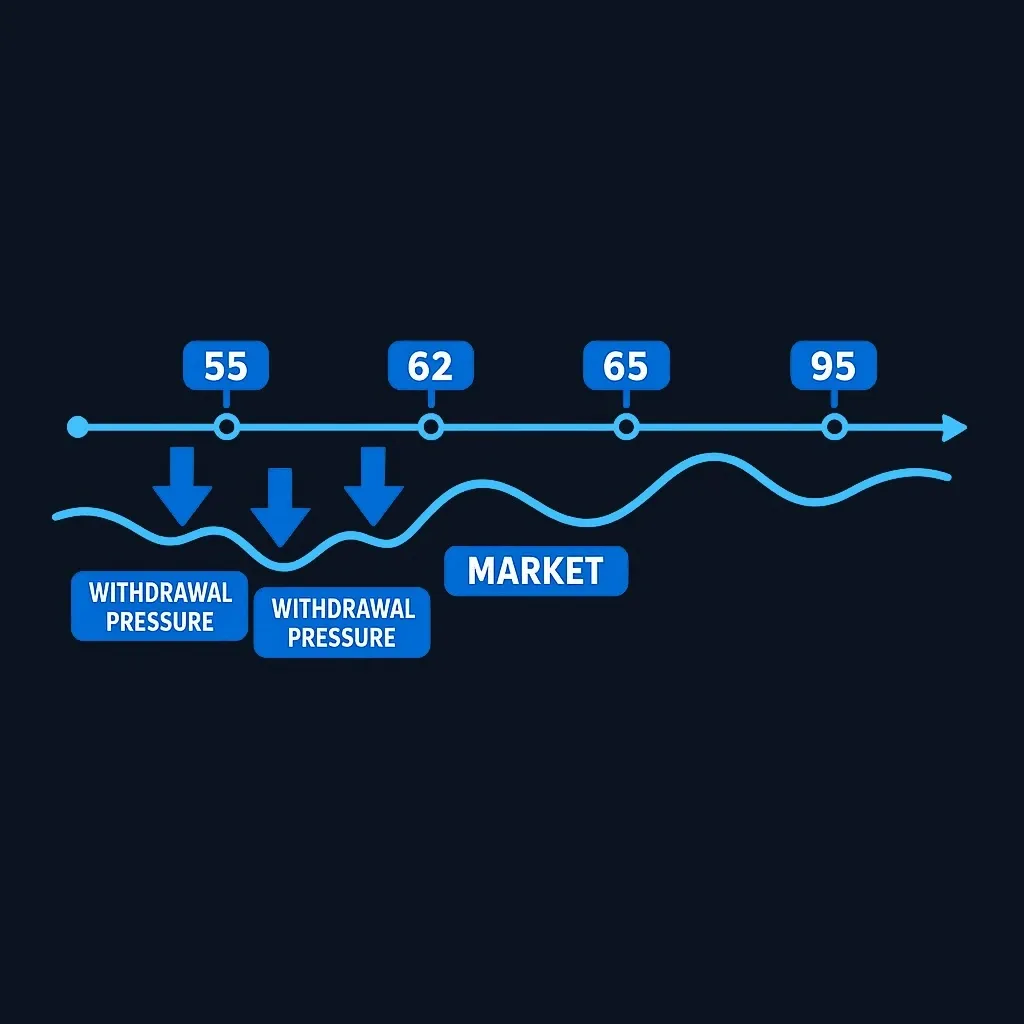
Retiring at 55 typically requires your savings to support 30–40+ years of living, depending on lifespan and retirement activities. That long horizon raises two challenges: sequence-of-returns risk (early market drops combined with withdrawals) and inflation eroding purchasing power over decades.
Typical income and benefit timing to plan for
If you retire at 55, there may be a long gap before public benefits begin. The Social Security Administration says retirement benefits can generally start no earlier than age 62, while Medicare says most people first become eligible around age 65. Eligibility can differ in some circumstances, so check the official tools for your situation.
Educational note: because benefits timing, tax rules, and health coverage vary by situation, treat the examples here as illustrations, not a personalized plan.
Major cost buckets to estimate now
- Housing (mortgage, taxes, utilities, maintenance).
- Health insurance and out-of-pocket medical expenses before Medicare.
- Daily living (food, transport, clothing).
- Discretionary spending (travel, hobbies) and taxes on withdrawals. Estimate each category conservatively and stress-test your budget for inflation and unexpected large expenses.
Decision framework
This framework helps you decide whether $1M is sufficient, and what trade-offs to accept. Follow three steps: set a target safe spending rate, build a fallback income plan, and reduce risks.
Step 1 — Set a target safe spending rate
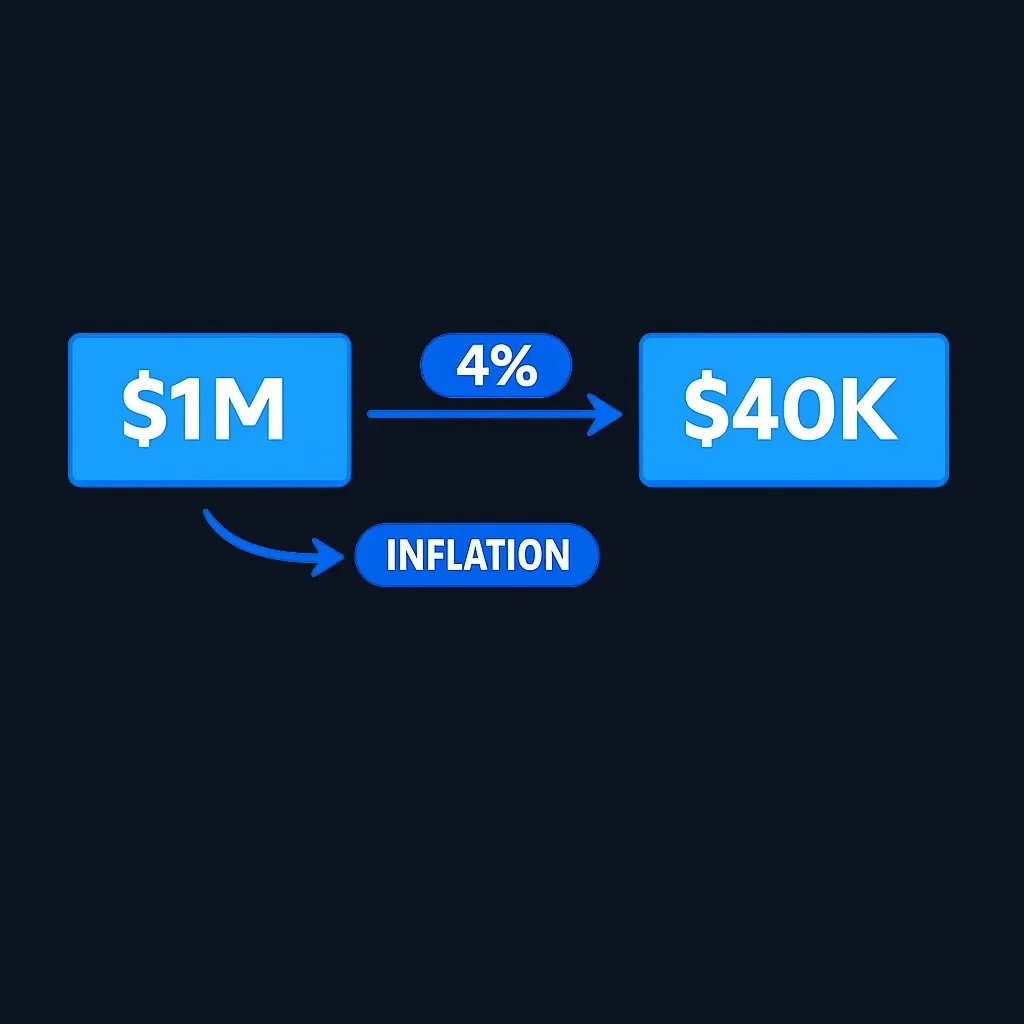
A common planning illustration starts with 4% of the initial portfolio in year one and adjusts that dollar amount for inflation later. For a $1 million portfolio, the arithmetic produces $40,000 in the first year. This is a model input, not a guarantee; longevity, fees, taxes, inflation, market returns, and later spending changes can produce very different outcomes.
How to pick a target:
- If $40,000 (4%) is materially below your expected living costs, either increase savings, reduce spending, add income, or accept higher portfolio risk.
- If you can live on substantially less (frugal lifestyle, paid-off home), $1M is more viable.
Educational note on risk: choosing a higher initial withdrawal increases the chance of depleting savings later. Pick assumptions aligned to your longevity, risk tolerance, and willingness to adjust spending.
Step 2 — Plan guaranteed or stable income to reduce sequence-of-returns risk
Guaranteed income (pensions, annuities, Social Security) reduces reliance on portfolio withdrawals. Examples and trade-offs:
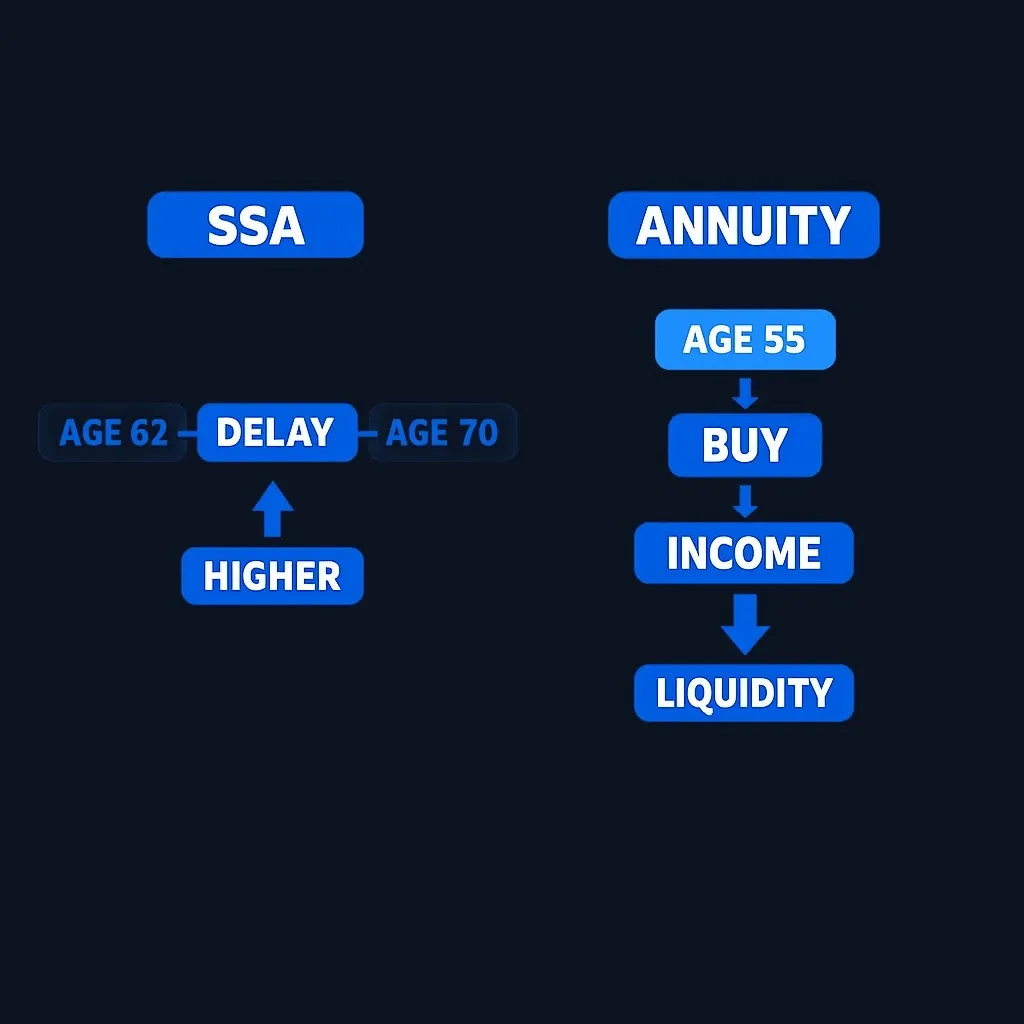
- Social Security: retirement benefits can generally start at age 62, and starting before full retirement age reduces the monthly amount. Use your official Social Security estimate rather than a generic average.
- Immediate annuities: an insurer may provide periodic payments in exchange for a premium, but payments, liquidity, fees, and guarantees depend on the contract and the insurer’s claims-paying ability. Review the contract and current quote; Investor.gov’s annuity overview explains the main features and risks.
Step 3 — Build flexibility and hedges
- Maintain a cash or short-term bond “bucket” covering 1–3 years of expenses to avoid forced withdrawals in downturns.
- Keep some growth allocation to outpace inflation, especially with a 30–40 year horizon.
- Have a plan for larger shocks: long-term care risk, major home repairs, family support.
Withdrawal strategies — comparison table
Below is a compact comparison to help choose an approach. Numbers that rely on the 4% concept are sourced.
| Strategy | How it works | Pros | Cons |
|---|---|---|---|
| 4% static illustration | Withdraw 4% of the initial portfolio in year 1, then adjust the dollar amount later | Simple planning scenario | Not a guarantee; sensitive to inflation, fees, longevity, taxes, and market sequence |
| Dynamic/variable withdrawals | Adjust withdrawals to portfolio returns or set a floor/ceiling | More resilient to market downturns | Requires discipline; spending may be volatile |
| Bucket strategy | Keep short-term cash for immediate expenses, bonds for mid-term, equities for growth | Reduces sequence risk; smoother spending | Needs active management; can underperform if too conservative |
| Partial annuitization | Exchange part of the portfolio for payments under an insurer’s annuity contract | May provide a predictable income stream | Reduces liquidity; costs, payments, and guarantees depend on the contract and insurer |
(Use the table to compare trade-offs. Verify current annuity and market conditions before acting.)
Practical checklist before you stop working
- Create a detailed annual budget and three stress scenarios (best, likely, worst).
- Model withdrawals under at least two strategies: 4% static and a dynamic rule.
- Obtain current health-insurance quotes for the years before Medicare eligibility and estimate out-of-pocket costs.
- Map Social Security claiming options using your official SSA benefit estimate.
- If evaluating an annuity, compare current insurer quotes, contract terms, fees, liquidity, and claims-paying ability.
- Keep an emergency reserve equal to 1–3 years of spending.
Case studies: realistic scenarios
These are hypothetical examples to show how the same $1M can support very different retirements. Numbers are illustrative; treat them as planning experiments, not predictions.
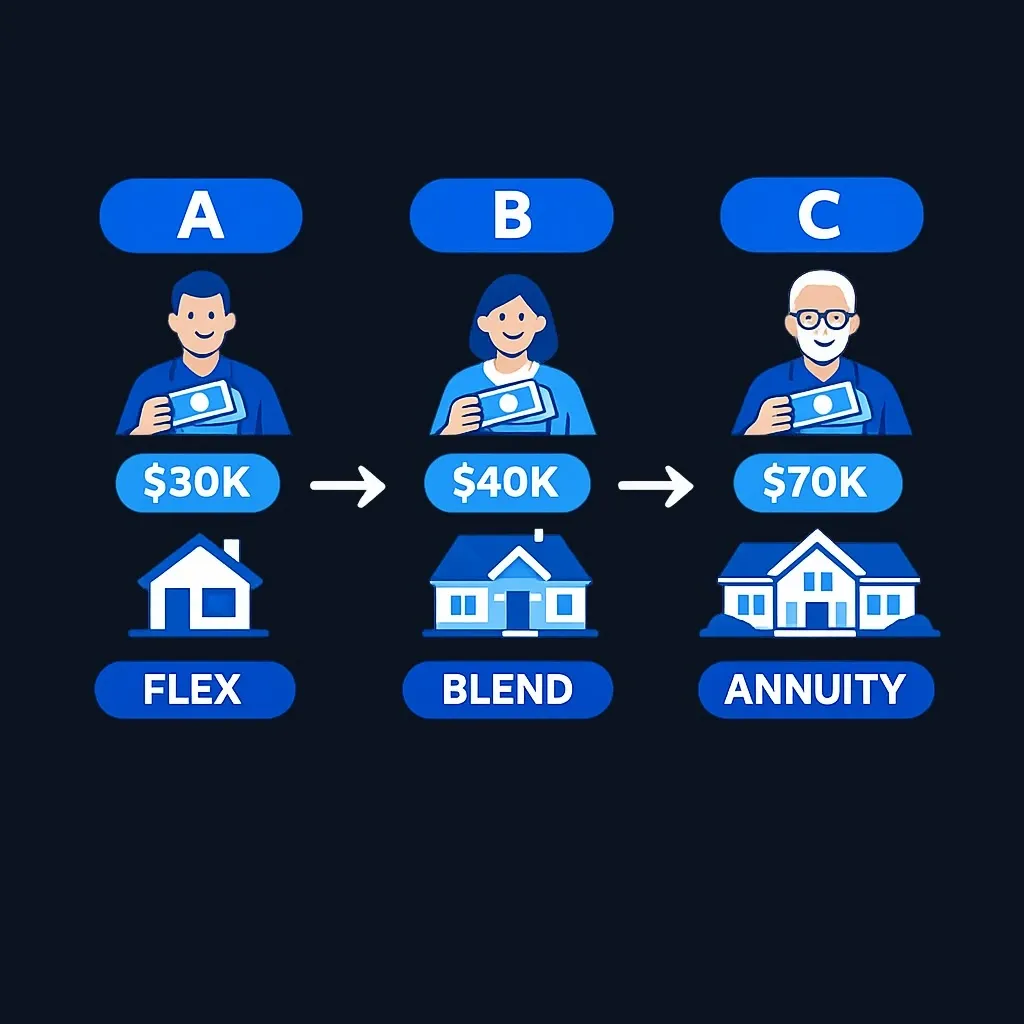
Case A — Frugal couple, low housing cost (Illustrative)
- Profile: Couple age 55, mortgage-free small home, conservative travel, low medical needs.
- Plan: Withdraw $30,000/year from portfolio, cover occasional health insurance from part-time consulting. Keep 2 years of cash and 40% in equities for growth.
- Likely outcome: Lower withdrawal pressure and smaller chance of depleting principal if disciplined; may leave legacy. Requires strong longevity planning.
Case B — Moderate lifestyle, moderate healthcare costs (Illustrative)
- Profile: Single, age 55, small mortgage, likes travel, expects higher health insurance until 65.
- Plan: Use a blended approach: withdraw $40,000/year initially (4% guideline), reduce discretionary spending in downturns, and convert 20% of portfolio to an annuity at 65 for baseline income.
- Likely outcome: Sustainable if markets perform reasonably and spending is flexible. Must budget carefully for private insurance pre-65.
Case C — High-spending retiree who buys partial annuity (Illustrative)
- Profile: Age 55, desires $70,000/year lifestyle and values guaranteed income.
- Plan: Compare a partial income-annuity scenario with keeping the portfolio liquid, using current written quotes and contract terms rather than an assumed payout rate.
- Likely outcome: Higher guaranteed income reduces sequence risk, but annuitization reduces liquidity and bequest potential. Check current annuity pricing and terms.
These scenarios show that lifestyle and income mix matter more than a headline “$1M.” The ability to adjust spending, generate partial guaranteed income, and cover health insurance are decisive.
Common mistakes to avoid
Here are repeatable mistakes people make when planning early retirement and how to fix them.
Mistake 1 — Ignoring the benefit gap (Social Security and Medicare)
Many plans overlook the gap before Social Security and Medicare eligibility. Fix: model those years separately with current insurance quotes, an SSA benefit estimate, and the official Medicare enrollment timeline.
Mistake 2 — Over-relying on a single rule without stress tests
Treat rules (like 4%) as starting points, not guarantees. Fix: run scenarios with market downturns in early retirement and a low-return sequence to see the worst-case effect.
Mistake 3 — Underestimating healthcare and long-term care costs
Health insurance premiums and out-of-pocket expenses before Medicare can be large. Fix: obtain actual premium quotes, budget conservatively, and consider supplemental long-term care planning.
Mistake 4 — No plan for flexibility
People assume fixed spending forever. Fix: define discretionary vs. essential spending, and pick concrete triggers for reducing discretionary spending if portfolio performance worsens.
Mistake 5 — Leaving all assets invested without short-term buffers
Fix: keep 1–3 years of expenses in cash or short-term bonds to avoid selling equities in a downturn.

Practice investing with Finelo
Build practical investing skills with guided lessons, simulator practice, and structured challenges.
Conclusion: Making informed decisions
Can you retire at 55 with $1 million? Possibly, but the result depends on spending, taxes, health care, longevity, other income, and market performance. A 4% planning illustration produces a $40,000 initial gross withdrawal, but it does not establish that the amount will be sustainable. Compare several withdrawal and income scenarios, including less favorable market and expense assumptions.
Before you decide:
- Build a detailed budget and three stress scenarios.
- Model withdrawal strategies (static 4%, dynamic, and partial annuity).
- Price actual health insurance and long-term care options for the years before Medicare.
- Consider partial guaranteed income to reduce sequence risk.
Verify current product pricing, annuity rates, and benefit rules before acting.
FAQs
Can I retire at 55 with $1 million?
Short answer: possibly, if planned spending, health coverage, taxes, and the gap before benefits fit a conservative range of tested scenarios. A 4% illustration equals a $40,000 initial gross withdrawal from $1 million, but it is not a promise of sustainability.
What is the 4% rule?
The 4% rule is a planning guideline that starts by withdrawing 4% of the initial portfolio in the first retirement year, then adjusts that dollar amount for inflation. It is a scenario input rather than a guarantee, and different tax, fee, longevity, inflation, and market assumptions can change the result.
How do I calculate my retirement expenses?
List fixed essential costs (housing, insurance, food) and discretionary costs (travel, hobbies). Add likely pre-Medicare health insurance costs and tax on withdrawals. Create three scenarios (frugal, expected, generous) and run withdrawal models for each.
How can I ensure my savings last through retirement?
Test several methods instead of relying on one forecast: lower initial withdrawals, flexible discretionary spending, short-term reserves, and available pension or annuity income. If an annuity is part of the comparison, verify its payments, fees, liquidity limits, guarantees, and insurer strength from the current contract and quote.
Sources and Further Verification
- Fidelity
- Social Security Administration retirement planner
- Medicare enrollment timing
- Investor.gov annuity overview
More from Finelo
- 1031 Exchange vs. Opportunity Zone: Key Differences
- 83(b) Election: Deadlines, Tax Risks, and When Early Filing May Fit
- After-Tax 401(k) vs. Roth 401(k): Key Differences
Disclaimer
This article is provided by Finelo for educational and informational purposes only. Finelo does not provide financial, investment, tax, legal, or insurance advice. Consider your circumstances and consult an appropriately qualified professional before making financial decisions.
InvestingBeginner GuideFinancial Education
Practice investing with Finelo
Build practical investing skills with guided lessons, simulator practice, and structured challenges.
About the author
Finelo Team
The Finelo Team creates practical investing and trading education designed to help beginners learn faster with structured challenges, simulator practice, and bite-sized lessons.
Keep reading — Related articles

Investing
Yield to Call vs Yield to Maturity: Assumptions and Bond Risks
Yield to call (YTC) estimates a bond's yield if the issuer redeems it on an eligible call date; yield to maturity (YTM) estimates yield if it remains outstanding to final maturity.
Finelo Team
Investing
Will My Employer Know If I Take a 401(k) Loan?
Who this page is for: readers new to 401(k) loans who want a practical, privacy‑focused explanation — what your employer can see, how to limit visibility, and the financial tradeoffs to weigh.
Finelo Team
Investing
What Medical Expenses Qualify for a 401(k) Hardship Withdrawal?
Before you decide, confirm three things with your plan administrator:
Finelo Team