Last editorial review: September 8, 2026
Retirement Withdrawal Order: Tax-Aware Account Sequencing Strategies
There is no universal retirement withdrawal order. Compare RMDs, basis, gains, Social Security, Medicare, state tax, estate goals, and current versus expected tax rates.
9 min read
Practice investing with Finelo
Build practical investing skills with guided lessons, simulator practice, and structured challenges.
Want to learn more?
Build practical investing skills with guided lessons, simulator practice, and structured challenges.
Explore FineloExplore Finelo's 28-day challenges
Turn learning into a daily habit with guided challenge paths.
U.S. scope: This article discusses U.S. institutions, financial products, tax rules, and dollar examples unless stated otherwise. Rules and product terms may change; verify current official guidance for your situation.
Quick answer
There is no legally required “best” retirement withdrawal order beyond meeting applicable distribution rules. Taxable-first, tax-deferred-next, and Roth-last is one planning heuristic, not a default that minimizes tax for everyone. Required minimum distributions, taxable gains, after-tax basis, Social Security, Medicare premiums, state tax, estate goals, and current versus expected tax rates can justify a blended sequence (Fidelity, IRS RMD guidance).
Educational note: this content is educational, not financial advice. Withdrawal sequencing affects taxes and longevity of assets; consider your objectives, time horizon, and consult a professional when making binding decisions.
Who this is for
This page is for decision-ready retirees and pre-retirees who understand the account types (taxable, tax-deferred, tax-free) and are choosing a specific withdrawal plan. If you are evaluating tradeoffs — whether to take money now from taxable brokerage accounts, convert some tax-deferred assets to Roth, or delay distributions to let tax-deferred growth continue — this guide helps you compare common approaches, recognize constraints (like required minimum distributions), and weigh tax outcomes.
If you are still learning basic account differences, look up those terms before using the decision guidance here. This material assumes you can translate goals (income needs, legacy intent, tax-smoothing) into sequencing choices.
Key benefits
Following a tax-aware withdrawal order aims to:
- Reduce lifetime taxes by taking advantage of lower tax years and preserving tax-free growth.
- Smooth taxable income to avoid spikes that trigger higher bracket-based taxes, Medicare surcharges, or other income-linked costs.
- Preserve flexibility and legacy options by leaving tax-free buckets for later withdrawals or heirs.
- Make cashflow predictable so Social Security, pensions, and portfolio withdrawals work together.
Checklist before finalizing a withdrawal sequence
- Do I have immediate cash needs that taxable accounts can fill without triggering extra taxes or penalties?
- Am I subject to required distributions now or soon, and will delaying withdrawals increase future taxable income?
- Are there low-tax years where partial Roth conversions would make sense?
- Do I want to preserve tax-free assets for late-life spending or inheritances?
These benefits are the reason retirement withdrawal planning is a central part of tax-aware retirement strategy Savvy tax withdrawals | Fidelity.
How it works
Understand the building blocks, sequencing frameworks, and practical checks you can apply.
Account types and how withdrawals generally affect taxes
- Taxable brokerage accounts: moving cash out is not itself taxable, but selling assets can create capital gain or loss; dividends and interest have their own rules, and basis matters.
- Tax-deferred accounts (traditional IRAs/401(k)s): taxable distributions are generally ordinary income, but after-tax basis can make part of a distribution nontaxable.
- Roth IRAs: qualified distributions are generally tax-free. Nonqualified withdrawals and inherited Roth IRAs have separate ordering and post-death distribution rules (IRS Publication 590-B).
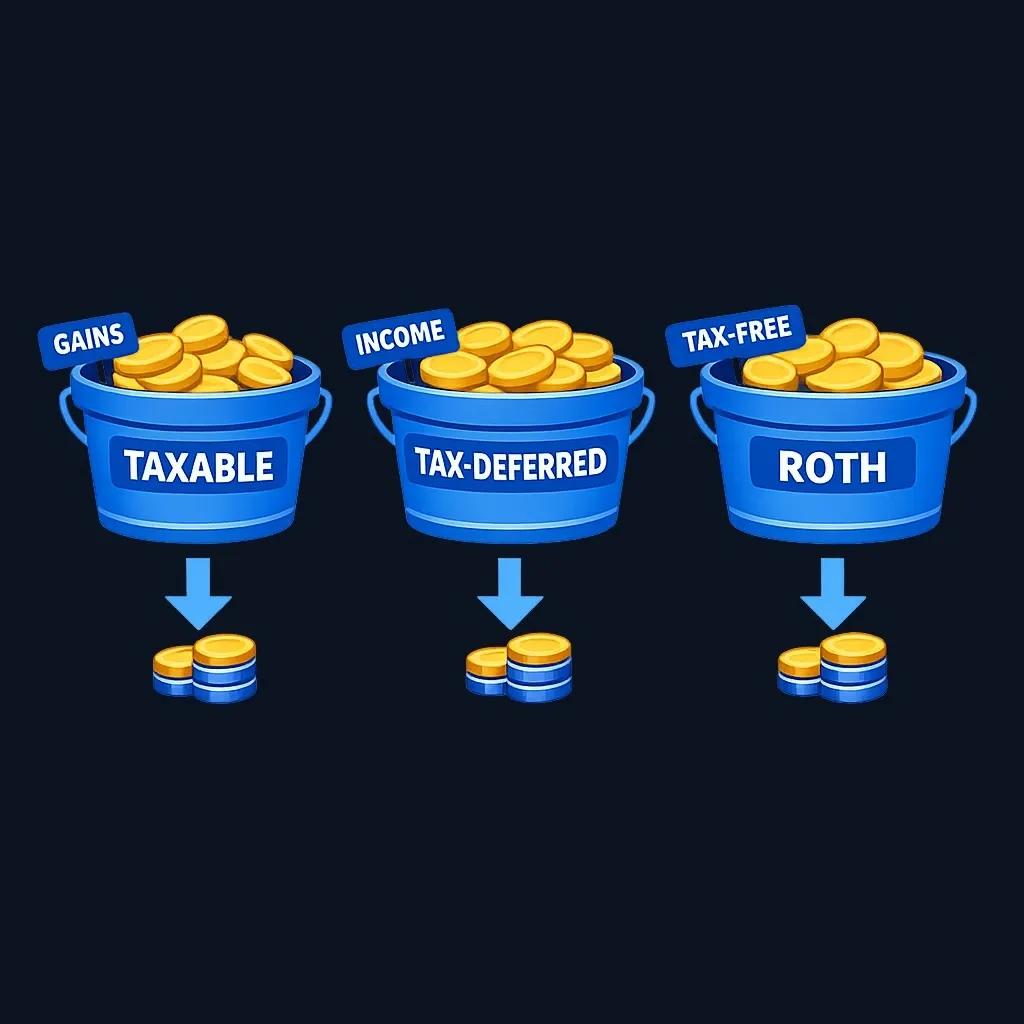
These broad tax characteristics are the foundation of sequencing decisions: use taxable buckets when you can do so without high taxes, draw tax-deferred amounts when necessary or when you need to manage tax brackets, and save Roth-like buckets for later tax-free flexibility Savvy tax withdrawals | Fidelity.
Sequencing frameworks (decision rules of thumb)
- Preservation-first approach: use taxable first, tax-deferred second, tax-free last. Rationale: taxable funds let you meet needs while preserving tax-advantaged growth.
- Tax-smoothing approach: blend withdrawals across account types to keep taxable income within a target range over multiple years.
- Conversion-first approach (when appropriate): perform partial Roth conversions during low-income years to reduce future tax liabilities and required distribution pressure.
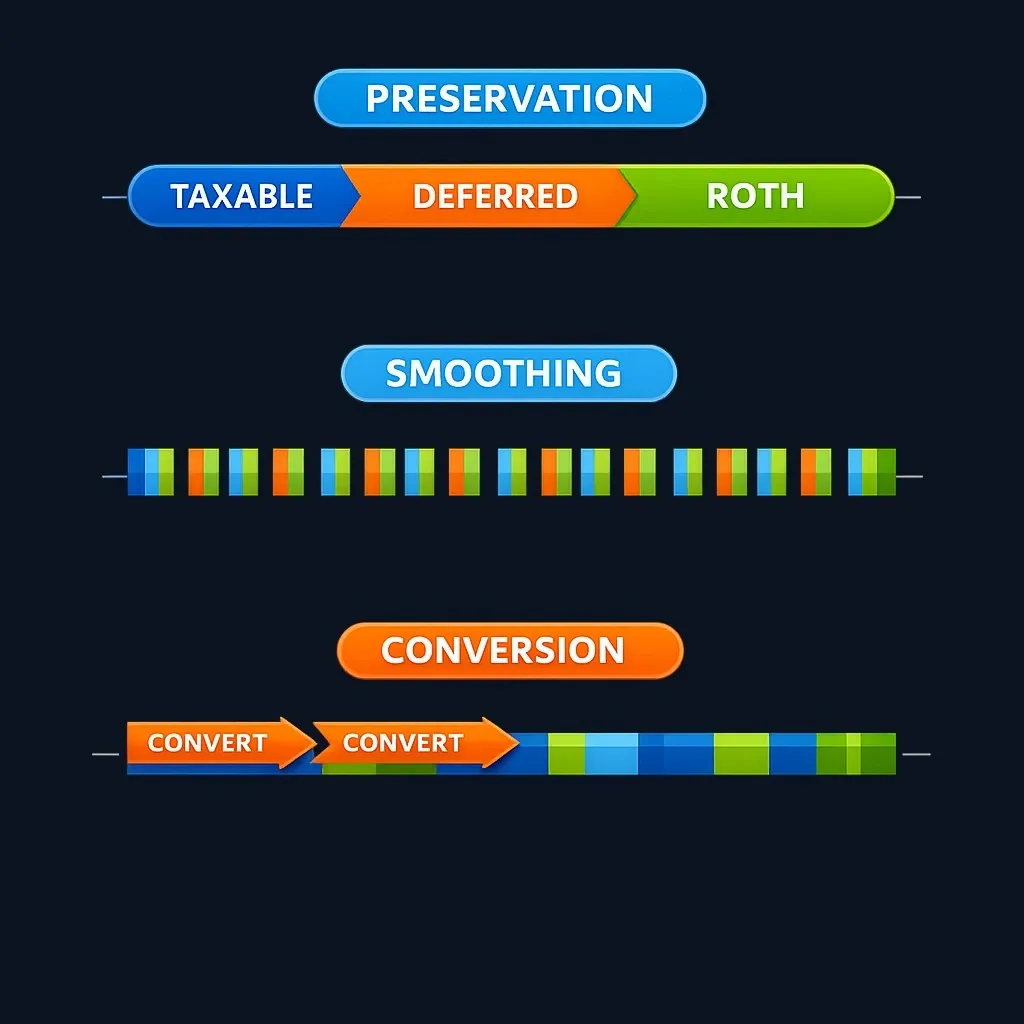
No single framework fits everyone. Use the one that aligns with your goals: minimize lifetime taxes, support specific cashflow needs, or leave a tax-advantaged legacy.
Practical checks before executing a sequence
- Check upcoming required distributions and time them into your plan.
- Project tax brackets under expected withdrawals and Social Security.
- If you plan Roth conversions, model multi-year conversion paths to avoid pushing yourself into a higher bracket.
- Consider state tax rules and income-based costs (e.g., Medicare-related surcharges) when smoothing income.
Factors Influencing Your Withdrawal Strategy
Your personal circumstances change the optimal order. Key factors and how they affect sequencing:
Age and timing
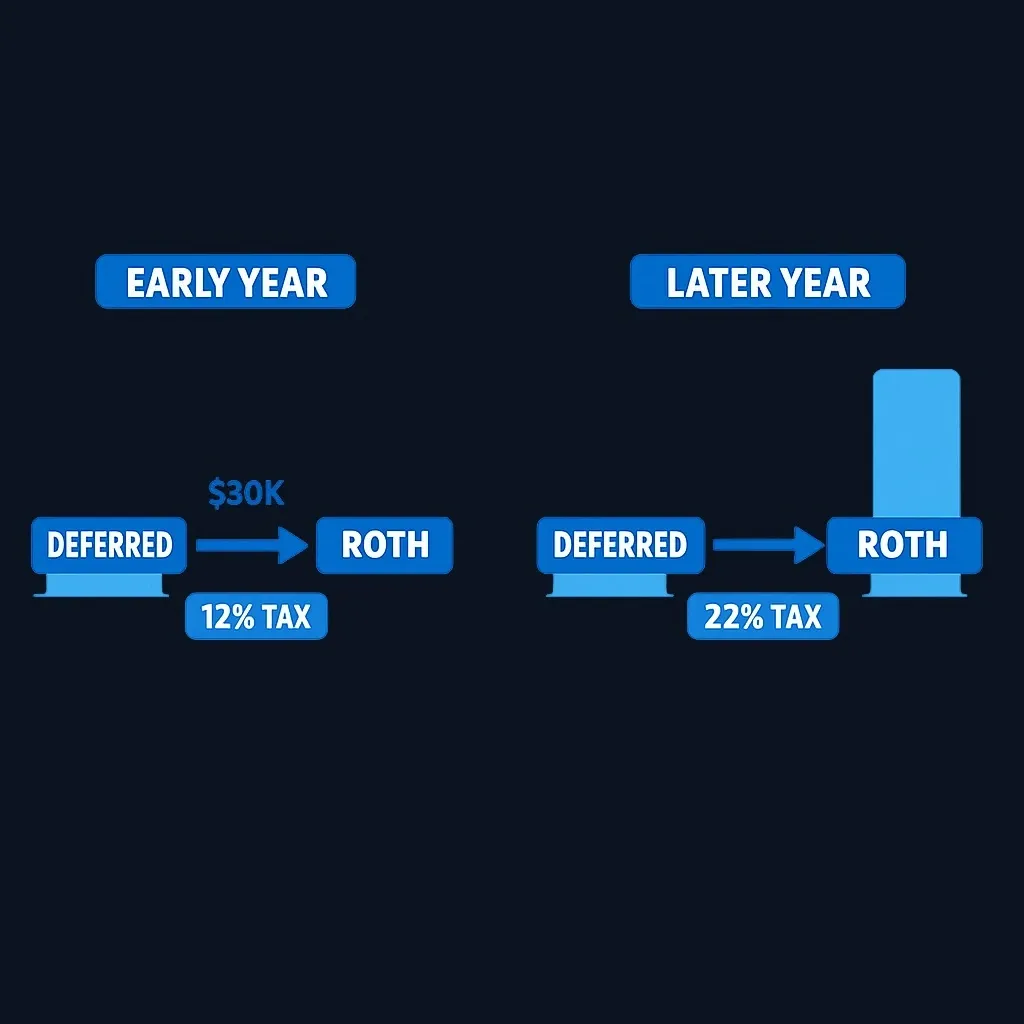
Your stage in retirement alters priorities. Early retirement years may allow tax-efficient Roth conversions; later years may be constrained by required distributions and higher mandatory withdrawals.
Example: someone in early retirement with a lower income year might convert some tax-deferred assets to Roth to reduce future taxable withdrawals; someone subject to immediate distribution rules will prioritize meeting those mandated withdrawals.
Health, spending needs, and horizon
Higher expected health or long-term care costs push toward maintaining liquid taxable reserves and preserving Roth assets for unpredictable late-life needs.
Tax profile and policy sensitivity
If you expect higher future tax rates (personal or legislative), favor moving taxable-deferred dollars into tax-free vehicles when possible. If you expect your tax rate to fall, drawing tax-deferred funds earlier can be sensible.
Estate and legacy intentions
If leaving tax-free assets to heirs is a priority, conserve Roth assets. If leaving taxable assets is acceptable, income sequencing can shift accordingly.
Market conditions and sequence risk
Withdrawals during market downturns reduce portfolio longevity. Consider sequencing strategies that reduce forced selling in down markets — for example, keeping a short-term cash buffer in taxable accounts or using a glidepath for withdrawals to avoid selling discounted assets immediately.
Planning prompt: model whether a cash reserve could reduce forced sales during a downturn. The appropriate amount is personal and can be far shorter or longer than a generic range; holding more cash also has inflation and opportunity costs.
Worked examples and common questions
This section gives applied scenarios and addresses common objections.
Case study A — Income-first with taxable buckets (illustrative)
Situation: A retiree with modest, steady spending needs prefers simple predictability. Approach: Use taxable brokerage account proceeds early for routine spending, allowing tax-advantaged accounts to keep growing. This reduces the need to trigger taxes from traditional accounts and preserves Roth for late flexibility. Why it works: Taxable accounts can often supply income without immediate ordinary income tax, while tax-deferred accounts continue tax-deferred growth if not required.
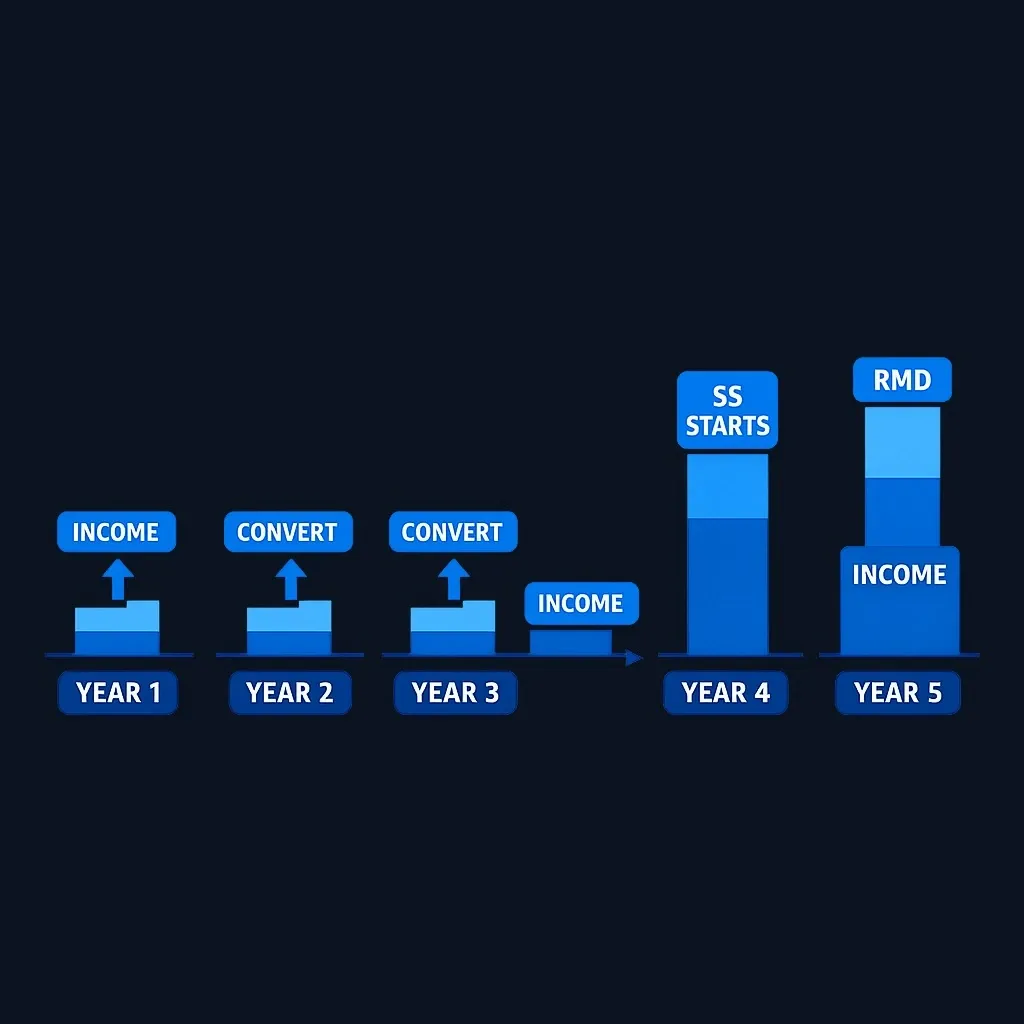
Case study B — Tax-smoothing and partial conversions (illustrative)
Situation: A retiree expects Social Security + modest pensions to start later, creating a multi-year window of low taxable income. Approach: Use that window for partial Roth conversions spread across several years to “fill” lower brackets now and reduce future required distributions. Why it works: Conversions now may be taxed at lower marginal rates and shrink future ordinary-income withdrawals.
Objection: “Why not use Roth money first to avoid taxes?”
Response: Using Roth early sacrifices your tax-free growth and removes a flexible hedge against future tax or unexpected expenses. For many people, conserving Roth for later preserves flexibility and legacy options.
Objection: “Isn’t the standard order always best?”
Response: Not always — required minimum distributions, very large taxable gains, urgent spending needs, or estate goals may alter the sequence. The “standard” order is a starting framework — model your specific tax and cashflow profile before committing.
Evidence and rationale for tax-aware sequencing are consistent with tax-focused retirement guidance Savvy tax withdrawals | Fidelity.
Practice investing with Finelo
Build practical investing skills with guided lessons, simulator practice, and structured challenges.
Comparison checklist: common withdrawal strategies
Use this compact checklist to compare approaches and decide which to model further.
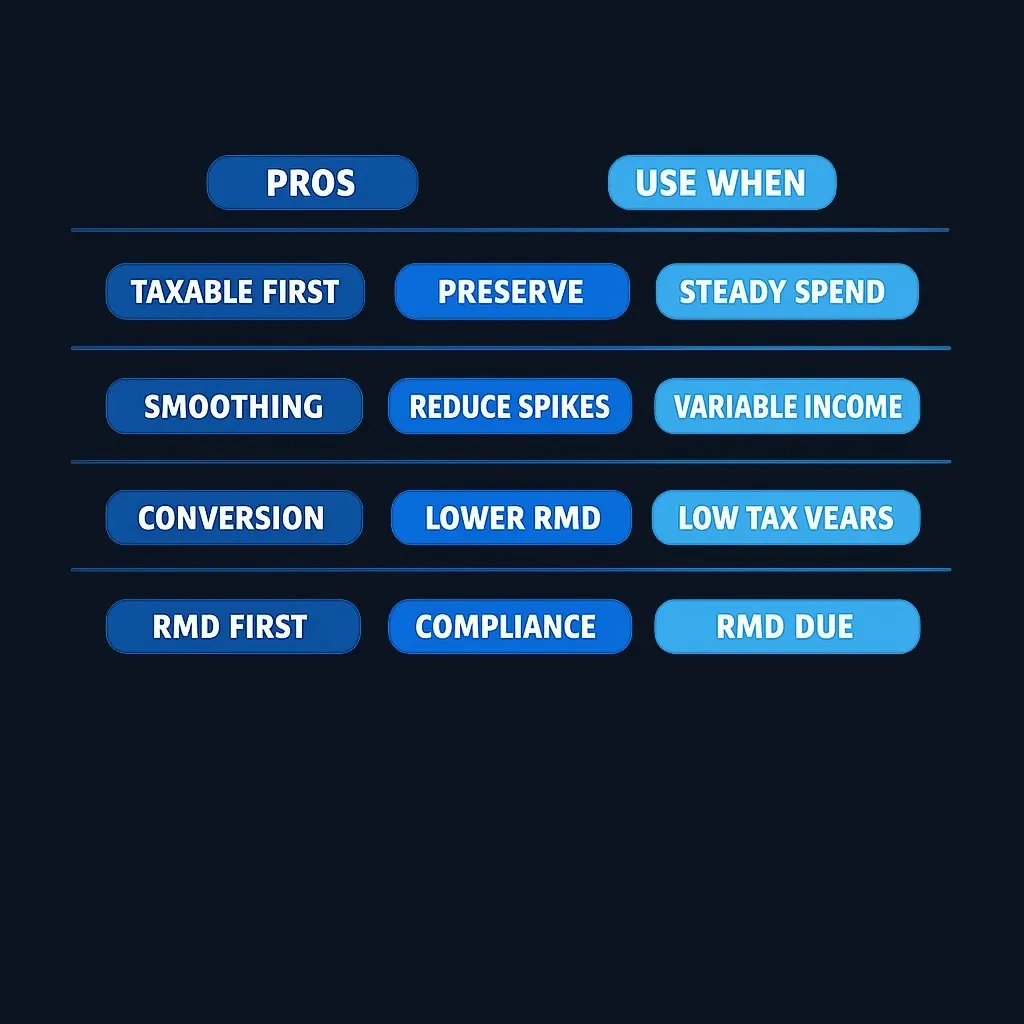
- Taxable-first
- Pros: preserves tax-advantaged accounts; simple.
- When to use: steady spending, want to preserve Roth for later.
- Tax-smoothing (mixed withdrawals)
- Pros: reduces year-to-year tax spikes.
- When to use: variable income sources or to avoid bracket creep.
- Roth-conversion window
- Pros: lowers future required taxable distributions.
- When to use: temporary low-income years or anticipated higher future tax rates.
- Required distributions-first (compliance-driven)
- Pros: meets mandatory rules; avoids compliance issues.
- When to use: when RMDs are due or when planning to minimize penalties.
After selecting candidate strategy(ies), run a multi-year projection to compare taxable income, Medicare implications, and remaining balances.
FAQs on Retirement Withdrawals
What is the best order to withdraw from retirement accounts?
There is no universal “best.” Taxable-first, tax-deferred-next, and Roth-last is one heuristic. A multi-year projection may favor blended withdrawals or conversions after accounting for RMDs, basis, capital gains, Social Security, Medicare, state tax, and estate objectives.
How can I minimize taxes on my withdrawals?
Tax minimization strategies include smoothing taxable income across years, using low-income years for limited Roth conversions, and timing withdrawals to avoid pushing yourself into higher tax brackets. Model multiple-year scenarios and consider interactions with Social Security and other income sources Savvy tax withdrawals | Fidelity.
What happens if I don't take my RMDs?
Failing to take required distributions can create tax and compliance consequences under tax law. Check official IRS guidance or consult a tax professional to confirm current rules and remedies.
Can I withdraw from my Roth IRA at any time?
Rules differ for contributions versus earnings. Typically, contributions (what you put in) are more accessible than earnings, which may be subject to conditions to be qualified tax-free. Confirm how withdrawals interact with your account’s rules before taking funds.
Conclusion and Next Steps
Key takeaways
- Treat withdrawal sequencing as a tax and cashflow optimization problem, not a fixed rule.
- Commonly, taxable accounts first, tax-deferred next, and tax-free last is a sensible starting order; adjust for required distributions, conversions, and personal goals Savvy tax withdrawals | Fidelity.
- Use multi-year projections, factor in market sequence risk, and account for healthcare or estate goals before locking in a plan.
Next step (recommended): map your expected income sources, identify any upcoming required distributions, and run a simple multi-year taxable-income projection. If helpful, consult a tax professional or licensed planner to test conversion and withdrawal scenarios.
(Optional CTA) Learn more about sequencing strategies and modeling tools with Finelo’s educational resources or schedule a planning session with your advisor.
Sources and Further Verification
- Savvy tax withdrawals Fidelity
- IRS: Required minimum distribution FAQs
- IRS Publication 590-B: IRA distribution and Roth rules
- IRS Publication 575: Pension and annuity income
More from Finelo
- 1031 Exchange vs. Opportunity Zone: Key Differences
- 83(b) Election: Deadlines, Tax Risks, and When Early Filing May Fit
- After-Tax 401(k) vs. Roth 401(k): Key Differences
Disclaimer
This article is provided by Finelo for educational and informational purposes only. Finelo does not provide financial, investment, tax, legal, or insurance advice. Consider your circumstances and consult an appropriately qualified professional before making financial decisions.
InvestingBeginner GuideFinancial Education
Practice investing with Finelo
Build practical investing skills with guided lessons, simulator practice, and structured challenges.
About the author
Finelo Team
The Finelo Team creates practical investing and trading education designed to help beginners learn faster with structured challenges, simulator practice, and bite-sized lessons.
Keep reading — Related articles

Investing
Yield to Call vs Yield to Maturity: Assumptions and Bond Risks
Yield to call (YTC) estimates a bond's yield if the issuer redeems it on an eligible call date; yield to maturity (YTM) estimates yield if it remains outstanding to final maturity.
Finelo Team

Investing
Will My Employer Know If I Take a 401(k) Loan?
Who this page is for: readers new to 401(k) loans who want a practical, privacy‑focused explanation — what your employer can see, how to limit visibility, and the financial tradeoffs to weigh.
Finelo Team
Investing
What Medical Expenses Qualify for a 401(k) Hardship Withdrawal?
Before you decide, confirm three things with your plan administrator:
Finelo Team