Last editorial review: September 8, 2026
RMD Tax Withholding: Federal Rules, Estimates, and Planning Questions
Required minimum distributions are generally taxed as ordinary income, and account owners can request federal withholding. Compare withholding with estimated payments and verify current IRS rules before choosing an approach.
9 min read
Practice investing with Finelo
Build practical investing skills with guided lessons, simulator practice, and structured challenges.
Want to learn more?
Build practical investing skills with guided lessons, simulator practice, and structured challenges.
Explore FineloExplore Finelo's 28-day challenges
Turn learning into a daily habit with guided challenge paths.
U.S. scope: This article discusses U.S. institutions, financial products, tax rules, and dollar examples unless stated otherwise. Rules and product terms may change; verify current official guidance for your situation.
Quick answer
The taxable portion of a required minimum distribution (RMD) is generally included in ordinary income; any after-tax basis or other tax-free portion requires separate calculation. Federal withholding may be elected on many RMD payments, but the default and available election depend on whether the payment is periodic or nonperiodic and on the account and payer (IRS Publication 575). Withholding and estimated payments are both tax-prepayment methods, not a change to the underlying tax owed. Educational note: this is educational information, not tax or investment advice. Tax results depend on your full financial picture; consult a tax professional for decisions tied to your situation.
What to know before deciding
This section explains who must worry about RMDs, the core tax effect, the risk if you miss one, and the practical withholding choices custodians typically offer.
Who needs to worry about RMDs
If you hold retirement accounts that are subject to RMD rules, you must take annual minimum withdrawals once required by IRS rules. The timing varies by account type and life event; check the IRS RMD FAQ for official start dates and account-specific rules. After reading this page, you should be able to identify whether your accounts are likely subject to RMDs and where to verify exact dates.
Tax implications in brief
The taxable portion of an RMD increases income for the year. Nondeductible IRA basis or another tax-free component can change the amount included in gross income (IRS RMD FAQ). RMD income can affect marginal tax rates, income-related Medicare premiums, or the taxable portion of Social Security benefits. Estimate the full-year result before choosing withholding or estimated payments.
Consequences of missing an RMD
If you fail to take the full RMD by the deadline, the IRS can assess an excise tax on the shortfall. Consult current IRS guidance for the calculation and available correction procedures. If you miss an RMD, consider acting promptly, documenting the transaction, and discussing relief options with a qualified tax professional.
Withholding options — quick comparison
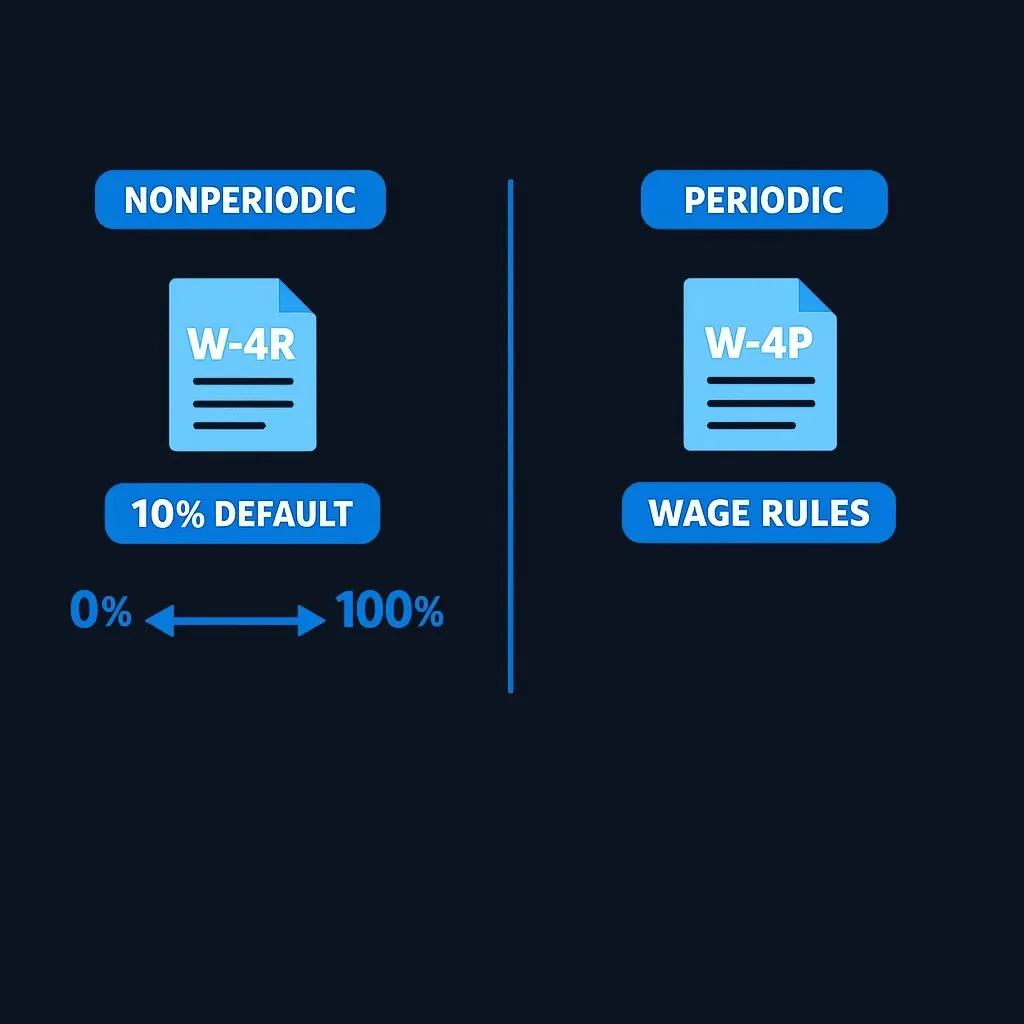
Federal rules generally permit a recipient to elect withholding on taxable retirement distributions that are not eligible rollover distributions, including many RMD payments. A nonperiodic payment generally has 10% default withholding unless another permitted rate is elected on Form W-4R; periodic payments use Form W-4P and wage-style rules (IRS Publication 575, 2026 Form W-4R). Confirm the payment type and form with the payer.
| Option | How it works | When it fits |
|---|---|---|
| No withholding; pay estimated taxes | You receive the full RMD and pay quarterly estimated taxes or a larger payment at tax filing | If you want maximum cashflow and can reliably pay estimated taxes |
| Flat percentage withholding | Custodian withholds a fixed percent of each distribution | If you want a simple, automatic prepayment method |
| Withhold to approximate marginal tax on added income | Estimate your combined income and set withholding to cover the RMD’s incremental tax | If you can forecast other income and want to avoid year‑end surprises |
Practical tip: custodians’ forms and percentage choices vary. If unsure, ask your custodian whether they accept a custom percentage, let you change elections mid‑year, or require a specific form.
How is RMD calculated?
This section gives the core formula, a step‑by‑step calculation, and two worked examples that show how the method applies to different account situations.
Core formula and official tables
The basic calculation uses the prior-year December 31 account balance divided by an IRS life-expectancy factor to produce that year’s RMD. For official tables, divisors, and examples, see the IRS RMD FAQ linked in the source section.
Step‑by‑step:
- Get the account balance as of December 31 of the prior year.
- Find your age and the matching divisor in the IRS life‑expectancy table.
- Divide the balance by that divisor. The result is the RMD for the current year.
- Repeat for each account required to have an RMD, applying aggregation rules only where current IRS rules allow them.
Worked example — single traditional IRA
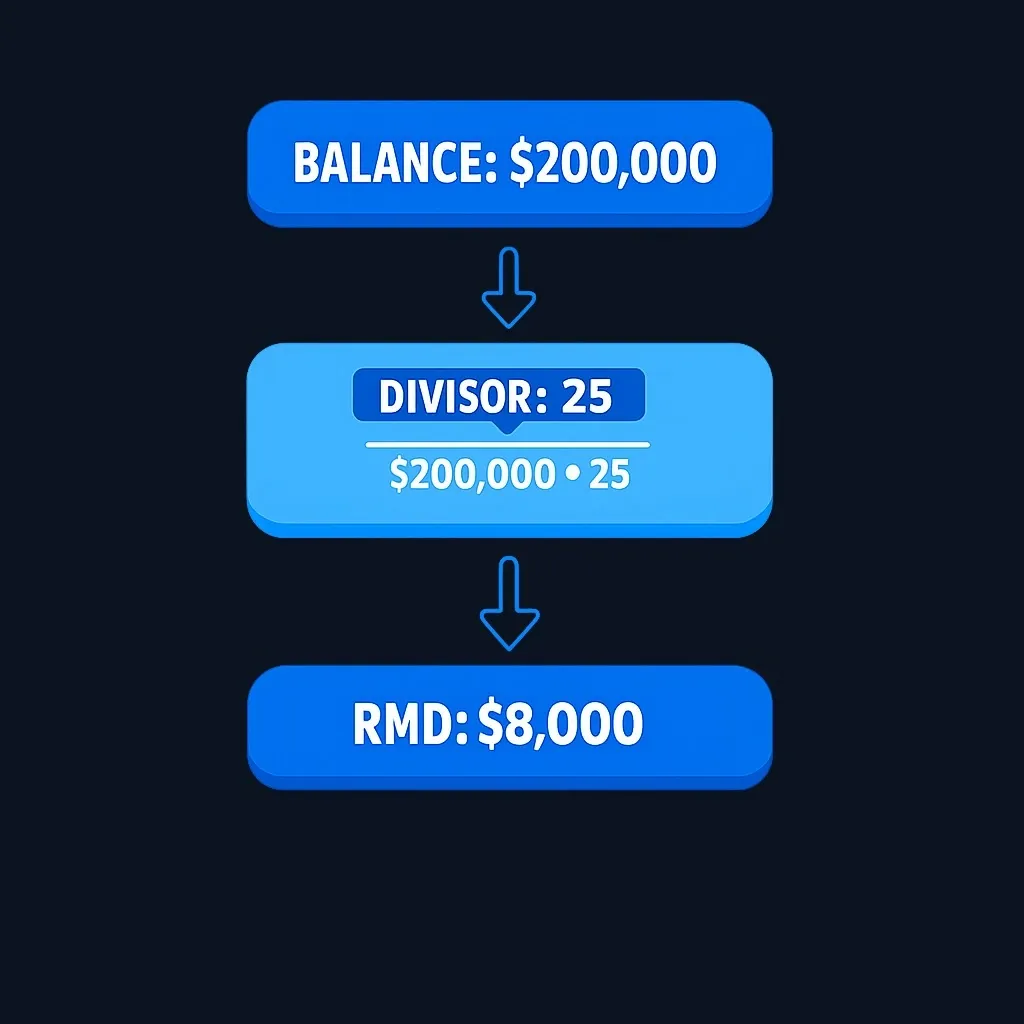
- Prior‑year December 31 balance: $200,000 (hypothetical).
- Assumed divisor for this arithmetic illustration only: 25.
- Illustrative result: $200,000 ÷ 25 = $8,000. This is not the reader's required amount. The actual divisor must come from the applicable current IRS table and personal facts.
Worked example — two accounts and aggregation note
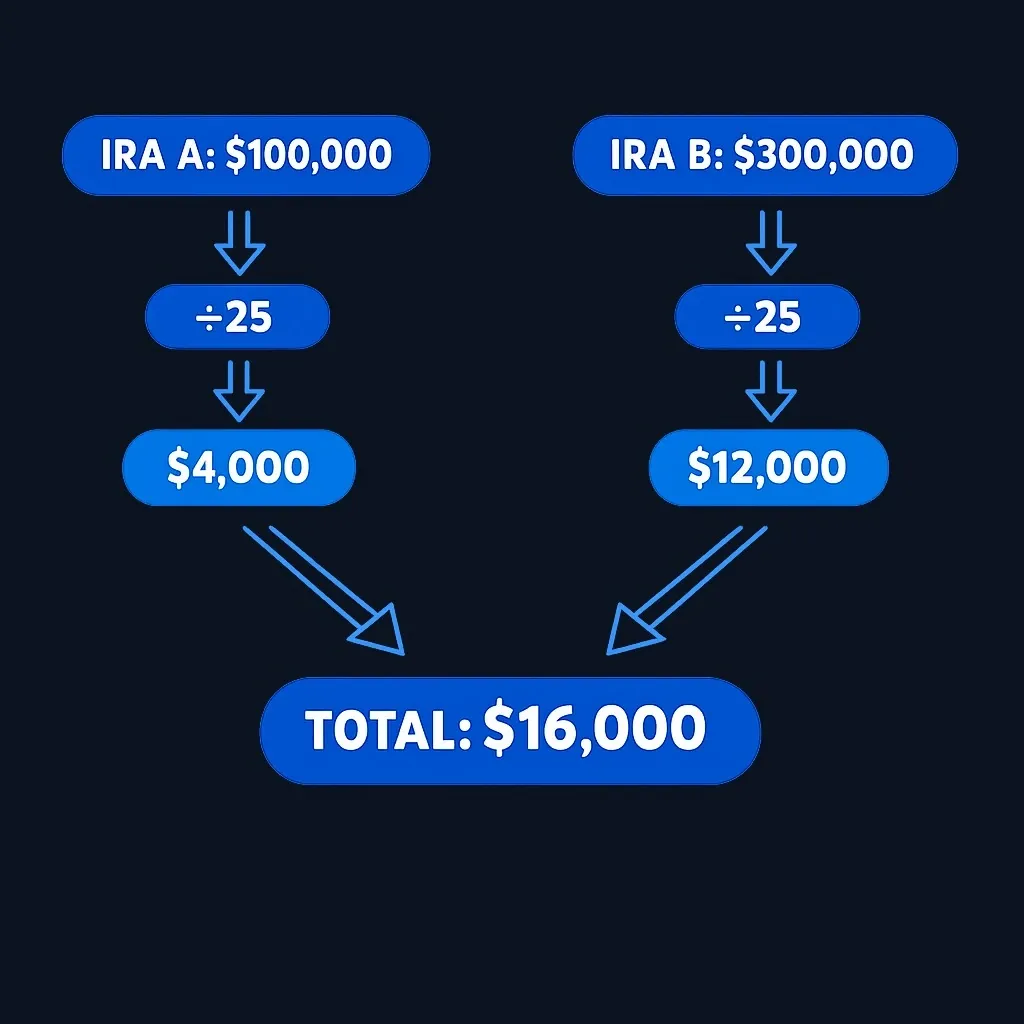
Scenario: you have traditional IRA A ($100,000) and traditional IRA B ($300,000) on December 31. Calculate each account’s RMD separately, then apply aggregation only if current IRS rules permit it. Confirm the treatment with the IRS tables and your custodian. Illustrative math only: if 25 were the applicable divisor, IRA A would produce $4,000 and IRA B $12,000, for a combined $16,000. The actual divisor and aggregation rule must be verified for the year and account types.
Withholding options for RMDs
This section expands on practical choices, decision criteria, and how to set or change withholding.
How withholding works in practice
For a nonperiodic RMD payment, Form W-4R generally permits a rate from 0% through 100%, subject to special restrictions such as certain payments delivered outside the United States. Periodic pension or annuity payments use Form W-4P instead (2026 Form W-4R). Payer procedures and timing can still differ.
Choosing a withholding approach
- Match withholding to expected marginal tax: estimate your combined income, then choose a withholding percent that approximates the incremental tax the RMD will add.
- Prefer steady prepayment: if you dislike quarterly estimated payments, choose withholding to avoid underpayment.
- Prefer full cashflow now: decline withholding and make estimated payments as needed.
Common mistakes to avoid
- Using a single‑year view and forgetting other income sources. Simulate the full year’s taxable income before setting withholding.
- Assuming withholding from one account covers all RMDs across different account types—check aggregation rules.
What happens if you miss an RMD?
If you fail to withdraw the required amount on time, the IRS may impose an excise tax on the shortfall; consult current IRS guidance for the calculation and available relief options. Possible corrective steps include taking the missed distribution and documenting the reason. A qualified tax professional can help you evaluate the current correction and reporting procedures.
Practice investing with Finelo
Build practical investing skills with guided lessons, simulator practice, and structured challenges.
Strategies for managing RMDs
Below are commonly used planning strategies and practical examples of when each can help. All strategies have tradeoffs; consult a tax advisor before acting.
Two widely used strategies
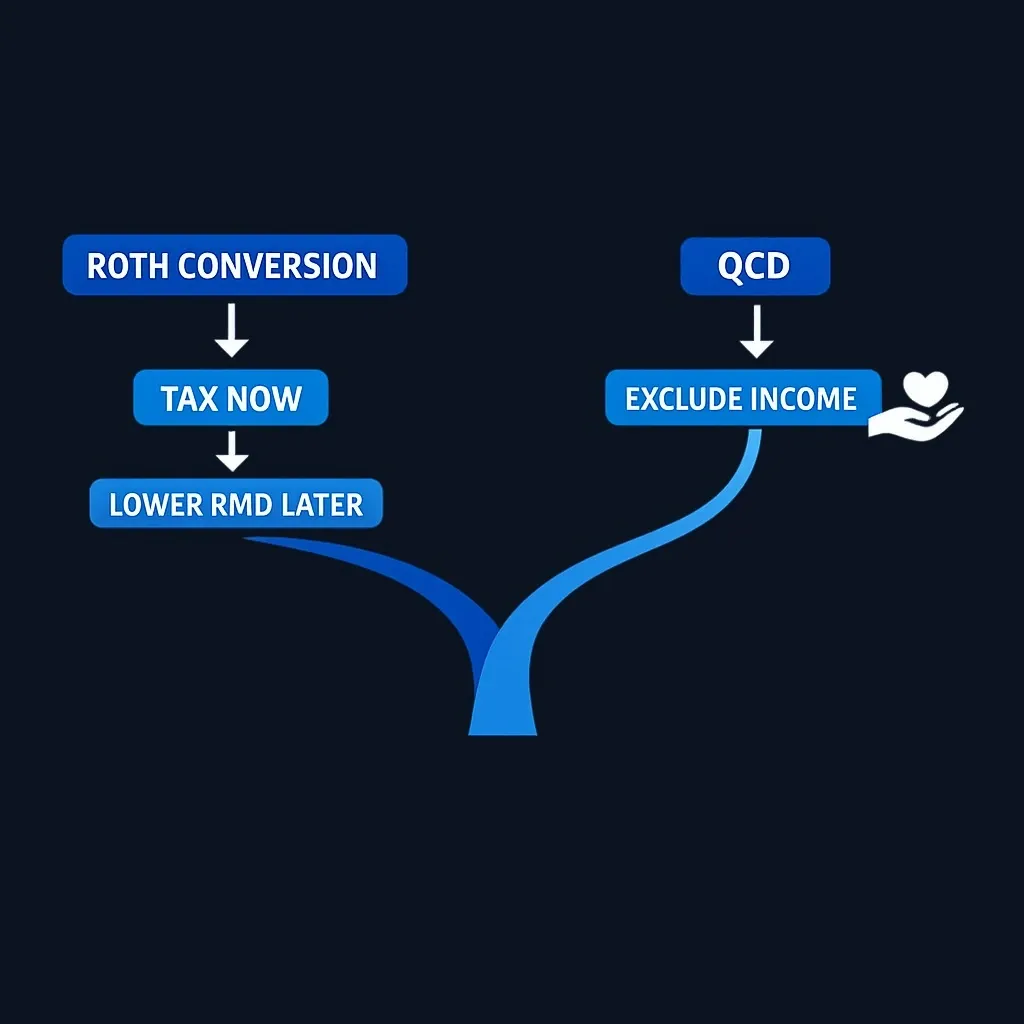
- Roth conversions (before RMDs begin): converting some pre‑tax retirement dollars to a Roth IRA can reduce future taxable RMDs because Roth IRAs are generally not subject to RMDs during the original owner’s lifetime. Roth conversions trigger current tax on the converted amount, so timing and amounts matter.
- Qualified charitable distributions (QCDs): once eligible, QCDs let you transfer up to a statutory limit directly from an IRA to a qualified charity and potentially exclude that amount from taxable income. QCDs must meet IRS rules and recipient requirements.
Both tools require planning: conversions increase taxable income the year converted; QCDs have documentation rules. Discuss timing, tax brackets, and charitable goals with a professional.
Cashflow and year‑by‑year choices
If a year’s market drops make RMDs small, you might accept withholding at a lower rate. If an unusually large liquidity need occurs, decrease withholding and pay estimated taxes. Revisit withholding elections whenever your income picture or retirement plan changes.
Realistic scenario (example)
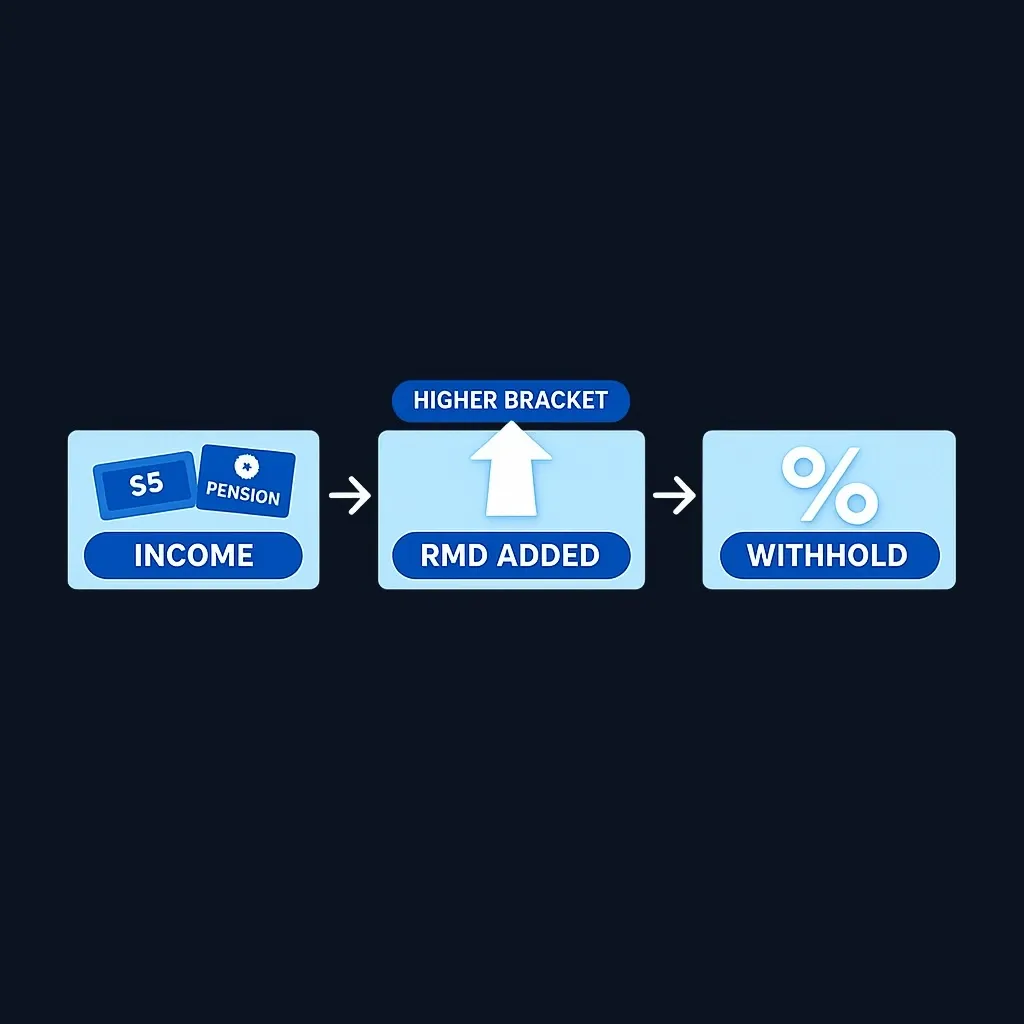
Scenario: a retiree expects pensions and Social Security to cover living expenses but faces a modest RMD that will push them into a higher bracket for that tax year. A targeted approach: estimate the marginal tax on added RMD income, elect withholding that covers that marginal tax, and—if appropriate—do a small Roth conversion in a lower‑income year to lower future RMDs. Run the numbers or work with an advisor before changing withholding or converting.
Decision framework
Use the checklist below to pick a practical withholding approach that matches goals, cashflow needs, and tax risk.
Step‑by‑step checklist
- Inventory accounts: list all retirement accounts, confirm which are subject to RMDs, and verify balances as of December 31 of the prior year.
- Project total taxable income: include wages, pensions, Social Security, and planned RMDs for the year.
- Estimate marginal tax impact: determine the additional tax the RMD will create.
- Choose tax‑payment method: elect custodian withholding to approximate that tax, or plan quarterly estimated payments if you want the full RMD amount now.
- Implement and document elections: submit custodian forms or calendar estimated payments.
- Review annually: adjust for market, income, or life changes.
Practical rule of thumb: if you prefer simplicity and want to avoid underpayment risk, favor some withholding. If you need full cashflow and are disciplined about paying estimated taxes, declining withholding can be reasonable.
FAQ
What is an RMD?
A required minimum distribution (RMD) is the minimum annual withdrawal the IRS requires from certain retirement accounts once distribution rules start for an owner. See the IRS RMD FAQ in the source section for official definitions, tables, and account-specific rules.
How is my RMD calculated?
Calculate an RMD by dividing the prior-year December 31 account balance by the applicable IRS life-expectancy divisor. Use current IRS tables and examples to identify the divisor and apply account-type aggregation rules where permitted.
Are RMDs taxed?
The taxable portion is generally included in ordinary income. A return of after-tax basis or another tax-free component is not taxed again, so “the entire RMD is taxable” is not universal (IRS Publication 575).
What should I do if I miss my RMD?
If you miss an RMD, consider taking the missed distribution promptly, keeping documentation, and consulting your custodian and a qualified tax professional about current relief and reporting procedures.
After reading this, you should be able to compute an illustrative RMD, choose between withholding or estimated taxes, and follow a short checklist to implement your choice. For printable checklists and calculators to bring to your custodian or tax advisor, Finelo publishes resources that can help turn this plan into action.
Sources and Further Verification
More from Finelo
- After-Tax 401(k) vs. Roth 401(k): Key Differences
- Tax Lien Investing for Beginners: Auctions, Returns, Costs, and Risks
- 1031 Exchange vs. Opportunity Zone: Key Differences
Disclaimer
This article is provided by Finelo for educational and informational purposes only. Finelo does not provide financial, investment, tax, legal, or insurance advice. Consider your circumstances and consult an appropriately qualified professional before making financial decisions.
InvestingBeginner GuideFinancial Education
Practice investing with Finelo
Build practical investing skills with guided lessons, simulator practice, and structured challenges.
About the author
Finelo Team
The Finelo Team creates practical investing and trading education designed to help beginners learn faster with structured challenges, simulator practice, and bite-sized lessons.
Keep reading — Related articles

Investing
Yield to Call vs Yield to Maturity: Assumptions and Bond Risks
Yield to call (YTC) estimates a bond's yield if the issuer redeems it on an eligible call date; yield to maturity (YTM) estimates yield if it remains outstanding to final maturity.
Finelo Team

Investing
Will My Employer Know If I Take a 401(k) Loan?
Who this page is for: readers new to 401(k) loans who want a practical, privacy‑focused explanation — what your employer can see, how to limit visibility, and the financial tradeoffs to weigh.
Finelo Team

Investing
What Medical Expenses Qualify for a 401(k) Hardship Withdrawal?
Before you decide, confirm three things with your plan administrator:
Finelo Team