Last editorial review: September 8, 2026
Stablecoins vs. Bitcoin: Uses, Volatility, Risks, and Key Differences
Stablecoins and Bitcoin have different use cases and risks. Compare volatility, reserves, redemption, custody, fees, tax reporting, platform terms, and potential loss before using either.
13 min read
Practice investing with Finelo
Build practical investing skills with guided lessons, simulator practice, and structured challenges.
Want to learn more?
Build practical investing skills with guided lessons, simulator practice, and structured challenges.
Explore FineloExplore Finelo's 28-day challenges
Turn learning into a daily habit with guided challenge paths.
U.S. scope: This article discusses U.S. institutions, financial products, tax rules, and dollar examples unless stated otherwise. Rules and product terms may change; verify current official guidance for your situation.
Quick comparison answer
Stablecoins are designed to reduce price variation relative to a reference asset, while Bitcoin is a market-priced crypto asset. Stablecoins can be used for transfers, settlement, or trading pairs, but “stable” does not mean insured, risk-free, or always redeemable at the stated value. Bitcoin adds substantial market-volatility risk. Compare purpose, issuer or protocol, reserves, redemption, custody, fees, tax reporting, platform terms, and potential loss before using either (Fidelity, Investor.gov).
What are stablecoins and Bitcoin?
Stablecoins in plain English
A stablecoin is a crypto asset designed around price stability. In practice, the user’s main reason for choosing one is often simple: they want digital money that behaves more like a known unit of account than a volatile crypto token. That makes stablecoins useful when the transfer amount matters more than potential price upside.
Stablecoins can be used inside crypto markets without immediately converting back to bank money. Fidelity notes that stablecoins are cryptocurrencies themselves, which is why they can work as trading pairs for more volatile tokens like bitcoin Fidelity. For an active trader, that can reduce operational friction. For a business, the appeal is different: a stable unit can make invoices, refunds, and treasury records easier to reason about.
The important detail is that “stable” describes the design goal, not a guarantee. A stablecoin still depends on its issuer, collateral model, smart contracts, exchange liquidity, and the blockchain network used for settlement. Before relying on one, a careful user checks how the coin is issued, what supports the peg, where it can be redeemed, and which network they are actually sending it on.
Bitcoin in plain English
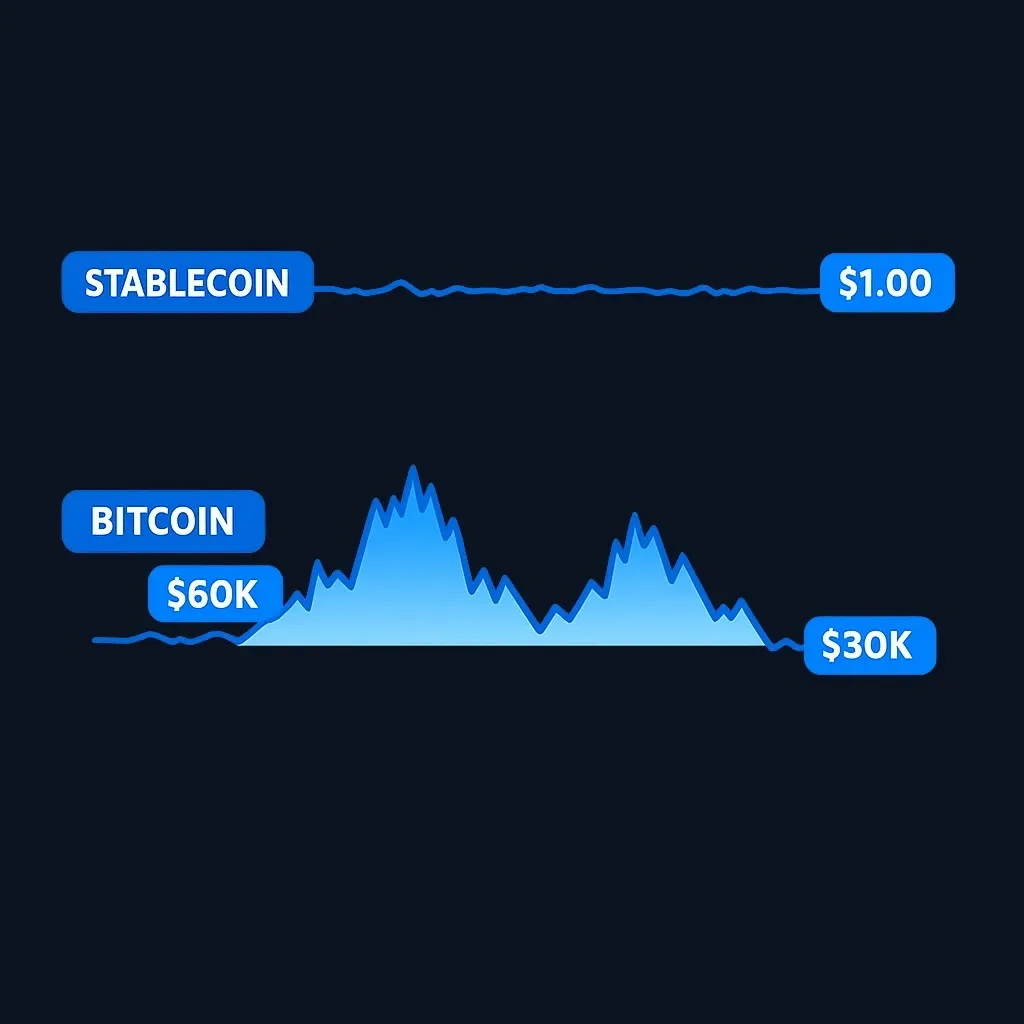
Bitcoin is a market-priced crypto asset. Its value changes based on supply, demand, liquidity, sentiment, and broader market conditions. That price movement is not a side issue; it is central to how many people evaluate Bitcoin.
CME Group’s Bitcoin education material points readers toward the CME CF Bitcoin Reference Rate and Bitcoin futures, which market participants can use to manage bitcoin volatility and risk CME Group. That tells you something important about Bitcoin’s role. People do not usually choose it because they need a stable invoice unit. They choose it when they want exposure to Bitcoin itself and can manage the uncertainty that comes with that exposure.
For comparison purposes, think of Bitcoin as the “price exposure” option and stablecoins as the “price predictability” option. That framing is more useful than asking which is universally better. They solve different problems.
Side-by-side comparison table
| Criterion | Stablecoins | Bitcoin |
|---|---|---|
| Main job | Keep crypto value easier to quote, transfer, and use in trading pairs | Provide exposure to bitcoin as a market-priced crypto asset |
| Price behavior | Designed for stability, but still subject to peg, issuer, liquidity, and network risks | Volatile enough that reference rates and futures are used to manage bitcoin volatility and risk CME Group |
| Common use pattern | Trading pairs, settlement, short-term parking of crypto value, payment-style workflows | Long-term exposure, speculative trading, portfolio experimentation, bitcoin-specific risk management |
| Trading role | Can pair with volatile tokens like bitcoin because stablecoins are cryptocurrencies themselves Fidelity | Often the volatile asset being traded, hedged, or measured |
| Main risk to watch | Peg failure, issuer weakness, reserve or collateral uncertainty, redemption friction, smart contract risk | Market volatility, custody mistakes, liquidity stress, transaction timing, behavioral risk |
| Best fit | Users who need predictable value over short periods | Users who accept price swings for bitcoin exposure |
| Poor fit | Users who assume “stable” means risk-free | Users who need exact value preservation for near-term payments |
The table shows the core tradeoff: stablecoins reduce one problem while adding another. They can reduce price uncertainty, but they introduce issuer, peg, and operational questions. Bitcoin avoids issuer-based peg risk, but it exposes the user to market volatility.
Decision criteria
1. What problem are you solving?
Start with the job, not the asset. If the job is “pay someone the equivalent of a known amount,” stablecoins usually match the problem better. If the job is “hold or trade bitcoin exposure,” Bitcoin is the relevant asset.
A common mistake is treating crypto as one broad category. That leads to poor fit. A contractor payout, a short-term trading balance, and a long-term speculative holding each require different risk controls.
2. How much price movement can you tolerate?
Price tolerance is the first real dividing line. Stablecoins are chosen when a user wants the transfer value to stay close to the intended unit. Bitcoin is chosen when the user accepts that the value may change before, during, or after the transaction.
This matters most when timing is tight. A business paying an invoice cannot easily explain why the payment value changed between approval and settlement. A trader, however, may accept price movement because exposure is the point.
3. Which risk do you prefer to manage?
Stablecoins and Bitcoin do not remove risk. They move the risk to different places.
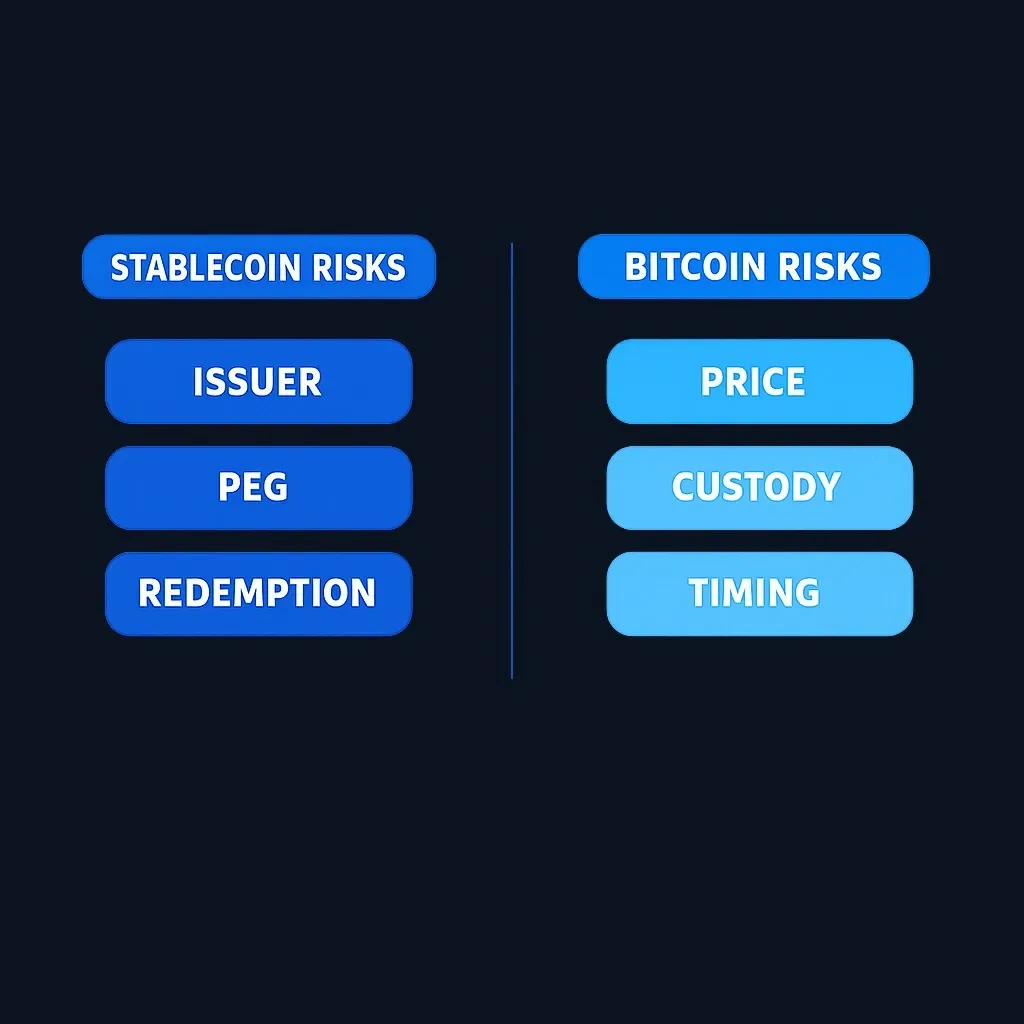
With stablecoins, you examine the issuer, collateral, redemption path, exchange support, wallet support, and network. With Bitcoin, you focus on price movement, custody, liquidity, execution timing, and whether you can emotionally tolerate drawdowns. CME Group’s discussion of Bitcoin reference rates and futures reflects that bitcoin volatility and risk often need active management CME Group.
A practical way to decide is to ask: “Would I rather manage peg and issuer risk, or market-price risk?” The answer often reveals the better fit.
4. How long will you hold it?
Time horizon changes the comparison. Stablecoins often fit short holding periods where the goal is to preserve a working balance. Bitcoin fits users who are evaluating longer exposure and can withstand volatility.
For example, a trader who exits a bitcoin position on Monday and wants to re-enter later may hold stablecoins as a trading pair. Fidelity notes that stablecoins can be an efficient trading pair for volatile tokens like bitcoin Fidelity. A different user who wants bitcoin exposure for years is making a separate decision.
5. What checks must happen before use?
Before using either option, run a short risk checklist:
- What is the purpose: payment, trading, holding, or settlement?
- What loss or price movement could you tolerate?
- Who controls the wallet or custody setup?
- Which exchange, wallet, or payment provider will handle conversion?
- What fees apply at purchase, transfer, and exit?
- What happens if liquidity dries up?
- What records will you need for accounting or taxes?
- What local rules apply to your situation?
- What internal approval is needed for a business use case?
- What is the fallback plan if a transfer fails or takes longer than expected?
This 10-point checklist prevents the most common error: choosing the asset before defining the workflow.
When to choose each option
Choose stablecoins when price predictability matters most
Stablecoins tend to fit payment-style and settlement-style tasks. If a business owes a contractor a known amount, price movement can create accounting friction. A stablecoin may fit that workflow better than Bitcoin because the goal is not upside exposure.
They can also help active traders stay within crypto markets. Fidelity explains that stablecoins may be used as trading pairs for volatile tokens like bitcoin because stablecoins are cryptocurrencies themselves Fidelity. That matters when the trader wants to reduce exposure without leaving the crypto ecosystem.
Stablecoins may also suit a user who wants to test wallet transfers with a more predictable unit. The risk is that predictability can create overconfidence. A user still needs to check the issuer, network, liquidity, and redemption route.
Choose Bitcoin when exposure is the purpose
Bitcoin makes more sense when the user wants bitcoin exposure and accepts volatility. That may include long-term holders, active traders, or market participants using tools designed around Bitcoin’s price. CME Group highlights Bitcoin futures and the CME CF Bitcoin Reference Rate as resources for managing bitcoin volatility and risk CME Group.
Bitcoin is a poor fit when the sender or receiver needs a stable near-term value. It can work for transfers, but the value can change while the user is deciding, sending, receiving, or converting. That makes it harder to use for payroll, invoicing, or budgeting without hedging or immediate conversion.
Worked example: freelancer payment vs. bitcoin exposure
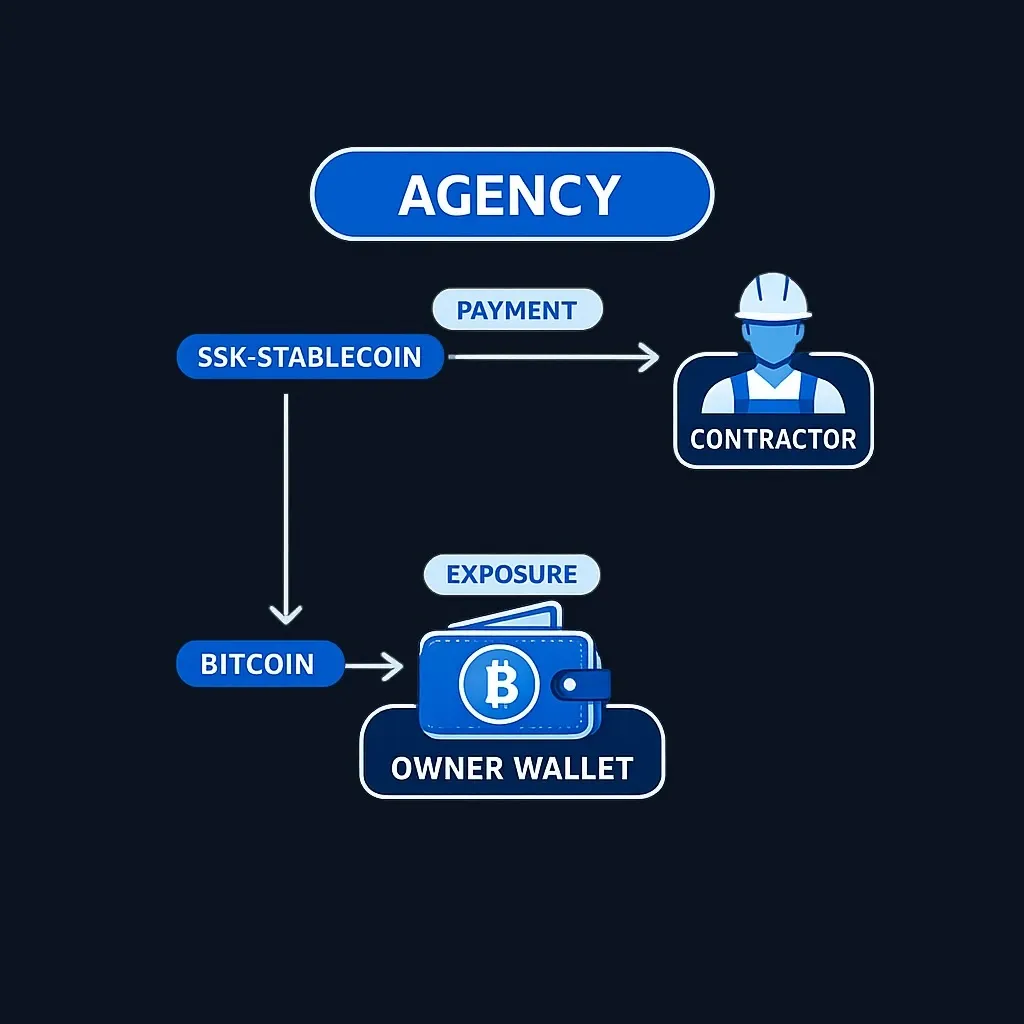
Imagine a design agency owes a contractor a fixed payment next week. The agency wants the contractor to receive value close to the agreed amount. In that case, a stablecoin workflow may be easier to manage, assuming the parties have checked custody, network, fees, and local rules.
Now imagine the agency owner personally wants long-term bitcoin exposure. That is a separate decision. Bitcoin might fit that goal if the owner accepts volatility and understands the custody setup, but it does not solve the contractor payment problem as cleanly.
This split is the key lesson. The same person can use stablecoins for operational transfers and Bitcoin for market exposure. The right tool depends on the job.
Tradeoffs and caveats
Stablecoin risks deserve more attention than the name suggests
The word “stablecoin” can make the product sound safer than it is. Stability is the design objective, not a promise that nothing can go wrong. A stablecoin can face stress if users lose confidence in the issuer, collateral, redemption process, or the trading markets around it.
Issuer risk is especially important. If a stablecoin depends on an organization that issues and redeems it, users need to understand that organization’s disclosures and controls. A reserve fund or collateral pool can reduce some concerns, but the user still needs to check quality, transparency, legal structure, and redemption terms.
There is also network risk. A stablecoin can exist on different blockchain networks, and the user must send it on the correct one. A correct token sent through the wrong network can create delays, failed deposits, or costly recovery steps.
Bitcoin risks are mostly about volatility, custody, and behavior
Bitcoin’s headline risk is price movement. CME Group’s materials point to Bitcoin futures and reference-rate tools that market participants can use to manage bitcoin volatility and risk CME Group. That does not make volatility disappear. It means serious users often need a plan for it.
Custody is another major issue. If a user controls private keys, they also carry responsibility for loss prevention. If a custodian controls access, the user must evaluate the custodian’s reliability, security practices, and withdrawal rules.
Behavioral risk can be just as damaging. Bitcoin’s price movement can push users into rushed decisions. A plan made during calm markets may fail when prices move quickly.
Market downturns affect them differently
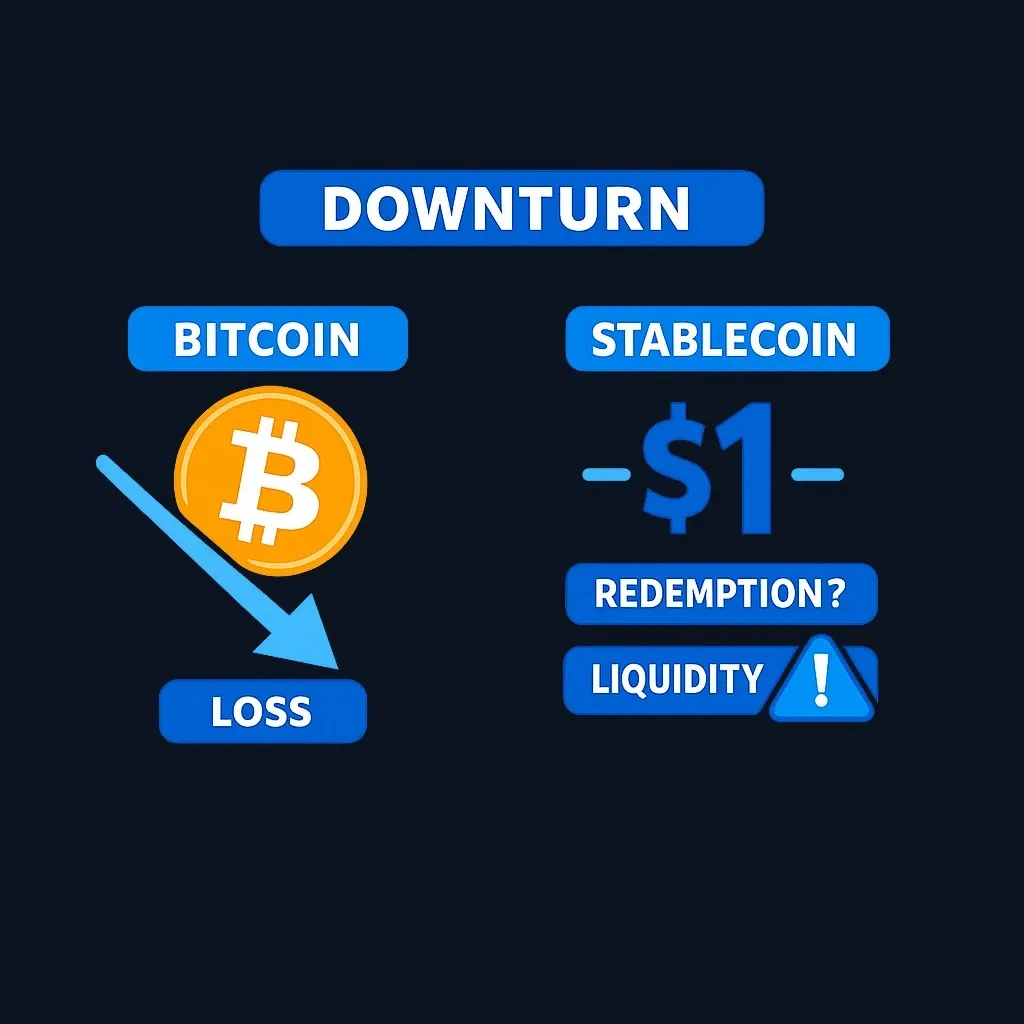
During crypto downturns, Bitcoin and stablecoins usually create different problems. Bitcoin exposes the holder to market-price losses. Stablecoins are intended to avoid that kind of price exposure, but they can face confidence, liquidity, or redemption pressure during stress.
That difference matters for planning. A trader holding Bitcoin through a downturn asks, “Can I tolerate the price move?” A stablecoin user asks, “Can I still redeem, transfer, or trade this asset as expected?” Those are not the same risk questions.
Regulatory and compliance uncertainty applies to both
Stablecoins and Bitcoin both operate in a changing regulatory environment. The issues are not identical. Stablecoins can raise questions about issuance, reserves, redemption, payments, and intermediaries. Bitcoin can raise questions about trading venues, custody, reporting, derivatives, and consumer protection.
For U.S. taxpayers, receiving digital assets as rewards or disposing of them can create federal reporting obligations; the IRS digital-assets page should be checked for the applicable tax year (IRS). Businesses considering crypto payment or treasury use also need accounting, tax, custody, sanctions, consumer, and state-law review appropriate to their activities.
Practice investing with Finelo
Build practical investing skills with guided lessons, simulator practice, and structured challenges.
When stablecoins and Bitcoin can work together
Stablecoins vs. Bitcoin is not always an either-or decision. Many users treat them as different tools in the same crypto workflow. One asset provides a working unit for transfers and trading pairs, while the other provides bitcoin-specific exposure.
A trader might sell Bitcoin into a stablecoin position, wait for a new setup, and later buy Bitcoin again. Fidelity’s point about stablecoins as trading pairs for volatile tokens like bitcoin supports that use case Fidelity. The stablecoin is not the investment thesis. It is the staging asset.
A business can also separate operational funds from treasury exposure. Operational balances may prioritize predictable value. Long-term reserves, if used at all, require a separate risk policy, approval process, and custody plan.
This approach avoids a common mistake: forcing one crypto asset to do every job. Stablecoins and Bitcoin are easier to compare when each one is judged by its intended role.
Bottom line
The comparison begins with the intended use. A person evaluating stablecoins should focus on the peg, issuer or protocol, reserves, redemption, custody, and network. A person evaluating Bitcoin should focus on price volatility, custody, liquidity, fees, and loss capacity. Neither category is a substitute for insured cash merely because it can be transferred digitally.
The practical answer is not “stablecoins are safer” or “Bitcoin is better.” The better question is: which risk matches your objective? Choose based on purpose, time horizon, liquidity needs, custody setup, fees, regulation, and your ability to handle loss.
FAQ
What are the main differences between stablecoins and Bitcoin?
Stablecoins are designed for price predictability and are often used for transfers, settlement, and trading pairs. Bitcoin is a market-priced crypto asset, and CME Group notes that market participants use Bitcoin futures and reference-rate tools to manage bitcoin volatility and risk CME Group.
How do stablecoins maintain their value?
Stablecoins aim to maintain value through a peg mechanism, which can involve issuer reserves, collateral, market incentives, or a combination of controls. Before relying on one, review how it is issued, what supports the peg, and whether redemption is practical under stress.
What are the risks of using stablecoins?
Stablecoin risks include peg failure, issuer weakness, reserve or collateral concerns, redemption delays, exchange liquidity problems, smart contract risk, and network mistakes. The key issue is that stable value is the goal, not a guarantee.
When should I use stablecoins instead of Bitcoin?
Stablecoins may fit better when you need predictable value for a payment, trading balance, or short-term transfer. Bitcoin may fit better when you want bitcoin exposure and accept volatility, especially if you understand how that risk will be managed.
Sources and Further Verification
More from Finelo
- Bitcoin vs. Ethereum: Uses, Costs, Risks, and Key Differences
- REIT vs. Rental Property: Costs, Income, Liquidity, and Key Trade-Offs
- 1031 Exchange vs. Opportunity Zone: Key Differences
Disclaimer
This article is provided by Finelo for educational and informational purposes only. Finelo does not provide financial, investment, tax, legal, or insurance advice. Consider your circumstances and consult an appropriately qualified professional before making financial decisions.
InvestingBeginner GuideFinancial Education
Practice investing with Finelo
Build practical investing skills with guided lessons, simulator practice, and structured challenges.
About the author
Finelo Team
The Finelo Team creates practical investing and trading education designed to help beginners learn faster with structured challenges, simulator practice, and bite-sized lessons.
Keep reading — Related articles

Investing
Yield to Call vs Yield to Maturity: Assumptions and Bond Risks
Yield to call (YTC) estimates a bond's yield if the issuer redeems it on an eligible call date; yield to maturity (YTM) estimates yield if it remains outstanding to final maturity.
Finelo Team

Investing
Will My Employer Know If I Take a 401(k) Loan?
Who this page is for: readers new to 401(k) loans who want a practical, privacy‑focused explanation — what your employer can see, how to limit visibility, and the financial tradeoffs to weigh.
Finelo Team

Investing
What Medical Expenses Qualify for a 401(k) Hardship Withdrawal?
Before you decide, confirm three things with your plan administrator:
Finelo Team


