Last editorial review: September 8, 2026
How to Find and Claim Unclaimed Stocks: A Step-by-Step Guide

Unclaimed stocks are shares, dividends, or other financial assets a company or financial institution lost contact with because the owner didn’t respond to communications. Start by searching…
7 min read
Practice investing with Finelo
Build practical investing skills with guided lessons, simulator practice, and structured challenges.
Want to learn more?
Build practical investing skills with guided lessons, simulator practice, and structured challenges.
Explore FineloExplore Finelo's 28-day challenges
Turn learning into a daily habit with guided challenge paths.
U.S. scope: This article discusses U.S. institutions, financial products, tax rules, and dollar examples unless stated otherwise. Rules and product terms may change; verify current official guidance for your situation.
Quick answer
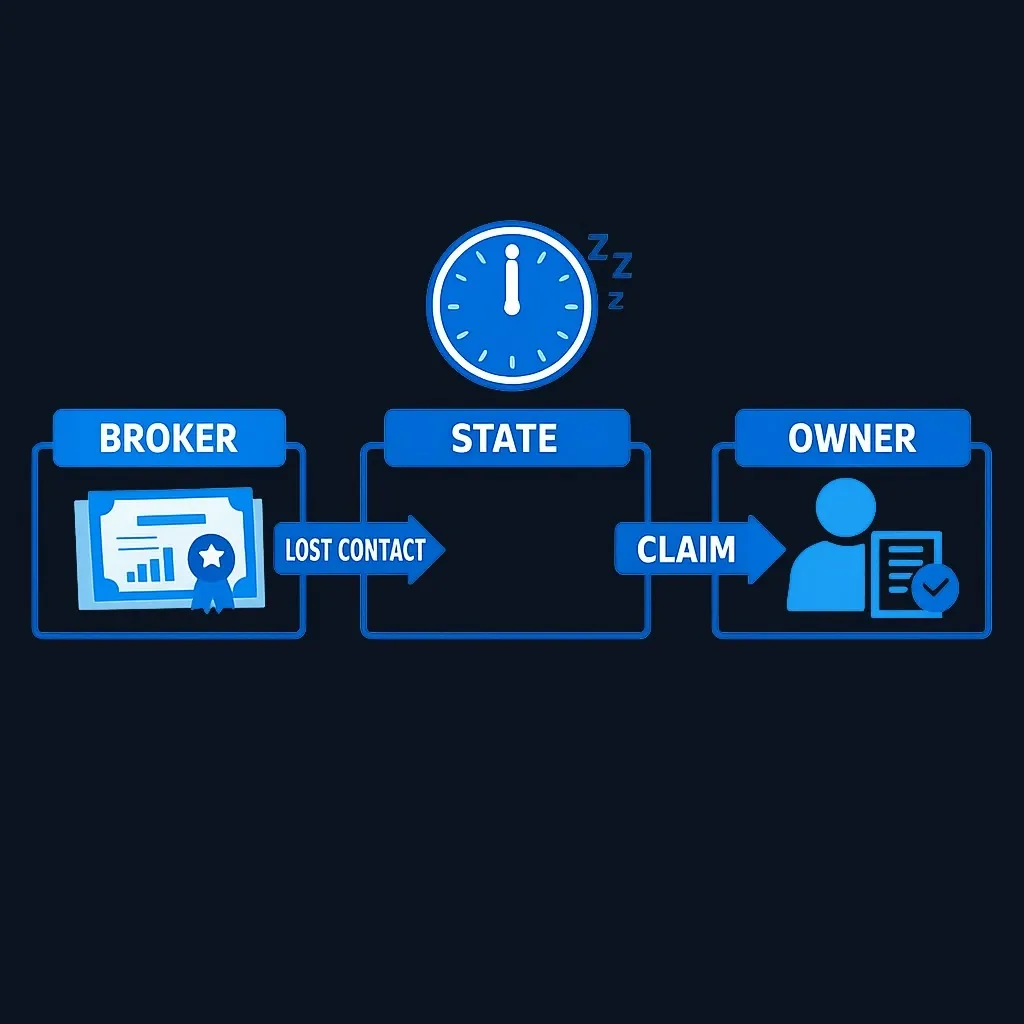
Unclaimed stocks are shares, dividends, or sale proceeds transferred to a state unclaimed-property program after the holder lost contact with the owner and the applicable dormancy and reporting process ran. Most unclaimed property is held by state governments, and there is no single federal search database, so start with the official program for each state where you have lived (USAGov).
What to know before deciding
This page is educational, not financial or legal advice. Reclaiming assets usually requires paperwork and proof of ownership; procedures and time limits differ by state. Finelo produces educational content to help you research and prepare. Verify exact rules and deadlines on the state office website before filing a claim.
Key early points
- States hold most unclaimed property, which can include securities and other financial assets; use each state's official search linked through USAGov.
- Searching state databases is free; recovery may require identity documents, proof of prior ownership, and patience for processing (Fidelity: 6 ways to find unclaimed money).
Decision framework
Use this quick framework to decide whether to pursue a claim: likely match, effort vs. value, and timing/legal window.
Quick checklist (decide then act)
- Likelihood: Do you have an account number, old statement, dividend notice, W-2, or employer records pointing to the asset? If yes, the match probability is higher (Fidelity).
- Effort vs. value: Searching is free, but gathering documents and responding to requests takes time. Prioritize claims that appear to have meaningful value.
- Timing: States set dormancy and notice rules; some assets can be turned over to public funds after a statutory waiting period (Wisconsin statute example). Check the state office for your exact deadlines.

Step-by-step claiming checklist (use this table to act)
| Step | What to do | Why it matters |
|---|---|---|
| 1. Search official state databases | Start with the state-office links collected by USAGov; search every state where the owner lived or did business. | There is no single federal database, and the reporting state can depend on the holder's records. |
| 2. Compare identifying details | Match name variants, former addresses, and identifying numbers from the record to your documents (Fidelity) | Companies sometimes remit assets under an old name or address; careful matching avoids false claims. |
| 3. Start the official claim | Use the state's online form or printable claim packet; for example, California publishes its search and claim instructions through the State Controller. | State requirements control the review; a third-party finder cannot waive them. |
| 4. Provide supporting documents | Typical items: government ID, proof of former address, account statements, employer or transfer records. Keep certified copies if requested (Fidelity) | Proper documentation speeds review and reduces back‑and‑forth. |
| 5. Wait for review and follow up | Processing time varies by state; respond promptly to requests for more evidence (California State Controller) | States may return cash, reissue securities, or instruct you how to receive the asset. |
Worked example (realistic scenario)
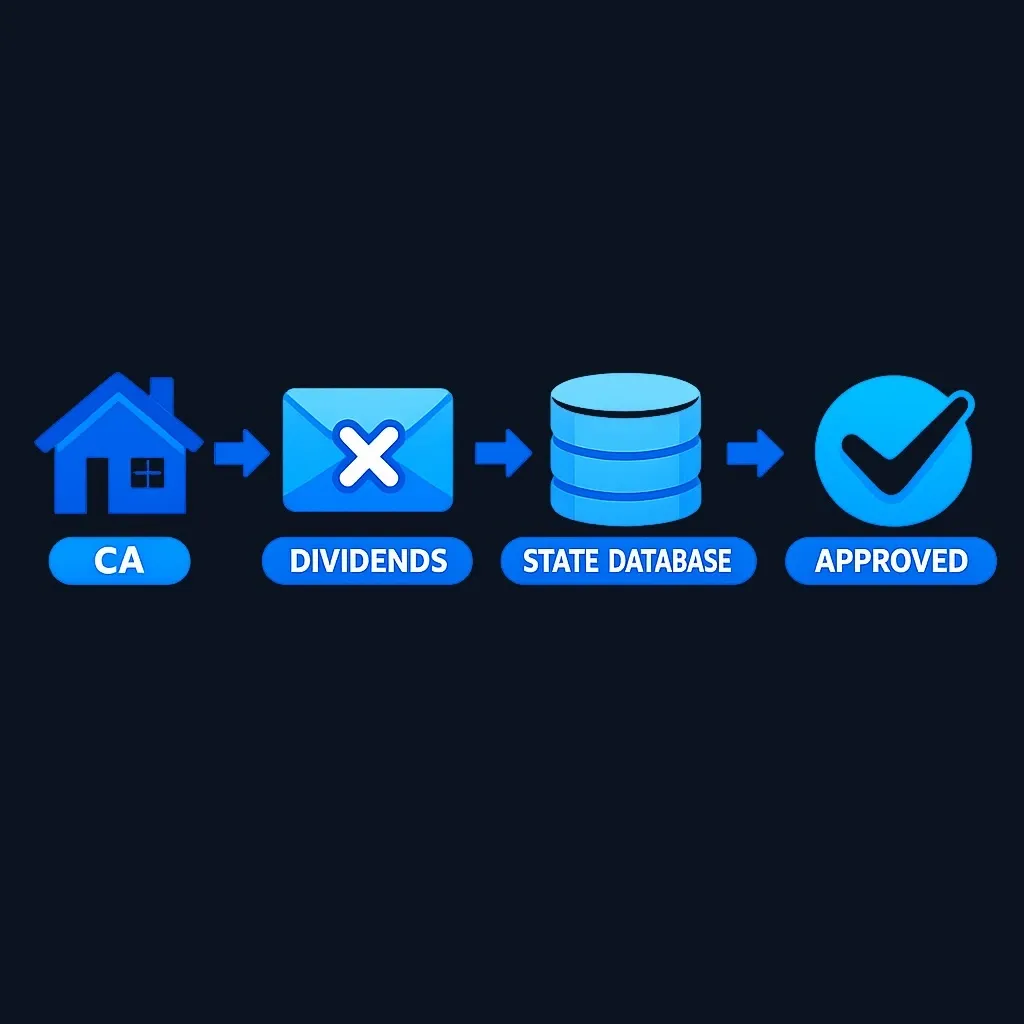
Suppose you moved states and never closed a brokerage account that paid dividends. Search the official unclaimed-property program for that state. If a listing appears to match, follow the exact state instructions; documentation varies by claimant and property type. The office may approve the claim, deny it, or request more evidence. California, for example, publishes claimant instructions and required forms through the State Controller.
Types of Unclaimed Stocks and Property
States often list many asset types as unclaimed property. Representative categories include:
- Bank accounts and safe‑deposit box contents (California State Controller).
- Stocks, mutual funds, bonds, dividends, and unclaimed brokerage proceeds, depending on the state's law and records.
- Uncashed cashier’s checks, money orders, and matured insurance proceeds (California State Controller).
- Estates, trust funds, escrow accounts, and similar fiduciary holdings (California State Controller).
Practical takeaway: if you ever held a brokerage account, received dividends, had an old bank account, or were paid by a former employer, those are the first asset types to check.

State-Specific Guidelines for Claiming Unclaimed Property
Each state runs its own unclaimed‑property program and sets dormancy periods, notice requirements, and claim procedures. Practical steps:
- Find the relevant state controller or treasurer's unclaimed-property page through USAGov.
- Check the state's dormancy, notice, documentation, and heir-claim procedures. Do not import a deadline or document list from another state.
- Search each state where you lived, worked, or owned property. Assets are commonly reported to the owner’s last known address or the state where the holder is located.
Tip: Keep a short list of former addresses and employers to guide multi‑state searches.

Practice investing with Finelo
Build practical investing skills with guided lessons, simulator practice, and structured challenges.
Legal Rights of Heirs in Claiming Unclaimed Funds
Heirs can often claim unclaimed property that belonged to a deceased person, but states require documentation and sometimes probate or estate‑related forms. Steps heirs typically follow:
- Start at the official program for the decedent's last known state and any other state that may hold the property; the site will list claimant categories and required documents.
- Prepare proof of your relationship and the decedent’s death certificate. Some states request probate documents or letters of administration depending on the asset and amount.
- Follow the state's instructions for deceased-owner or heir claims; probate documents may be required depending on the claimant's authority, asset, and state law.
Practical legal note: requirements vary widely; consult the specific state page before assembling paperwork.
Common Mistakes to Avoid When Claiming Unclaimed Stocks
- Relying only on third‑party recovery companies. Start with official state databases and forms because state offices are the authoritative source (California State Controller).
- Misreading listings. Names, former addresses, or company names may differ; confirm identifiers before filing a claim (Fidelity).
- Submitting incomplete documentation. States often reject or delay claims that lack clear proof of identity or ownership.
- Failing to respond to state requests. Missing documentation can delay or prevent approval even when the listing appears to match.
- Assuming all assets are returned quickly. Processing times vary; follow up if processing exceeds the state’s published estimates.
Avoid these mistakes by using the state’s official instructions and by preparing certified or clear copies of supporting documents when requested.
FAQ
What is unclaimed money?
Unclaimed money or property includes assets transferred to a state program after a holder lost contact with the owner and the applicable reporting process ran. Categories can include bank accounts, securities, dividends, checks, and other property; exact definitions vary by state (USAGov).
How can I find unclaimed money owed to me?
Begin with official state programs linked through USAGov. Search name variants and former addresses, then submit documents only through the official state site.
How long does a state hold unclaimed property before using it?
Dormancy periods, reporting rules, and the state's treatment of the property differ. Check the controlling state statute and the official unclaimed-property office rather than relying on a national rule.
Can I claim unclaimed property for a deceased relative?
An heir or authorized estate representative may be able to file, but the required authority and documents vary. Start with the state's deceased-owner claim instructions; California, for example, lists different documentation for owners, heirs, trustees, and business claimants (California State Controller).
If you think you have an unclaimed asset, start with your state controller or treasurer’s unclaimed property search and gather any supporting documents before filing a claim (California State Controller; Fidelity).
Sources and Further Verification
- Fidelity: 6 ways to find unclaimed money
- USAGov: Find unclaimed money
- California State Controller: unclaimed-property search
- California State Controller: claim instructions
More from Finelo
- 1031 Exchange vs. Opportunity Zone: Key Differences
- 83(b) Election: Deadlines, Tax Risks, and When Early Filing May Fit
- After-Tax 401(k) vs. Roth 401(k): Key Differences
Disclaimer
This article is provided by Finelo for educational and informational purposes only. Finelo does not provide financial, investment, tax, legal, or insurance advice. Consider your circumstances and consult an appropriately qualified professional before making financial decisions.
InvestingBeginner GuideFinancial Education
Practice investing with Finelo
Build practical investing skills with guided lessons, simulator practice, and structured challenges.
About the author
Finelo Team
The Finelo Team creates practical investing and trading education designed to help beginners learn faster with structured challenges, simulator practice, and bite-sized lessons.
Keep reading — Related articles

Investing
Yield to Call vs Yield to Maturity: Assumptions and Bond Risks
Yield to call (YTC) estimates a bond's yield if the issuer redeems it on an eligible call date; yield to maturity (YTM) estimates yield if it remains outstanding to final maturity.
Finelo Team

Investing
Will My Employer Know If I Take a 401(k) Loan?
Who this page is for: readers new to 401(k) loans who want a practical, privacy‑focused explanation — what your employer can see, how to limit visibility, and the financial tradeoffs to weigh.
Finelo Team

Investing
What Medical Expenses Qualify for a 401(k) Hardship Withdrawal?
Before you decide, confirm three things with your plan administrator:
Finelo Team