A straddle is an options strategy for traders who expect a big move but do not know which way it will go. A long straddle means buying a call and a put on the same stock, at the same at-the-money strike and the same expiration.
Straddle Options: Payoffs, Breakevens, and Risks
A long straddle combines a call and a put at the same strike and expiration. Learn its payoff, two breakeven prices, premium costs, and the risks of the short version.
8 min read
Practice trading with Finelo
Practice in a simulator, learn with bite-sized lessons, and build confidence before risking real money.
Want to learn more?
Practice in a simulator, learn with bite-sized lessons, and build confidence before risking real money.
Explore FineloExplore Finelo's 28-day challenges
Turn learning into a daily habit with guided challenge paths.
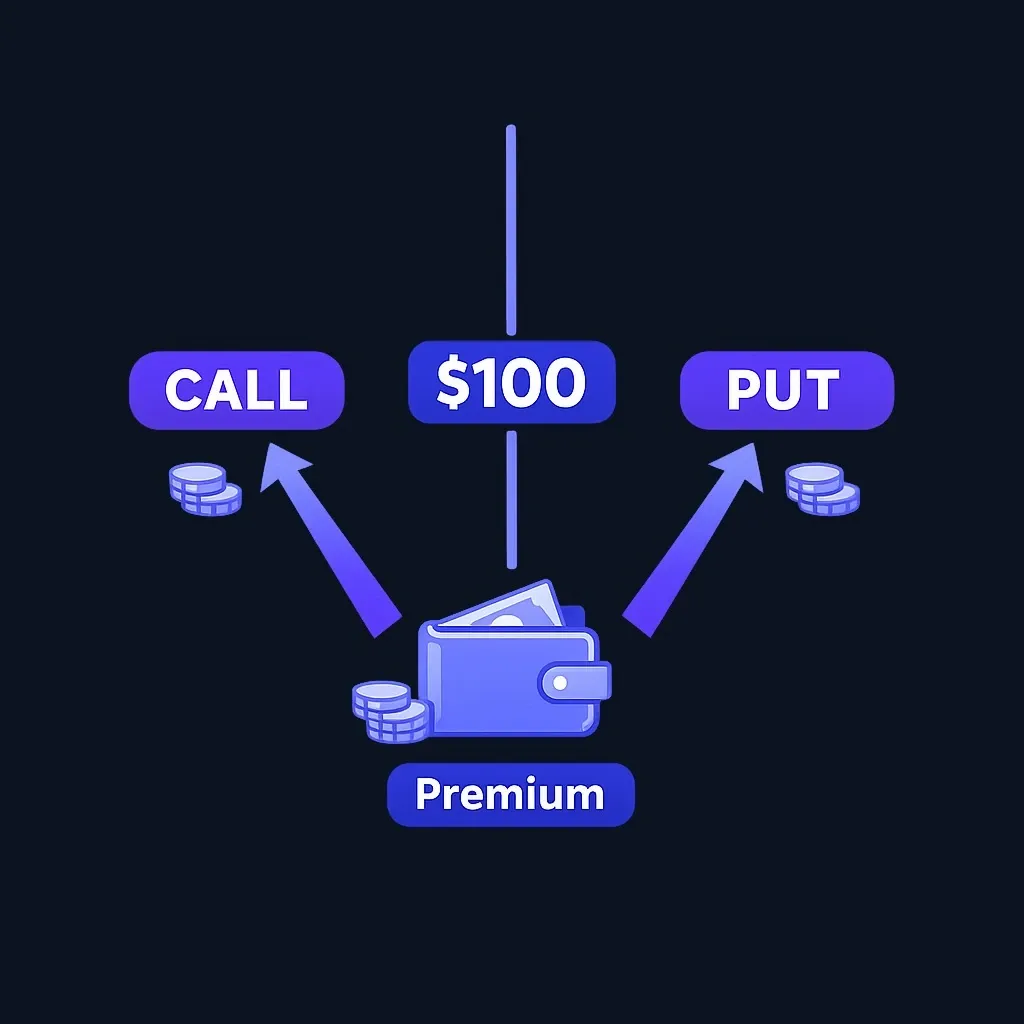
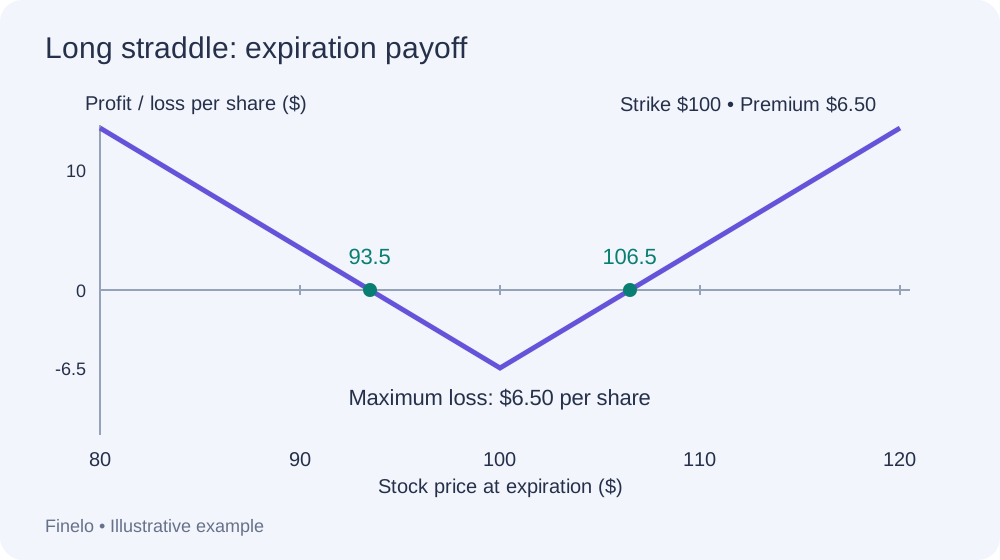
Because you own both directions, you profit if the stock moves far enough either up or down, and "far enough" has a precise meaning: past the strike price plus or minus the total premium you paid. If a 100-dollar-strike straddle costs 6.50, the stock has to finish above 106.50 or below 93.50 to make money at expiration.
The most you can lose is the premium you paid, and that worst case lands if the stock sits exactly at the strike. You are not picking a direction, you are betting the move will be bigger than the price you paid for both options.
This guide is for early-intermediate learners who already know what calls and puts are and want the volatility play explained plainly. If those basics are still settling in, start with options trading for beginners; this page builds directly on them.
A straddle buys you out of the direction question, and bills you two premiums for it.
How a long straddle works
A long straddle has exactly two legs, opened together: you buy one at-the-money call, which profits if the stock rises, and one at-the-money put at the same strike and expiration, which profits if the stock falls.
You pay two premiums, and their sum, the debit, is the most the position can lose. At entry the straddle is roughly delta-neutral, because the call's bullish exposure and the put's bearish exposure cancel out, so small wiggles barely move the profit or loss.
What you actually own is exposure to movement itself: a large move in either direction makes one leg worth far more than both cost together, while the other leg expires worthless.
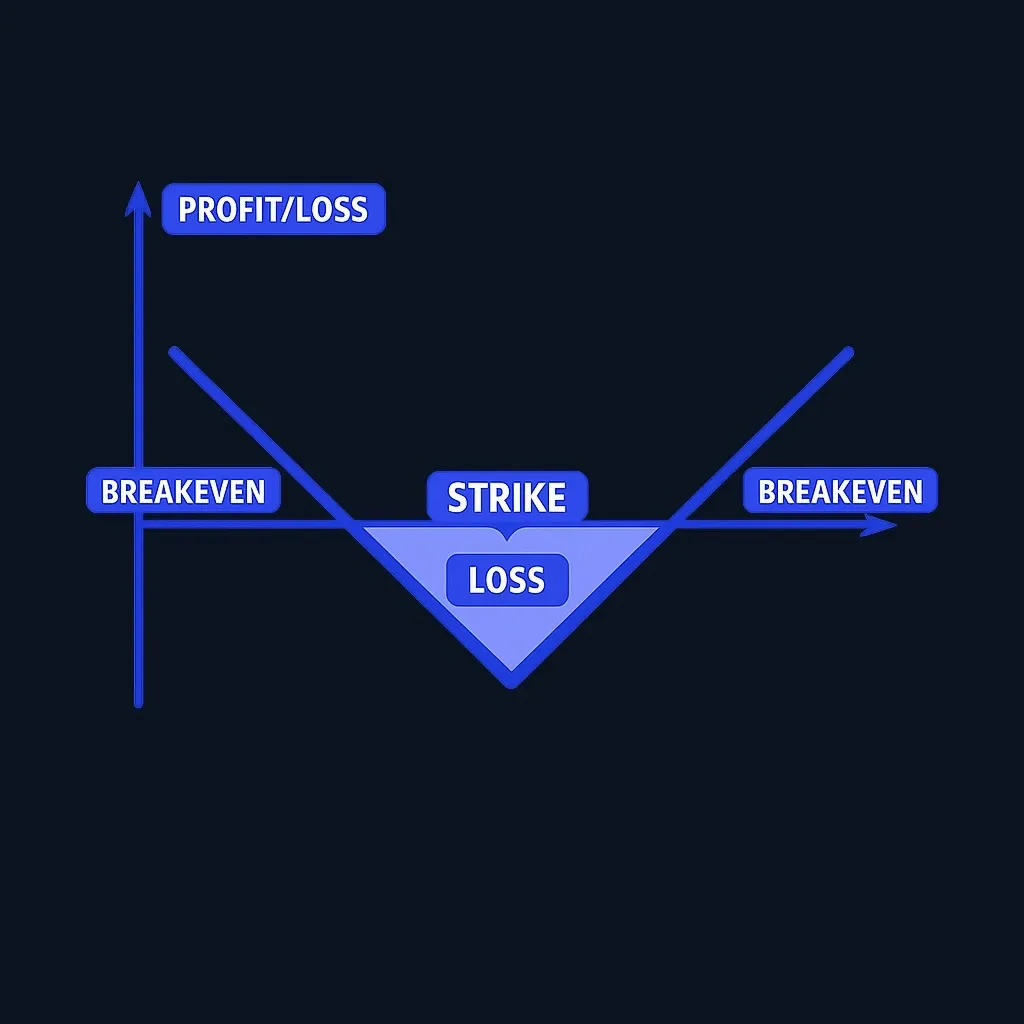
Plotted at expiration, the payoff is a V. The loss is deepest at the strike, it shrinks as the stock travels away in either direction, and it turns to profit past the two breakevens, unlimited on the upside because the stock can keep rising, and substantial on the downside because the stock can fall all the way to zero.
The breakeven math: a worked example
All figures here are illustrative. A stock trades at 100 dollars. A 30-day 100-strike call costs 3.30 and the 100-strike put costs 3.20, for a total debit of 6.50 per share, or 650 dollars for the pair of contracts (each covers 100 shares).
The breakevens sit one total premium away from the strike on each side: 100 plus 6.50 is 106.50 on the upside, and 100 minus 6.50 is 93.50 on the downside. Here is the position at expiration across five prices:
| Stock at expiration | Call worth | Put worth | Net profit or loss |
|---|---|---|---|
| $85 | $0 | $15.00 | +$8.50 |
| $93.50 | $0 | $6.50 | $0 (breakeven) |
| $100 | $0 | $0 | −$6.50 (max loss) |
| $106.50 | $6.50 | $0 | $0 (breakeven) |
| $115 | $15.00 | $0 | +$8.50 |
Read the table and the pattern is stark: the position loses everywhere between 93.50 and 106.50, and the loss is deepest at 100, the strike where it started. Even a five dollar move, respectable for a single month, still finishes slightly in the red here.
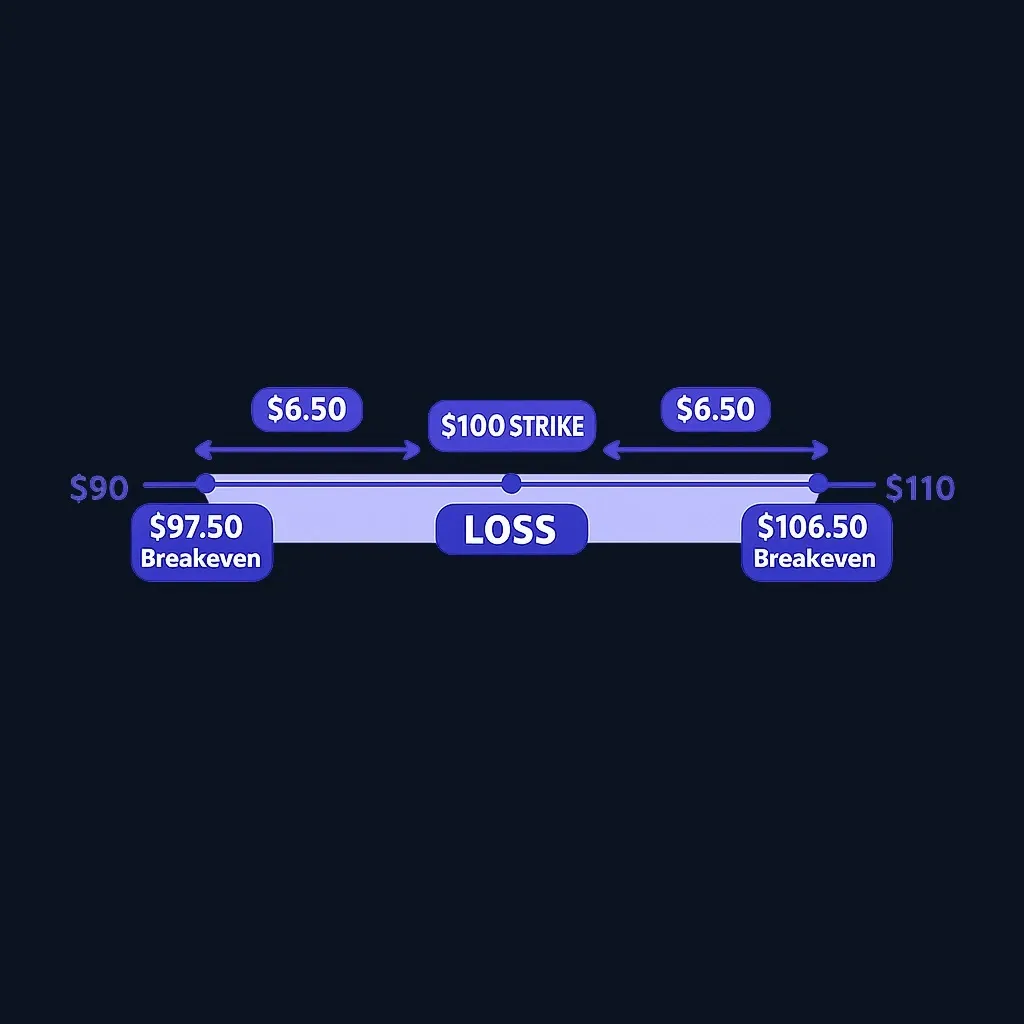
A straddle turns a simple question, will the stock move, into a harder one: will it move more than you paid for both options.
When traders use straddles
Straddles cluster around scheduled uncertainty: earnings announcements, drug-trial or regulatory decisions, court rulings, product launches, and major economic releases, moments when a large move looks likely but its direction is genuinely unknown. Some traders also buy them when they expect volatility to expand broadly, since rising implied volatility lifts the value of both legs even before the stock commits to a direction.
One honest caveat belongs in the same breath as the use case. Option prices already fold in the market's estimate of the coming move, so the premium you pay is not a discount on a surprise, it is the market's own forecast with a markup.
If you actually lean one way, a defined-risk directional play such as a bull call spread usually fits that view at far lower cost than paying for both sides of a straddle.
The more obvious the catalyst, the more of its expected move you have already paid for in the premium.
What can go wrong
The first enemy is time. A straddle owns two options, so it pays two lots of time decay, and every flat day chips away at both legs at once. As Fidelity notes in its own strategy guide, a long straddle tends to bleed value quickly when time passes and the stock does not move, and that decay only accelerates as expiration nears, which is exactly when you are still waiting for the move.
The second, and often the more brutal around events, is falling implied volatility. Premiums inflate before earnings and deflate the instant the uncertainty resolves, the effect traders call the volatility crush. The result can feel deeply unfair: the stock gaps four percent overnight, and the straddle still loses, because a five percent move was already priced in and the volatility premium in both legs evaporated at the open.
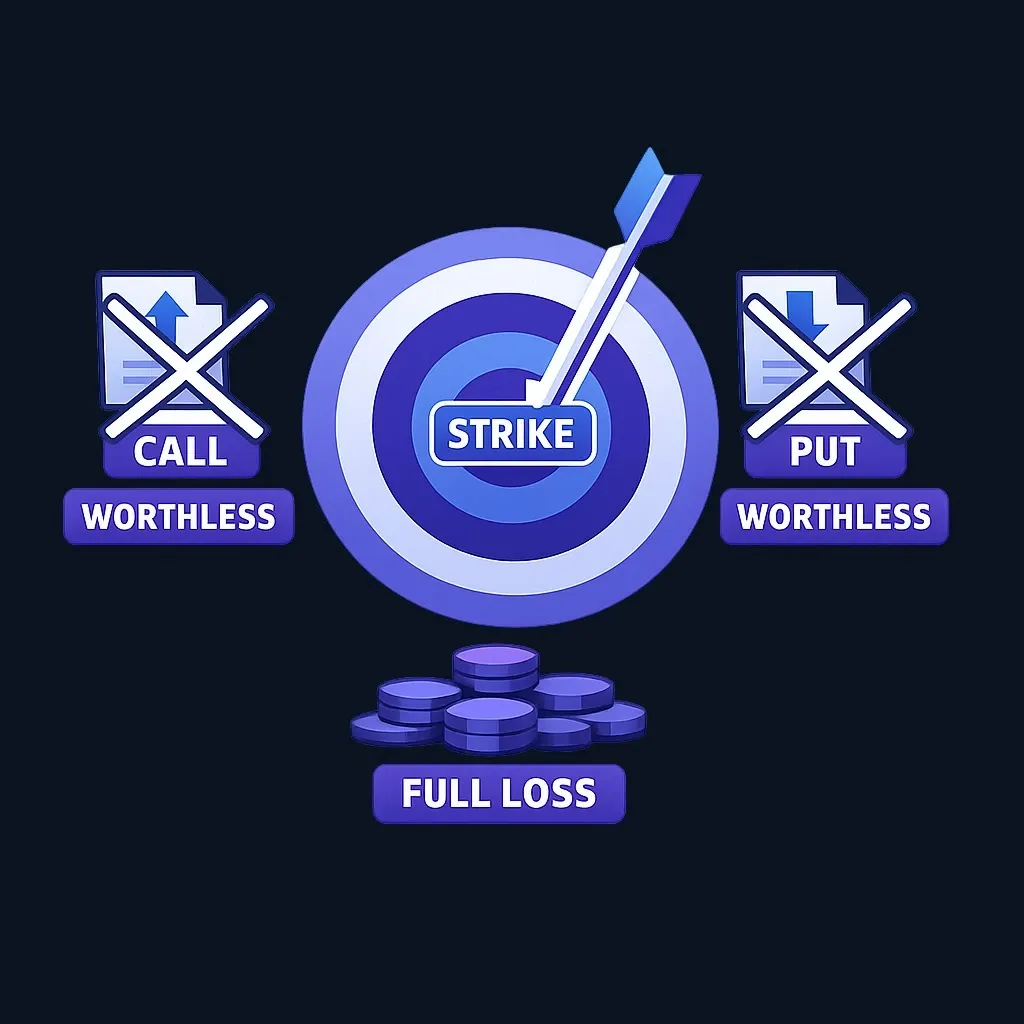
The worst single outcome is the pin, the stock finishing right at the strike, where both legs expire worthless and the entire debit is gone. It is the mirror image of what the option Greeks promised at entry: a position built for movement is punished hardest by stillness.
Practice trading with Finelo
Practice in a simulator, learn with bite-sized lessons, and build confidence before risking real money.
The short straddle
Everything above can be flipped. A short straddle sells the at-the-money call and put, collects both premiums, and profits if the stock stays near the strike while time decay works in the seller's favor. It is the stagnation bet, and it carries the opposite risk profile, which is where the danger lives.
The credit collected is the most a seller can make, while the loss is open-ended: theoretically unlimited if the stock rallies through the short call, and severe if it crashes through the short put. Brokers require margin and elevated approval for exactly this reason. This page describes short straddles so you can recognize one, and it is deliberately not a guide to trading them.
If the mechanics of obligation and assignment at expiration are new to you, that is a sign this side of the trade is not for you yet, and strict risk management is non-negotiable for anyone who does use it.
A short straddle collects a little premium for the chance to lose a lot, which makes it an advanced position, not an income shortcut.
Straddle vs strangle
The straddle's closest relative is the strangle, the same two-legged, direction-neutral idea with one structural change: the strikes. A straddle uses the same at-the-money strike for both legs; a strangle uses two out-of-the-money strikes, a higher call and a lower put.
| Straddle | Strangle | |
|---|---|---|
| Strikes | Same strike for call and put | Two different strikes |
| Moneyness | Both legs at the money | Both legs out of the money |
| Cost | Higher, two at-the-money premiums | Lower, often roughly half |
| Breakevens | Closer to the current price | Further away, needs a bigger move |
| Full-loss zone | Only at the exact strike | The whole range between the strikes |
| Trade-off | Pay more, need less movement | Pay less, need more movement |
Same bet, different price-versus-probability trade: the straddle charges more and forgives smaller moves, while the strangle is cheaper but expires completely worthless anywhere between its two out-of-the-money strikes. Which one is "better" depends entirely on how large a move you expect and what the premiums cost that day.
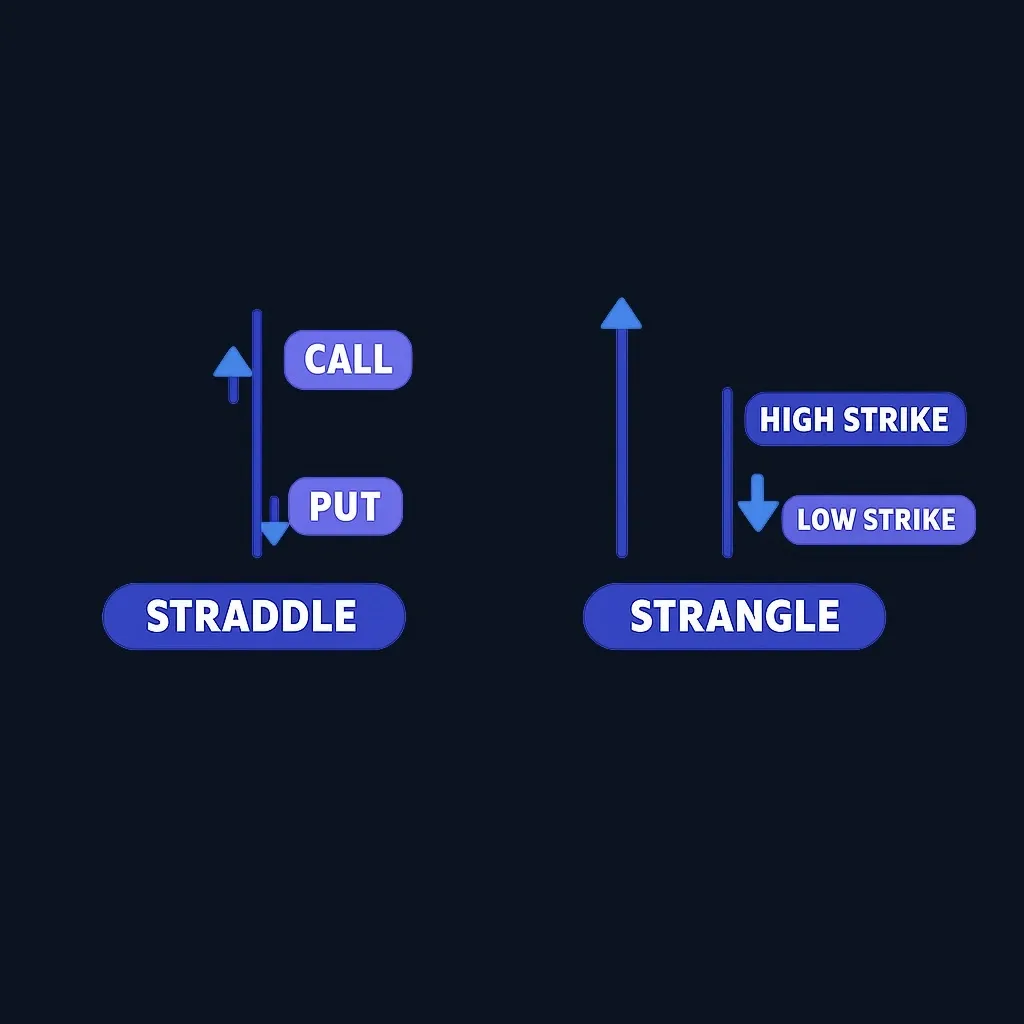
For the full mechanics of the cheaper sibling, its strike selection, its own breakeven math, and worked examples, see Finelo's guide to the strangle option strategy.
Costs and practical considerations
A straddle pays retail frictions twice: two premiums, two bid-ask spreads, and commissions on two legs, so liquid underlyings with tight options markets matter more here than for a single-leg trade. It also helps to remember that you do not have to hold to expiration.
Many traders exit once the move, or the volatility pop, has happened, selling both legs while the winning side is still rich and the losing side keeps some value. And check what happens to your options at expiration before holding one that long, because an in-the-money leg left open can turn into a stock position you never intended to hold.
Next steps
The test of understanding a straddle is not reciting the two legs, it is the breakeven sentence: I profit only if the stock moves more than the total premium, in either direction, before expiration. If you can also explain why an earnings straddle can lose even when the stock moves, you understand this strategy better than most people trading it.
From here, build the concepts underneath it: the option Greeks that price every leg, and the strangle that trades the same idea for a lower price and a wider miss.
Inside the Finelo app, you can study how options behave and practice buy, sell, and hold decisions on real market data with virtual funds. There are no deposits, no withdrawals, and no broker connection, it is a closed practice loop, so the only cost of a wrong read is the lesson. To go deeper, Finelo publishes educational material for beginners, and you can check Finelo reviews, the About Finelo page, or the Finelo support center.
Final decisions are always yours. Understanding a strategy is what lets you judge when its cost is worth paying.
Educational note: This article is for educational purposes only and does not constitute financial, investment, legal, or tax advice. Finelo is an educational product, not a brokerage or adviser. Simulator practice uses virtual funds. Investing and trading involve risk, including possible loss of principal; verify account-specific requirements with your broker.
Sources and Further Verification
Frequently asked questions
What is a straddle in options trading?
A long straddle is buying a call and a put on the same underlying, at the same strike (usually at the money) and the same expiration. It profits if the stock finishes beyond the strike plus or minus the total premium, in either direction, and the most you can lose is the premium paid.
Is a straddle a good option strategy?
It is a tool, not an edge. It earns its cost only when the real move beats the one the market already priced in, and around events premiums inflate because a move is expected. You get defined risk and no need to pick direction, in exchange for high cost and double time decay.
Which is more profitable, a straddle or a strangle?
Neither is inherently more profitable, they price the same bet differently. The straddle costs more but profits on smaller moves; the strangle costs less but needs a bigger move and loses everything anywhere between its two strikes. The right choice depends on the expected move size against that day's premiums.
How does a straddle lose money?
Three main ways: the stock does not move enough to clear both premiums; time decay erodes both legs while you wait; or implied volatility collapses after an event, deflating both options even if the stock moved. The full premium is lost only if the stock expires exactly at the strike.
What is a short straddle?
Selling both the at-the-money call and put to collect premium, profiting if the stock stays near the strike. Its risk is open-ended in both directions, theoretically unlimited on a rally and severe on a crash, which makes it an advanced, margin-intensive position that is unsuitable for beginners.
Straddle OptionsTradingBeginner
Practice trading with Finelo
Practice in a simulator, learn with bite-sized lessons, and build confidence before risking real money.
About the author
Finelo Team
The Finelo Team creates practical investing and trading education designed to help beginners learn faster with structured challenges, simulator practice, and bite-sized lessons.
Keep reading — Related articles
Trading
Understanding Walk Forward Analysis in Trading
Brief educational note: this article is educational — not investment advice — and trading involves the risk of loss.
Finelo Team
Trading
VWAP vs Moving Average: Formulas, Uses, and Limits
VWAP weights price by recorded volume over a defined period, while a moving average summarizes a sequence of prices over a rolling lookback.
Finelo Team
Trading
Volume Profile vs Market Profile: What Each Chart Measures
Volume Profile groups traded volume by price level.
Finelo Team


